AbdulHakam Shafiu Abdullahi , Umar Mustapha , Omer Ahmed Taialla , Esraa Kotob , Ijaz Hussain , Khalid Alhooshani , Shehzada Muhammad Sajid Jillani , Saheed A. Ganiyu
{"title":"Enhancing the electrochemical conversion of carbon dioxide to value-added products on zinc oxide-MXene nanocomposite","authors":"AbdulHakam Shafiu Abdullahi , Umar Mustapha , Omer Ahmed Taialla , Esraa Kotob , Ijaz Hussain , Khalid Alhooshani , Shehzada Muhammad Sajid Jillani , Saheed A. Ganiyu","doi":"10.1016/j.jcis.2025.137487","DOIUrl":null,"url":null,"abstract":"<div><div>Developing efficient and sustainable catalysts for CO<sub>2</sub> electroreduction is critical to addressing the rising atmospheric CO<sub>2</sub> levels and mitigating climate change. This study presents a novel ZnO-MXene (Ti<sub>2</sub>C) nanocomposite as a high-performance electrocatalyst for CO<sub>2</sub> conversion, offering a strategic approach for generating valuable carbon-based feedstocks. The ZnO-MXene nanocomposites were synthesized via the wet impregnation method and comprehensively characterized using X-ray diffraction (XRD), energy-dispersive X-ray spectroscopy (EDS), field emission scanning electron microscopy (FESEM), transmission electron microscopy (TEM), and Fourier transform infrared spectroscopy (FTIR). Electrochemical performance was assessed through linear sweep voltammetry (LSV), cyclic voltammetry (CV), and controlled potential coulometry, with gas chromatography employed for product quantification. ZnO-MX<sub>10</sub> and ZnO-MX<sub>2.5</sub> exhibited high selectivity for CH<sub>4</sub> (79.3 % Faradaic efficiency, FE) at −0.56 V<sub>RHE</sub> and CO (76.8 % FE) at −0.78 V<sub>RHE</sub>, while significantly suppressing competing H<sub>2</sub> evolution. The synergistic interaction between ZnO and MXene enhances charge transfer, increases active sites, and improves surface area, leading to superior electrochemical performance. Overall, this work introduces a novel ZnO-MXene nanocomposite with dual selectivity for CO and CH<sub>4</sub>, enhanced electroactive surface, and long-term stability. Unlike conventional Zn-based catalysts, which exhibit either limited selectivity or rapid degradation, our composite achieves 79.3 % Faradaic efficiency for CH<sub>4</sub> and 76.8 % for CO, while suppressing H<sub>2</sub> evolution. This unique tunability and stability make ZnO-MXene an attractive alternative to noble metal-based electrocatalysts.</div></div>","PeriodicalId":351,"journal":{"name":"Journal of Colloid and Interface Science","volume":"692 ","pages":"Article 137487"},"PeriodicalIF":9.7000,"publicationDate":"2025-08-15","publicationTypes":"Journal Article","fieldsOfStudy":null,"isOpenAccess":false,"openAccessPdf":"","citationCount":"0","resultStr":null,"platform":"Semanticscholar","paperid":null,"PeriodicalName":"Journal of Colloid and Interface Science","FirstCategoryId":"92","ListUrlMain":"https://www.sciencedirect.com/science/article/pii/S0021979725008781","RegionNum":1,"RegionCategory":"化学","ArticlePicture":[],"TitleCN":null,"AbstractTextCN":null,"PMCID":null,"EPubDate":"2025/3/31 0:00:00","PubModel":"Epub","JCR":"Q1","JCRName":"CHEMISTRY, PHYSICAL","Score":null,"Total":0}
引用次数: 0
Abstract
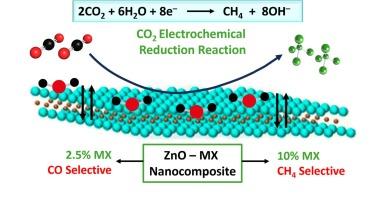
Developing efficient and sustainable catalysts for CO2 electroreduction is critical to addressing the rising atmospheric CO2 levels and mitigating climate change. This study presents a novel ZnO-MXene (Ti2C) nanocomposite as a high-performance electrocatalyst for CO2 conversion, offering a strategic approach for generating valuable carbon-based feedstocks. The ZnO-MXene nanocomposites were synthesized via the wet impregnation method and comprehensively characterized using X-ray diffraction (XRD), energy-dispersive X-ray spectroscopy (EDS), field emission scanning electron microscopy (FESEM), transmission electron microscopy (TEM), and Fourier transform infrared spectroscopy (FTIR). Electrochemical performance was assessed through linear sweep voltammetry (LSV), cyclic voltammetry (CV), and controlled potential coulometry, with gas chromatography employed for product quantification. ZnO-MX10 and ZnO-MX2.5 exhibited high selectivity for CH4 (79.3 % Faradaic efficiency, FE) at −0.56 VRHE and CO (76.8 % FE) at −0.78 VRHE, while significantly suppressing competing H2 evolution. The synergistic interaction between ZnO and MXene enhances charge transfer, increases active sites, and improves surface area, leading to superior electrochemical performance. Overall, this work introduces a novel ZnO-MXene nanocomposite with dual selectivity for CO and CH4, enhanced electroactive surface, and long-term stability. Unlike conventional Zn-based catalysts, which exhibit either limited selectivity or rapid degradation, our composite achieves 79.3 % Faradaic efficiency for CH4 and 76.8 % for CO, while suppressing H2 evolution. This unique tunability and stability make ZnO-MXene an attractive alternative to noble metal-based electrocatalysts.
期刊介绍:
The Journal of Colloid and Interface Science publishes original research findings on the fundamental principles of colloid and interface science, as well as innovative applications in various fields. The criteria for publication include impact, quality, novelty, and originality.
Emphasis:
The journal emphasizes fundamental scientific innovation within the following categories:
A.Colloidal Materials and Nanomaterials
B.Soft Colloidal and Self-Assembly Systems
C.Adsorption, Catalysis, and Electrochemistry
D.Interfacial Processes, Capillarity, and Wetting
E.Biomaterials and Nanomedicine
F.Energy Conversion and Storage, and Environmental Technologies



 京公网安备 11010802042870号
京ICP备2023020795号-1
京公网安备 11010802042870号
京ICP备2023020795号-1

 分享
分享
 求助内容:
求助内容: 应助结果提醒方式:
 扫码关注我们
