High loading of atomically exposed edge nickel sites embedded in hollow porous carbon nanofibers for enhanced methanol electrooxidation in direct methanol fuel cells
Fei Chen , Quan Zhou , Shuyan Yu , Shiquan Guo , Man Guo , Chong Zhang , Ziyu Guan , Haijiao Xie , Congju Li
{"title":"High loading of atomically exposed edge nickel sites embedded in hollow porous carbon nanofibers for enhanced methanol electrooxidation in direct methanol fuel cells","authors":"Fei Chen , Quan Zhou , Shuyan Yu , Shiquan Guo , Man Guo , Chong Zhang , Ziyu Guan , Haijiao Xie , Congju Li","doi":"10.1016/j.jcis.2025.137488","DOIUrl":null,"url":null,"abstract":"<div><div>The enhancement of catalytic activity and durability for atomically dispersed metal-nitrogen-carbon (M–N–C) catalysts in methanol oxidation reaction (MOR) anodes within direct methanol fuel cells presents a significant challenge. Here, we developed hollow porous nanofiber catalysts featuring edge Ni–N<sub>4</sub> atomic sites through coaxial electrostatic spinning with domain-restricted Ni atoms embedded within a zeolitic imidazolium ester backbone, thereby increasing the exposure of accessible active sites (Ni: 4.96 %). The distinctive hollow porous fiber morphology and hierarchical structure facilitate convenient electronic conductivity and mass transport of reactants. Theoretical findings indicate that the surface adsorption of methanol at the edge Ni–N<sub>4</sub> atomic sites exhibits negative free energy, promoting the adsorption and activation of reactants. Furthermore, the initial dehydrogenation step demonstrates a low free energy change, favoring reaction kinetics. The membrane electrode assembly achieved a power density of 42.2 mW cm<sup>−2</sup> in single-cell application tests while displaying improved durability. This research provides valuable insights for future advancements in single-atom catalyst development for fuel cells or other energy applications.</div></div>","PeriodicalId":351,"journal":{"name":"Journal of Colloid and Interface Science","volume":"692 ","pages":"Article 137488"},"PeriodicalIF":9.7000,"publicationDate":"2025-08-15","publicationTypes":"Journal Article","fieldsOfStudy":null,"isOpenAccess":false,"openAccessPdf":"","citationCount":"0","resultStr":null,"platform":"Semanticscholar","paperid":null,"PeriodicalName":"Journal of Colloid and Interface Science","FirstCategoryId":"92","ListUrlMain":"https://www.sciencedirect.com/science/article/pii/S0021979725008793","RegionNum":1,"RegionCategory":"化学","ArticlePicture":[],"TitleCN":null,"AbstractTextCN":null,"PMCID":null,"EPubDate":"2025/3/31 0:00:00","PubModel":"Epub","JCR":"Q1","JCRName":"CHEMISTRY, PHYSICAL","Score":null,"Total":0}
引用次数: 0
Abstract
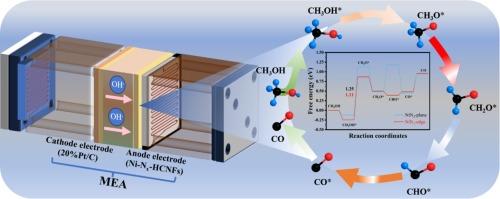
The enhancement of catalytic activity and durability for atomically dispersed metal-nitrogen-carbon (M–N–C) catalysts in methanol oxidation reaction (MOR) anodes within direct methanol fuel cells presents a significant challenge. Here, we developed hollow porous nanofiber catalysts featuring edge Ni–N4 atomic sites through coaxial electrostatic spinning with domain-restricted Ni atoms embedded within a zeolitic imidazolium ester backbone, thereby increasing the exposure of accessible active sites (Ni: 4.96 %). The distinctive hollow porous fiber morphology and hierarchical structure facilitate convenient electronic conductivity and mass transport of reactants. Theoretical findings indicate that the surface adsorption of methanol at the edge Ni–N4 atomic sites exhibits negative free energy, promoting the adsorption and activation of reactants. Furthermore, the initial dehydrogenation step demonstrates a low free energy change, favoring reaction kinetics. The membrane electrode assembly achieved a power density of 42.2 mW cm−2 in single-cell application tests while displaying improved durability. This research provides valuable insights for future advancements in single-atom catalyst development for fuel cells or other energy applications.
期刊介绍:
The Journal of Colloid and Interface Science publishes original research findings on the fundamental principles of colloid and interface science, as well as innovative applications in various fields. The criteria for publication include impact, quality, novelty, and originality.
Emphasis:
The journal emphasizes fundamental scientific innovation within the following categories:
A.Colloidal Materials and Nanomaterials
B.Soft Colloidal and Self-Assembly Systems
C.Adsorption, Catalysis, and Electrochemistry
D.Interfacial Processes, Capillarity, and Wetting
E.Biomaterials and Nanomedicine
F.Energy Conversion and Storage, and Environmental Technologies



 京公网安备 11010802042870号
京ICP备2023020795号-1
京公网安备 11010802042870号
京ICP备2023020795号-1

 分享
分享
 求助内容:
求助内容: 应助结果提醒方式:
 扫码关注我们
