Ruifen Li , Dionysios Neofytos , Jacob J.K. Kirkensgaard , Antara Pal , Jan Skov Pedersen , Milena Corredig
{"title":"In-depth exploration of the structure of pea albumin, its fractions and their heating and foaming properties","authors":"Ruifen Li , Dionysios Neofytos , Jacob J.K. Kirkensgaard , Antara Pal , Jan Skov Pedersen , Milena Corredig","doi":"10.1016/j.jcis.2025.137507","DOIUrl":null,"url":null,"abstract":"<div><h3>Hypothesis</h3><div>The structure and functionality of pea albumin can be described in detail as a combination of its main fractions, PA1 and PA2.</div></div><div><h3>Experimental</h3><div>PA1 and PA2 were purified from a Pea Albumin extract (PA) using size exclusion chromatography, and characterized by two-dimensional gel electrophoresis. Their secondary structure was analyzed using Fourier-Transform Infrared Spectroscopy (FTIR). The structures before and after heat treatment (90 °C, 1 & 5 min) were investigated by Small-Angle X-ray Scattering (SAXS). SAXS intensities were evaluated using high-resolution models obtained as predictions from the AlphaFold Protein Structure Database. Interfacial and foaming properties were also evaluated.</div></div><div><h3>Findings</h3><div>Both PA1 and PA2 contained various isoforms, and PA2 displayed a high β-sheet/α-helix ratio. In solution, SAXS intensities of PA1 could be predicted by its native structure, and after heating PA1 showed limited aggregation<em>.</em> PA2 could be presented as a dimer, which unfolded and formed large aggregates during heating. The high-resolution models could also explain well the SAXS signal of the unfractionated PA, combining PA1 and PA2. After heating, PA2 dominated the properties of the PA mixtures. PA2 predominantly contributed to the interfacial and foaming properties of PA, in spite of both PA1 and PA2 showing adsorption at the air/water interface. Indeed, PA1 in isolation could not form a stable foam.</div></div><div><h3>Perspective</h3><div>SAXS data analyzed with high-resolution structure models allowed for an in depth understanding of the structural changes of PA1 and PA2, and provided a mechanistic understanding of the relationships between structure, composition, and technological functionality of the albumin fractions from pea.</div></div>","PeriodicalId":351,"journal":{"name":"Journal of Colloid and Interface Science","volume":"692 ","pages":"Article 137507"},"PeriodicalIF":9.7000,"publicationDate":"2025-08-15","publicationTypes":"Journal Article","fieldsOfStudy":null,"isOpenAccess":false,"openAccessPdf":"","citationCount":"0","resultStr":null,"platform":"Semanticscholar","paperid":null,"PeriodicalName":"Journal of Colloid and Interface Science","FirstCategoryId":"92","ListUrlMain":"https://www.sciencedirect.com/science/article/pii/S0021979725008987","RegionNum":1,"RegionCategory":"化学","ArticlePicture":[],"TitleCN":null,"AbstractTextCN":null,"PMCID":null,"EPubDate":"2025/4/3 0:00:00","PubModel":"Epub","JCR":"Q1","JCRName":"CHEMISTRY, PHYSICAL","Score":null,"Total":0}
引用次数: 0
Abstract
Hypothesis
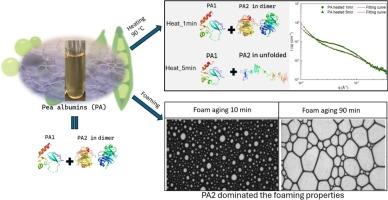
The structure and functionality of pea albumin can be described in detail as a combination of its main fractions, PA1 and PA2.
Experimental
PA1 and PA2 were purified from a Pea Albumin extract (PA) using size exclusion chromatography, and characterized by two-dimensional gel electrophoresis. Their secondary structure was analyzed using Fourier-Transform Infrared Spectroscopy (FTIR). The structures before and after heat treatment (90 °C, 1 & 5 min) were investigated by Small-Angle X-ray Scattering (SAXS). SAXS intensities were evaluated using high-resolution models obtained as predictions from the AlphaFold Protein Structure Database. Interfacial and foaming properties were also evaluated.
Findings
Both PA1 and PA2 contained various isoforms, and PA2 displayed a high β-sheet/α-helix ratio. In solution, SAXS intensities of PA1 could be predicted by its native structure, and after heating PA1 showed limited aggregation. PA2 could be presented as a dimer, which unfolded and formed large aggregates during heating. The high-resolution models could also explain well the SAXS signal of the unfractionated PA, combining PA1 and PA2. After heating, PA2 dominated the properties of the PA mixtures. PA2 predominantly contributed to the interfacial and foaming properties of PA, in spite of both PA1 and PA2 showing adsorption at the air/water interface. Indeed, PA1 in isolation could not form a stable foam.
Perspective
SAXS data analyzed with high-resolution structure models allowed for an in depth understanding of the structural changes of PA1 and PA2, and provided a mechanistic understanding of the relationships between structure, composition, and technological functionality of the albumin fractions from pea.
期刊介绍:
The Journal of Colloid and Interface Science publishes original research findings on the fundamental principles of colloid and interface science, as well as innovative applications in various fields. The criteria for publication include impact, quality, novelty, and originality.
Emphasis:
The journal emphasizes fundamental scientific innovation within the following categories:
A.Colloidal Materials and Nanomaterials
B.Soft Colloidal and Self-Assembly Systems
C.Adsorption, Catalysis, and Electrochemistry
D.Interfacial Processes, Capillarity, and Wetting
E.Biomaterials and Nanomedicine
F.Energy Conversion and Storage, and Environmental Technologies



 京公网安备 11010802042870号
京ICP备2023020795号-1
京公网安备 11010802042870号
京ICP备2023020795号-1

 分享
分享
 求助内容:
求助内容: 应助结果提醒方式:
 扫码关注我们
