Caleb J. Browne, Philipp Mews, Molly Estill, Xianxiao Zhou, Leanne M. Holt, Rita Futamura, Li Shen, Bin Zhang, Eric J. Nestler
{"title":"Cocaine and morphine induce shared and divergent transcriptional regulation in nucleus accumbens D1 and D2 medium spiny neurons","authors":"Caleb J. Browne, Philipp Mews, Molly Estill, Xianxiao Zhou, Leanne M. Holt, Rita Futamura, Li Shen, Bin Zhang, Eric J. Nestler","doi":"10.1038/s41380-025-03004-1","DOIUrl":null,"url":null,"abstract":"Substance use disorders (SUDs) induce widespread molecular dysregulation in nucleus accumbens (NAc), a brain region pivotal for coordinating motivation and reward, which is linked to neural and behavioral disturbances promoting addiction. Despite the overlapping symptomatology of SUDs, different drug classes exert partly unique influences on neural circuits, cell types, physiology, and gene expression. To better understand common and divergent molecular mechanisms governing SUD pathology, we characterized the cell-type-specific restructuring of the NAc transcriptional landscape after psychostimulant or opioid exposure. We combined fluorescence-activated nuclei sorting and deep RNA sequencing to profile NAc D1 and D2 medium spiny neurons (MSNs) across cocaine and morphine exposure paradigms, including initial exposure, prolonged withdrawal after repeated exposure, and re-exposure post-withdrawal. Our analyses reveal that D1 MSNs display many convergent transcriptional responses between the two drug classes, whereas D2 MSNs manifest highly divergent responses, with morphine causing more adaptations in this cell type. Utilizing multiscale embedded gene co-expression network analysis (MEGENA), we discerned transcriptional regulatory networks subserving biological functions altered by cocaine vs. morphine. We observed largely integrative engagement of overlapping gene networks across drug classes in D1 MSNs, but opposite regulation of key D2 networks, highlighting potential therapeutic gene network targets within MSNs. Analysis of gene regulatory systems at the level of enhancers revealed that morphine engages a unique enhancer landscape in D2 MSNs compared to cocaine. Our findings, and future work leveraging this dataset, will open avenues for the development of targeted therapeutic interventions, addressing the urgent need for more effective treatments for SUDs.","PeriodicalId":19008,"journal":{"name":"Molecular Psychiatry","volume":"30 9","pages":"4247-4257"},"PeriodicalIF":10.1000,"publicationDate":"2025-04-05","publicationTypes":"Journal Article","fieldsOfStudy":null,"isOpenAccess":false,"openAccessPdf":"","citationCount":"0","resultStr":null,"platform":"Semanticscholar","paperid":null,"PeriodicalName":"Molecular Psychiatry","FirstCategoryId":"3","ListUrlMain":"https://www.nature.com/articles/s41380-025-03004-1","RegionNum":1,"RegionCategory":"医学","ArticlePicture":[],"TitleCN":null,"AbstractTextCN":null,"PMCID":null,"EPubDate":"","PubModel":"","JCR":"Q1","JCRName":"BIOCHEMISTRY & MOLECULAR BIOLOGY","Score":null,"Total":0}
引用次数: 0
Abstract
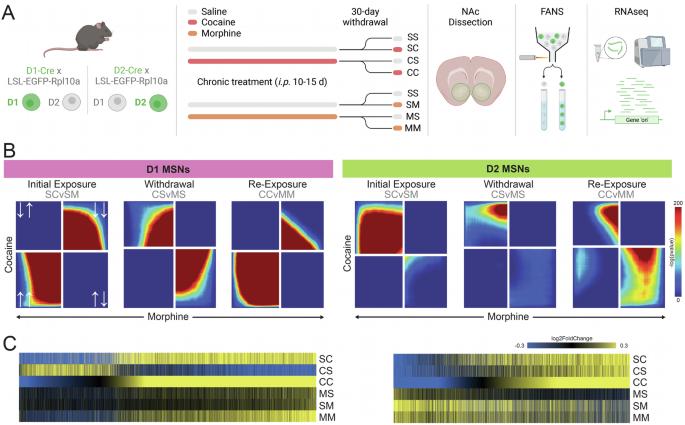
Substance use disorders (SUDs) induce widespread molecular dysregulation in nucleus accumbens (NAc), a brain region pivotal for coordinating motivation and reward, which is linked to neural and behavioral disturbances promoting addiction. Despite the overlapping symptomatology of SUDs, different drug classes exert partly unique influences on neural circuits, cell types, physiology, and gene expression. To better understand common and divergent molecular mechanisms governing SUD pathology, we characterized the cell-type-specific restructuring of the NAc transcriptional landscape after psychostimulant or opioid exposure. We combined fluorescence-activated nuclei sorting and deep RNA sequencing to profile NAc D1 and D2 medium spiny neurons (MSNs) across cocaine and morphine exposure paradigms, including initial exposure, prolonged withdrawal after repeated exposure, and re-exposure post-withdrawal. Our analyses reveal that D1 MSNs display many convergent transcriptional responses between the two drug classes, whereas D2 MSNs manifest highly divergent responses, with morphine causing more adaptations in this cell type. Utilizing multiscale embedded gene co-expression network analysis (MEGENA), we discerned transcriptional regulatory networks subserving biological functions altered by cocaine vs. morphine. We observed largely integrative engagement of overlapping gene networks across drug classes in D1 MSNs, but opposite regulation of key D2 networks, highlighting potential therapeutic gene network targets within MSNs. Analysis of gene regulatory systems at the level of enhancers revealed that morphine engages a unique enhancer landscape in D2 MSNs compared to cocaine. Our findings, and future work leveraging this dataset, will open avenues for the development of targeted therapeutic interventions, addressing the urgent need for more effective treatments for SUDs.
期刊介绍:
Molecular Psychiatry focuses on publishing research that aims to uncover the biological mechanisms behind psychiatric disorders and their treatment. The journal emphasizes studies that bridge pre-clinical and clinical research, covering cellular, molecular, integrative, clinical, imaging, and psychopharmacology levels.




 京公网安备 11010802042870号
京ICP备2023020795号-1
京公网安备 11010802042870号
京ICP备2023020795号-1

 分享
分享
 求助内容:
求助内容: 应助结果提醒方式:
 扫码关注我们
