Bo Peng, Shouwei Jian*, Jianxiang Huang, Fei Dai, Baodong Li, Gao Xin, Xinxin He and Jiaxuan Chen,
{"title":"Performance Impairment of Greener Phosphogypsum Binder under Alkaline Conditions: Phenomenon and Mechanism Analysis","authors":"Bo Peng, Shouwei Jian*, Jianxiang Huang, Fei Dai, Baodong Li, Gao Xin, Xinxin He and Jiaxuan Chen, ","doi":"10.1021/acssuschemeng.4c10107","DOIUrl":null,"url":null,"abstract":"<p >The sustainable utilization of hemihydrate phosphogypsum (HPG) in building materials is crucial for reducing industrial waste and promoting eco-friendly practices. However, its performance is sensitive to pH variations, which can impede its engineering applications. To understand the effect of pH on phosphogypsum hydration, this study examined the strength, hydration heat, hydration rate, ion concentration, phase composition, and microstructure of HPG and hemihydrate flue gas desulfurization gypsum (HFGD) under varying pH conditions. The results showed that pH had little effect on HFGD but significantly affected HPG. At pH 6.13, HPG had a 2 h strength of 6.57 MPa, a single hydration peak, and a 90% hydration rate in 1 h. At pH 8.53, the strength dropped to 0.93 MPa, the hydration peak almost disappeared, and the hydration rate was 57.62% in 10 h. At pH 11.62, strength increased to 5.67 MPa, with two hydration peaks and a 90% hydration rate in 2 h. Further ion analysis in the slurry indicates that the release and transformation of HPO<sub>4</sub><sup>2–</sup> under different pH conditions mainly affect phosphogypsum properties. In low acidity (pH = 5–7), low HPO<sub>4</sub><sup>2–</sup> content minimally impacts hydration. In low alkalinity (pH = 7–10), substantial HPO<sub>4</sub><sup>2–</sup> release severely hinders hydration. At higher alkalinity (pH = 10–12), abundant HPO<sub>4</sub><sup>2–</sup> gradually converts to insoluble calcium phosphate, reducing inhibition and causing a second exothermic peak. This research highlights the importance of controlling alkalinity and HPO<sub>4</sub><sup>2–</sup> content to optimize the HPG cementitious performance, thereby supporting cleaner production methods and advancing sustainable construction practices.</p>","PeriodicalId":25,"journal":{"name":"ACS Sustainable Chemistry & Engineering","volume":"13 13","pages":"5019–5034 5019–5034"},"PeriodicalIF":7.3000,"publicationDate":"2025-03-26","publicationTypes":"Journal Article","fieldsOfStudy":null,"isOpenAccess":false,"openAccessPdf":"","citationCount":"0","resultStr":null,"platform":"Semanticscholar","paperid":null,"PeriodicalName":"ACS Sustainable Chemistry & Engineering","FirstCategoryId":"92","ListUrlMain":"https://pubs.acs.org/doi/10.1021/acssuschemeng.4c10107","RegionNum":1,"RegionCategory":"化学","ArticlePicture":[],"TitleCN":null,"AbstractTextCN":null,"PMCID":null,"EPubDate":"","PubModel":"","JCR":"Q1","JCRName":"CHEMISTRY, MULTIDISCIPLINARY","Score":null,"Total":0}
引用次数: 0
Abstract
The sustainable utilization of hemihydrate phosphogypsum (HPG) in building materials is crucial for reducing industrial waste and promoting eco-friendly practices. However, its performance is sensitive to pH variations, which can impede its engineering applications. To understand the effect of pH on phosphogypsum hydration, this study examined the strength, hydration heat, hydration rate, ion concentration, phase composition, and microstructure of HPG and hemihydrate flue gas desulfurization gypsum (HFGD) under varying pH conditions. The results showed that pH had little effect on HFGD but significantly affected HPG. At pH 6.13, HPG had a 2 h strength of 6.57 MPa, a single hydration peak, and a 90% hydration rate in 1 h. At pH 8.53, the strength dropped to 0.93 MPa, the hydration peak almost disappeared, and the hydration rate was 57.62% in 10 h. At pH 11.62, strength increased to 5.67 MPa, with two hydration peaks and a 90% hydration rate in 2 h. Further ion analysis in the slurry indicates that the release and transformation of HPO42– under different pH conditions mainly affect phosphogypsum properties. In low acidity (pH = 5–7), low HPO42– content minimally impacts hydration. In low alkalinity (pH = 7–10), substantial HPO42– release severely hinders hydration. At higher alkalinity (pH = 10–12), abundant HPO42– gradually converts to insoluble calcium phosphate, reducing inhibition and causing a second exothermic peak. This research highlights the importance of controlling alkalinity and HPO42– content to optimize the HPG cementitious performance, thereby supporting cleaner production methods and advancing sustainable construction practices.
期刊介绍:
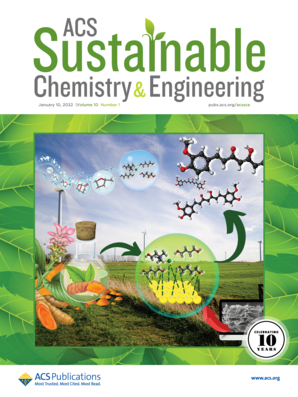
ACS Sustainable Chemistry & Engineering is a prestigious weekly peer-reviewed scientific journal published by the American Chemical Society. Dedicated to advancing the principles of green chemistry and green engineering, it covers a wide array of research topics including green chemistry, green engineering, biomass, alternative energy, and life cycle assessment.
The journal welcomes submissions in various formats, including Letters, Articles, Features, and Perspectives (Reviews), that address the challenges of sustainability in the chemical enterprise and contribute to the advancement of sustainable practices. Join us in shaping the future of sustainable chemistry and engineering.




 京公网安备 11010802042870号
京ICP备2023020795号-1
京公网安备 11010802042870号
京ICP备2023020795号-1

 分享
分享
 求助内容:
求助内容: 应助结果提醒方式:
 扫码关注我们
