High-performance nitrogen-doped carbon catalyst with Co-Cu-CuxO interfaces via bimetallic ion exchange-carbonization: Synergistic Co/Cu interactions and nonradical activation mechanism for micropollutant removal
Xinqiang Cao , Yang Liu , Fucai Yang , Xianhang Huang , Wenfeng Qiu
{"title":"High-performance nitrogen-doped carbon catalyst with Co-Cu-CuxO interfaces via bimetallic ion exchange-carbonization: Synergistic Co/Cu interactions and nonradical activation mechanism for micropollutant removal","authors":"Xinqiang Cao , Yang Liu , Fucai Yang , Xianhang Huang , Wenfeng Qiu","doi":"10.1016/j.jcis.2025.137490","DOIUrl":null,"url":null,"abstract":"<div><div>Mono-metal active sites, with their restricted electron transfer ability, typically lead to lower redox reaction efficiency, which hampers peroxymonosulfate (PMS) activation and reduces antibiotic degradation effectiveness. In this work, a novel nitrogen-doped carbon catalyst with Co-Cu-Cu<em>x</em>O interfaces was synthesized by pyrolyzing a Zn-based elliptical two-dimensional template through a Co<sup>2+</sup>/Cu<sup>2+</sup> bimetallic ion exchange process. The synthesized samples were comprehensively characterized using a range of physicochemical analysis techniques. Furthermore, the catalytic performance was systematically evaluated under varying conditions, including peroxymonosulfate dosage, tetracycline concentration, solution pH, and the influence of co-existing ions and organic matter in water. The results indicated that the optimized 1:1–950 catalyst achieved over 96 % degradation of tetracycline (TC) through PMS activation, with a reaction rate constant (<em>k</em>) of 0.038 min<sup>−1</sup>, significantly outperforming both the mono-metal ion exchange group and the non-metal ion exchange group. This improvement was attributed to the synergistic effects of <img>Co(II)/<img>Co(III) and <img>Cu(I)/<img>Cu(II) redox reactions at the Co-Cu-Cu<em>x</em>O interfaces. Quenching experiments, electron spin resonance (ESR), and electrochemical analyses revealed that non-radical reactive oxygen species (ROS), such as singlet oxygen (<sup>1</sup>O<sub>2</sub>) and high-valent metal-oxo species (e.g., <img>Cu(III)-oxo and <img>Co(IV)-oxo), played a key role in the degradation process. The degradation pathways for TC were proposed using high-performance liquid chromatography-mass spectrometry (HPLC-MS), and the environmental safety of the catalytic system was confirmed through physiological testing on mung bean growth. This work presents an efficient approach for PMS activation in TC degradation, using nitrogen-doped carbon catalysts with Co-Cu-Cu<em>x</em>O interfaces synthesized via bimetallic ion exchange and carbonization strategy, with promising applications in advanced wastewater treatment.</div></div>","PeriodicalId":351,"journal":{"name":"Journal of Colloid and Interface Science","volume":"692 ","pages":"Article 137490"},"PeriodicalIF":9.7000,"publicationDate":"2025-08-15","publicationTypes":"Journal Article","fieldsOfStudy":null,"isOpenAccess":false,"openAccessPdf":"","citationCount":"0","resultStr":null,"platform":"Semanticscholar","paperid":null,"PeriodicalName":"Journal of Colloid and Interface Science","FirstCategoryId":"92","ListUrlMain":"https://www.sciencedirect.com/science/article/pii/S0021979725008811","RegionNum":1,"RegionCategory":"化学","ArticlePicture":[],"TitleCN":null,"AbstractTextCN":null,"PMCID":null,"EPubDate":"2025/3/31 0:00:00","PubModel":"Epub","JCR":"Q1","JCRName":"CHEMISTRY, PHYSICAL","Score":null,"Total":0}
引用次数: 0
Abstract
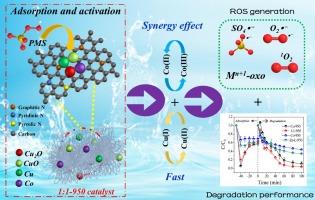
Mono-metal active sites, with their restricted electron transfer ability, typically lead to lower redox reaction efficiency, which hampers peroxymonosulfate (PMS) activation and reduces antibiotic degradation effectiveness. In this work, a novel nitrogen-doped carbon catalyst with Co-Cu-CuxO interfaces was synthesized by pyrolyzing a Zn-based elliptical two-dimensional template through a Co2+/Cu2+ bimetallic ion exchange process. The synthesized samples were comprehensively characterized using a range of physicochemical analysis techniques. Furthermore, the catalytic performance was systematically evaluated under varying conditions, including peroxymonosulfate dosage, tetracycline concentration, solution pH, and the influence of co-existing ions and organic matter in water. The results indicated that the optimized 1:1–950 catalyst achieved over 96 % degradation of tetracycline (TC) through PMS activation, with a reaction rate constant (k) of 0.038 min−1, significantly outperforming both the mono-metal ion exchange group and the non-metal ion exchange group. This improvement was attributed to the synergistic effects of Co(II)/Co(III) and Cu(I)/Cu(II) redox reactions at the Co-Cu-CuxO interfaces. Quenching experiments, electron spin resonance (ESR), and electrochemical analyses revealed that non-radical reactive oxygen species (ROS), such as singlet oxygen (1O2) and high-valent metal-oxo species (e.g., Cu(III)-oxo and Co(IV)-oxo), played a key role in the degradation process. The degradation pathways for TC were proposed using high-performance liquid chromatography-mass spectrometry (HPLC-MS), and the environmental safety of the catalytic system was confirmed through physiological testing on mung bean growth. This work presents an efficient approach for PMS activation in TC degradation, using nitrogen-doped carbon catalysts with Co-Cu-CuxO interfaces synthesized via bimetallic ion exchange and carbonization strategy, with promising applications in advanced wastewater treatment.
期刊介绍:
The Journal of Colloid and Interface Science publishes original research findings on the fundamental principles of colloid and interface science, as well as innovative applications in various fields. The criteria for publication include impact, quality, novelty, and originality.
Emphasis:
The journal emphasizes fundamental scientific innovation within the following categories:
A.Colloidal Materials and Nanomaterials
B.Soft Colloidal and Self-Assembly Systems
C.Adsorption, Catalysis, and Electrochemistry
D.Interfacial Processes, Capillarity, and Wetting
E.Biomaterials and Nanomedicine
F.Energy Conversion and Storage, and Environmental Technologies



 京公网安备 11010802042870号
京ICP备2023020795号-1
京公网安备 11010802042870号
京ICP备2023020795号-1

 分享
分享
 求助内容:
求助内容: 应助结果提醒方式:
 扫码关注我们
