Hanwei Teng , Shuo Chen , Rendi Kurniawan , Shujian Li , Changping Li , Moran Xu , Jielin Chen , Tae Jo Ko
{"title":"Brittle–ductile transition model for ultrasonic vibration–assisted blade dicing","authors":"Hanwei Teng , Shuo Chen , Rendi Kurniawan , Shujian Li , Changping Li , Moran Xu , Jielin Chen , Tae Jo Ko","doi":"10.1016/j.ijmecsci.2025.110196","DOIUrl":null,"url":null,"abstract":"<div><div>The critical machining parameters of the brittle–ductile transition (BDT) play a crucial role in enabling ductile-mode machining of brittle materials. Ultrasonic vibration–assisted blade dicing (UVABD) enhances machining quality significantly compared to conventional dicing methods. Nevertheless, radial ultrasonic vibration complicates the motion trajectories of the irregular grains on the dicing saw, making it difficult to predict the critical machining parameters. A comprehensive model that can predict critical machining parameters for BDT in UVABD has yet to be developed. In this paper, a mathematical model is proposed to predict the critical machining parameters for BDT in UVABD, considering the actual grain geometric characteristics and the interactions among multiple grains affected by ultrasonic vibration. The model was validated through experiments on single-crystal silicon wafers. A combined numerical and experimental method was used to comprehensively investigate the critical machining parameters for BDT. The results indicate that material removal in UVABD primarily involves plastic ploughing and brittle fracture. The proposed model's predictions agreed well with the experimental results, with the average relative error being 10.7 %. Finally, the model was applied to examine how machining parameters influence the critical machining parameters for BDT. Higher spindle speeds and vibration amplitudes, combined with lower feed rates and dicing depths, were found to facilitate the realization of ductile machining. This study establishes a theoretical foundation for ductile machining in UVABD and offers new insights into the BDT mechanism of brittle materials under UVABD.</div></div>","PeriodicalId":56287,"journal":{"name":"International Journal of Mechanical Sciences","volume":"293 ","pages":"Article 110196"},"PeriodicalIF":9.4000,"publicationDate":"2025-05-01","publicationTypes":"Journal Article","fieldsOfStudy":null,"isOpenAccess":false,"openAccessPdf":"","citationCount":"0","resultStr":null,"platform":"Semanticscholar","paperid":null,"PeriodicalName":"International Journal of Mechanical Sciences","FirstCategoryId":"5","ListUrlMain":"https://www.sciencedirect.com/science/article/pii/S0020740325002826","RegionNum":1,"RegionCategory":"工程技术","ArticlePicture":[],"TitleCN":null,"AbstractTextCN":null,"PMCID":null,"EPubDate":"2025/3/31 0:00:00","PubModel":"Epub","JCR":"Q1","JCRName":"ENGINEERING, MECHANICAL","Score":null,"Total":0}
引用次数: 0
Abstract
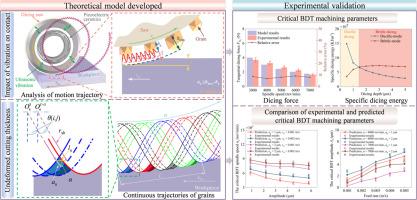
The critical machining parameters of the brittle–ductile transition (BDT) play a crucial role in enabling ductile-mode machining of brittle materials. Ultrasonic vibration–assisted blade dicing (UVABD) enhances machining quality significantly compared to conventional dicing methods. Nevertheless, radial ultrasonic vibration complicates the motion trajectories of the irregular grains on the dicing saw, making it difficult to predict the critical machining parameters. A comprehensive model that can predict critical machining parameters for BDT in UVABD has yet to be developed. In this paper, a mathematical model is proposed to predict the critical machining parameters for BDT in UVABD, considering the actual grain geometric characteristics and the interactions among multiple grains affected by ultrasonic vibration. The model was validated through experiments on single-crystal silicon wafers. A combined numerical and experimental method was used to comprehensively investigate the critical machining parameters for BDT. The results indicate that material removal in UVABD primarily involves plastic ploughing and brittle fracture. The proposed model's predictions agreed well with the experimental results, with the average relative error being 10.7 %. Finally, the model was applied to examine how machining parameters influence the critical machining parameters for BDT. Higher spindle speeds and vibration amplitudes, combined with lower feed rates and dicing depths, were found to facilitate the realization of ductile machining. This study establishes a theoretical foundation for ductile machining in UVABD and offers new insights into the BDT mechanism of brittle materials under UVABD.
期刊介绍:
The International Journal of Mechanical Sciences (IJMS) serves as a global platform for the publication and dissemination of original research that contributes to a deeper scientific understanding of the fundamental disciplines within mechanical, civil, and material engineering.
The primary focus of IJMS is to showcase innovative and ground-breaking work that utilizes analytical and computational modeling techniques, such as Finite Element Method (FEM), Boundary Element Method (BEM), and mesh-free methods, among others. These modeling methods are applied to diverse fields including rigid-body mechanics (e.g., dynamics, vibration, stability), structural mechanics, metal forming, advanced materials (e.g., metals, composites, cellular, smart) behavior and applications, impact mechanics, strain localization, and other nonlinear effects (e.g., large deflections, plasticity, fracture).
Additionally, IJMS covers the realms of fluid mechanics (both external and internal flows), tribology, thermodynamics, and materials processing. These subjects collectively form the core of the journal's content.
In summary, IJMS provides a prestigious platform for researchers to present their original contributions, shedding light on analytical and computational modeling methods in various areas of mechanical engineering, as well as exploring the behavior and application of advanced materials, fluid mechanics, thermodynamics, and materials processing.



 京公网安备 11010802042870号
京ICP备2023020795号-1
京公网安备 11010802042870号
京ICP备2023020795号-1

 分享
分享
 求助内容:
求助内容: 应助结果提醒方式:
 扫码关注我们
