{"title":"Analytical model of CFRP cutting mechanics with strain rate effect","authors":"Zhenghui Lu, Xiaoliang Jin","doi":"10.1016/j.ijmecsci.2025.110206","DOIUrl":null,"url":null,"abstract":"<div><div>When machining carbon fiber reinforced polymer (CFRP), the effect of strain rate on chip formation as fiber orientation and cutting speed change remains unclear, although it is recognized that the mechanical properties of CFRP are sensitive to strain rate. This paper provides a new analytical model to predict chip formation and associated cutting forces for CFRP. The changing cutting strain rate and stress states of varying fiber orientations are modeled, and the variation of CFRP strength due to strain rate is incorporated into selected composite failure criteria for determining material failure mode in cutting. Orthogonal cutting experiments were conducted on CFRP workpieces with distinct fiber orientations to validate the model. It is found that the model can capture the experimental cutting forces for CFRP workpieces with different fiber orientations across the full range [0°, 180°] at different cutting speeds. The simulations show that, due to the cutting strain rate, the strengths of CFRP in different loading directions can increase by up to 2.8 times compared to corresponding quasi-static strengths for varying fiber orientations at cutting speed 100 m/min. However, the sensitivity of cutting forces with the strain rate highly depends on the fiber orientation. As the fiber orientation varies, four distinct failure cases are classified based on the simulated different situations of strain rate-induced strength enhancement and stress-based failure modes. The simulated transitions of the failure cases explain the variations of experimental cutting forces. This work provides a new understanding of the CFRP cutting mechanism with strain rate effect.</div></div>","PeriodicalId":56287,"journal":{"name":"International Journal of Mechanical Sciences","volume":"293 ","pages":"Article 110206"},"PeriodicalIF":9.4000,"publicationDate":"2025-05-01","publicationTypes":"Journal Article","fieldsOfStudy":null,"isOpenAccess":false,"openAccessPdf":"","citationCount":"0","resultStr":null,"platform":"Semanticscholar","paperid":null,"PeriodicalName":"International Journal of Mechanical Sciences","FirstCategoryId":"5","ListUrlMain":"https://www.sciencedirect.com/science/article/pii/S0020740325002929","RegionNum":1,"RegionCategory":"工程技术","ArticlePicture":[],"TitleCN":null,"AbstractTextCN":null,"PMCID":null,"EPubDate":"2025/3/31 0:00:00","PubModel":"Epub","JCR":"Q1","JCRName":"ENGINEERING, MECHANICAL","Score":null,"Total":0}
引用次数: 0
Abstract
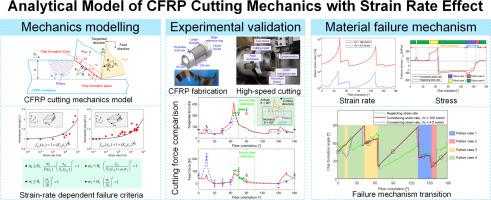
When machining carbon fiber reinforced polymer (CFRP), the effect of strain rate on chip formation as fiber orientation and cutting speed change remains unclear, although it is recognized that the mechanical properties of CFRP are sensitive to strain rate. This paper provides a new analytical model to predict chip formation and associated cutting forces for CFRP. The changing cutting strain rate and stress states of varying fiber orientations are modeled, and the variation of CFRP strength due to strain rate is incorporated into selected composite failure criteria for determining material failure mode in cutting. Orthogonal cutting experiments were conducted on CFRP workpieces with distinct fiber orientations to validate the model. It is found that the model can capture the experimental cutting forces for CFRP workpieces with different fiber orientations across the full range [0°, 180°] at different cutting speeds. The simulations show that, due to the cutting strain rate, the strengths of CFRP in different loading directions can increase by up to 2.8 times compared to corresponding quasi-static strengths for varying fiber orientations at cutting speed 100 m/min. However, the sensitivity of cutting forces with the strain rate highly depends on the fiber orientation. As the fiber orientation varies, four distinct failure cases are classified based on the simulated different situations of strain rate-induced strength enhancement and stress-based failure modes. The simulated transitions of the failure cases explain the variations of experimental cutting forces. This work provides a new understanding of the CFRP cutting mechanism with strain rate effect.
期刊介绍:
The International Journal of Mechanical Sciences (IJMS) serves as a global platform for the publication and dissemination of original research that contributes to a deeper scientific understanding of the fundamental disciplines within mechanical, civil, and material engineering.
The primary focus of IJMS is to showcase innovative and ground-breaking work that utilizes analytical and computational modeling techniques, such as Finite Element Method (FEM), Boundary Element Method (BEM), and mesh-free methods, among others. These modeling methods are applied to diverse fields including rigid-body mechanics (e.g., dynamics, vibration, stability), structural mechanics, metal forming, advanced materials (e.g., metals, composites, cellular, smart) behavior and applications, impact mechanics, strain localization, and other nonlinear effects (e.g., large deflections, plasticity, fracture).
Additionally, IJMS covers the realms of fluid mechanics (both external and internal flows), tribology, thermodynamics, and materials processing. These subjects collectively form the core of the journal's content.
In summary, IJMS provides a prestigious platform for researchers to present their original contributions, shedding light on analytical and computational modeling methods in various areas of mechanical engineering, as well as exploring the behavior and application of advanced materials, fluid mechanics, thermodynamics, and materials processing.



 京公网安备 11010802042870号
京ICP备2023020795号-1
京公网安备 11010802042870号
京ICP备2023020795号-1

 分享
分享
 求助内容:
求助内容: 应助结果提醒方式:
 扫码关注我们
