Bin Fu , Yan Gu , Jieqiong Lin , Xiaoqin Zhou , Tianyu Gao , Jiali Wang , Lingling Han , Yongliang Zhang
{"title":"Pulsed laser remelting non-resonant vibration assisted grinding Al-Si alloy","authors":"Bin Fu , Yan Gu , Jieqiong Lin , Xiaoqin Zhou , Tianyu Gao , Jiali Wang , Lingling Han , Yongliang Zhang","doi":"10.1016/j.ijmecsci.2025.110226","DOIUrl":null,"url":null,"abstract":"<div><div>High silicon aluminum alloy has broad applications in high power packaging parts and automobile lightweight. However, hard and brittle Si particles make the alloy surface easily to break during machining, resulting in serious surface defects. In this paper, a pulsed laser surface remelting non-resonant vibration assisted grinding method was proposed. The advantages of high instantaneous energy and quick cooling rate of pulsed laser are applied to form a remelting layer. The machinability of the alloy is improved by refining Si particles. The periodic separation of the workpiece-tool is used to reduce grinding forces and tool wear when abrasive particles cut the modified layer with higher hardness. The influence of remelting of the alloy induced by different power pulse laser on the material mechanical properties was revealed by laser irradiation experiments and indentation experiments. The influence mechanism of pulsed laser on the crystal structure and element distribution was simulated by molecular dynamics. The validity of the grinding method was confirmed by characterizing the grinding force, residual stress, tool wear, surface roughness and surface defect. The surface roughness of Al-27 wt. %Si decreased to 26 nm under the condition of 20 W power, 2 μm amplitude and 650 Hz frequency. The study reveals the deep mechanism of pulsed laser in laser assisted manufacturing and opens up a new research idea for the precise and low-damage processing of high silicon aluminum alloy.</div></div>","PeriodicalId":56287,"journal":{"name":"International Journal of Mechanical Sciences","volume":"293 ","pages":"Article 110226"},"PeriodicalIF":9.4000,"publicationDate":"2025-05-01","publicationTypes":"Journal Article","fieldsOfStudy":null,"isOpenAccess":false,"openAccessPdf":"","citationCount":"0","resultStr":null,"platform":"Semanticscholar","paperid":null,"PeriodicalName":"International Journal of Mechanical Sciences","FirstCategoryId":"5","ListUrlMain":"https://www.sciencedirect.com/science/article/pii/S0020740325003121","RegionNum":1,"RegionCategory":"工程技术","ArticlePicture":[],"TitleCN":null,"AbstractTextCN":null,"PMCID":null,"EPubDate":"2025/4/2 0:00:00","PubModel":"Epub","JCR":"Q1","JCRName":"ENGINEERING, MECHANICAL","Score":null,"Total":0}
引用次数: 0
Abstract
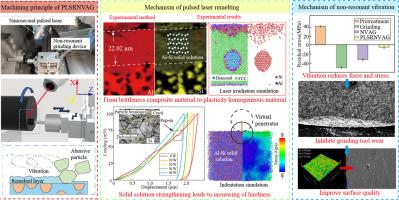
High silicon aluminum alloy has broad applications in high power packaging parts and automobile lightweight. However, hard and brittle Si particles make the alloy surface easily to break during machining, resulting in serious surface defects. In this paper, a pulsed laser surface remelting non-resonant vibration assisted grinding method was proposed. The advantages of high instantaneous energy and quick cooling rate of pulsed laser are applied to form a remelting layer. The machinability of the alloy is improved by refining Si particles. The periodic separation of the workpiece-tool is used to reduce grinding forces and tool wear when abrasive particles cut the modified layer with higher hardness. The influence of remelting of the alloy induced by different power pulse laser on the material mechanical properties was revealed by laser irradiation experiments and indentation experiments. The influence mechanism of pulsed laser on the crystal structure and element distribution was simulated by molecular dynamics. The validity of the grinding method was confirmed by characterizing the grinding force, residual stress, tool wear, surface roughness and surface defect. The surface roughness of Al-27 wt. %Si decreased to 26 nm under the condition of 20 W power, 2 μm amplitude and 650 Hz frequency. The study reveals the deep mechanism of pulsed laser in laser assisted manufacturing and opens up a new research idea for the precise and low-damage processing of high silicon aluminum alloy.
期刊介绍:
The International Journal of Mechanical Sciences (IJMS) serves as a global platform for the publication and dissemination of original research that contributes to a deeper scientific understanding of the fundamental disciplines within mechanical, civil, and material engineering.
The primary focus of IJMS is to showcase innovative and ground-breaking work that utilizes analytical and computational modeling techniques, such as Finite Element Method (FEM), Boundary Element Method (BEM), and mesh-free methods, among others. These modeling methods are applied to diverse fields including rigid-body mechanics (e.g., dynamics, vibration, stability), structural mechanics, metal forming, advanced materials (e.g., metals, composites, cellular, smart) behavior and applications, impact mechanics, strain localization, and other nonlinear effects (e.g., large deflections, plasticity, fracture).
Additionally, IJMS covers the realms of fluid mechanics (both external and internal flows), tribology, thermodynamics, and materials processing. These subjects collectively form the core of the journal's content.
In summary, IJMS provides a prestigious platform for researchers to present their original contributions, shedding light on analytical and computational modeling methods in various areas of mechanical engineering, as well as exploring the behavior and application of advanced materials, fluid mechanics, thermodynamics, and materials processing.



 京公网安备 11010802042870号
京ICP备2023020795号-1
京公网安备 11010802042870号
京ICP备2023020795号-1

 分享
分享
 求助内容:
求助内容: 应助结果提醒方式:
 扫码关注我们
