U. Martínez-Ortega , R. Aguayo-Ortiz , D. Aguilar-Cazares , E.D. Guerrero-Molina , V. Aguilar-Martínez , A. Moreno-Rodríguez , J.S. López-González , J.M. Vázquez-Ramos , F. Hernández-Luis
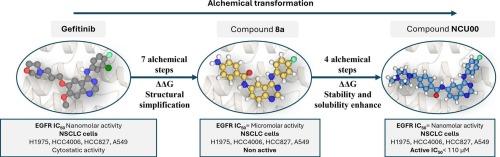
{"title":"Alchemical free energy-based optimization of quinazoline derivatives as potent EGFR inhibitors with cytotoxic activity","authors":"U. Martínez-Ortega , R. Aguayo-Ortiz , D. Aguilar-Cazares , E.D. Guerrero-Molina , V. Aguilar-Martínez , A. Moreno-Rodríguez , J.S. López-González , J.M. Vázquez-Ramos , F. Hernández-Luis","doi":"10.1016/j.bmc.2025.118179","DOIUrl":null,"url":null,"abstract":"<div><div>Gefitinib (GFB) is a well-established EGFR inhibitor used in the treatment of non-small cell lung cancer (NSCLC) that has shown resistance in certain cases of this cancer. In this work, we aimed to enhance GFB’s inhibitory activity using alchemical free energy calculations, leading to the design of five new quinazoline derivatives. Among these, compound <strong>8a</strong> was the most potent, inhibiting EGFR at 10 µM and showing significant antiproliferative effects at 25 µM. Further optimization identified two new compounds, <strong>NCU00</strong> and <strong>NCU01</strong>, with improved EGFR inhibition and superior cytotoxicity in four NSCLC cell lines compared to GFB. Molecular dynamics simulations revealed crucial interactions that contribute to the enhanced inhibitory activity of <strong>NCU00</strong> and <strong>NCU01</strong>. Toxicological assessments in mice showed no adverse effects on kidney or liver function, and <strong>NCU01</strong> exhibited no developmental toxicity in zebrafish embryos. This study highlights the effectiveness of alchemical free energy methods in optimizing quinazoline-bearing EGFR inhibitors.</div></div>","PeriodicalId":255,"journal":{"name":"Bioorganic & Medicinal Chemistry","volume":"124 ","pages":"Article 118179"},"PeriodicalIF":3.0000,"publicationDate":"2025-07-01","publicationTypes":"Journal Article","fieldsOfStudy":null,"isOpenAccess":false,"openAccessPdf":"","citationCount":"0","resultStr":null,"platform":"Semanticscholar","paperid":null,"PeriodicalName":"Bioorganic & Medicinal Chemistry","FirstCategoryId":"3","ListUrlMain":"https://www.sciencedirect.com/science/article/pii/S0968089625001208","RegionNum":3,"RegionCategory":"医学","ArticlePicture":[],"TitleCN":null,"AbstractTextCN":null,"PMCID":null,"EPubDate":"2025/4/2 0:00:00","PubModel":"Epub","JCR":"Q2","JCRName":"BIOCHEMISTRY & MOLECULAR BIOLOGY","Score":null,"Total":0}
引用次数: 0
Abstract
Gefitinib (GFB) is a well-established EGFR inhibitor used in the treatment of non-small cell lung cancer (NSCLC) that has shown resistance in certain cases of this cancer. In this work, we aimed to enhance GFB’s inhibitory activity using alchemical free energy calculations, leading to the design of five new quinazoline derivatives. Among these, compound 8a was the most potent, inhibiting EGFR at 10 µM and showing significant antiproliferative effects at 25 µM. Further optimization identified two new compounds, NCU00 and NCU01, with improved EGFR inhibition and superior cytotoxicity in four NSCLC cell lines compared to GFB. Molecular dynamics simulations revealed crucial interactions that contribute to the enhanced inhibitory activity of NCU00 and NCU01. Toxicological assessments in mice showed no adverse effects on kidney or liver function, and NCU01 exhibited no developmental toxicity in zebrafish embryos. This study highlights the effectiveness of alchemical free energy methods in optimizing quinazoline-bearing EGFR inhibitors.
期刊介绍:
Bioorganic & Medicinal Chemistry provides an international forum for the publication of full original research papers and critical reviews on molecular interactions in key biological targets such as receptors, channels, enzymes, nucleotides, lipids and saccharides.
The aim of the journal is to promote a better understanding at the molecular level of life processes, and living organisms, as well as the interaction of these with chemical agents. A special feature will be that colour illustrations will be reproduced at no charge to the author, provided that the Editor agrees that colour is essential to the information content of the illustration in question.



 京公网安备 11010802042870号
京ICP备2023020795号-1
京公网安备 11010802042870号
京ICP备2023020795号-1

 分享
分享
 求助内容:
求助内容: 应助结果提醒方式:
 扫码关注我们
