Peng Dong , Tingna Shao , Jiangpeng Xie , Xiaohui Zhang , Yang Xin , Xiaorui Wang , Yu Zhao , Guixian Li
{"title":"The cascade catalysis of core-shell CoW-MOF: Further intensified allylic oxidation of cyclohexene to 2-cyclohexene-1-one","authors":"Peng Dong , Tingna Shao , Jiangpeng Xie , Xiaohui Zhang , Yang Xin , Xiaorui Wang , Yu Zhao , Guixian Li","doi":"10.1016/j.mcat.2025.115098","DOIUrl":null,"url":null,"abstract":"<div><div>The low selectivity of cyclohexene allylic oxidation products (2-cyclohexene-1-one and 2-cyclohexene-1-ol) is the main barrier hindering the industrialization process of the cyclohexene allylic oxidation reaction. Improving the selectivity of 2-cyclohexene-1-one through cascade catalysis is an innovative strategy for the preparation of a single-target product from cyclohexene. In this paper, based on the “dissolution-regeneration” process, the Co-based metal-organic framework ZIF-67 was reconstructed using Na₂WO₄·4H₂O (as the W sources). a series of core-shell nanostructured catalysts (Co<sub>x</sub>W<sub>y</sub>-MOF) composed of a ZIF-67 core and a CoWO₄ shell layer were obtained. These catalysts have a specific surface area one order of magnitude higher than that of the porous CoWO₄ composite oxide. Thus, the significantly abundant active Co and W sites were evenly dispersed on such a high specific surface area for the cyclohexene allylic cascade reaction to generate 2-cyclohexene-1-one. Compared with porous CoWO<sub>4</sub> composite oxide, the conversion rate of Co<sub>0.5</sub>W<sub>0.5</sub>-MOF catalyst to cyclohexene increased by 9.8 %, and the value was 87.6 %. The selectivity for 2-cyclohexene-1-one is increased by 12.5 %, and the value was 83.3 %. Moreover, it can maintain its catalytic performance after five catalytic cycles of repeated use. The reasons for further intensified the cyclohexene allylic cascade oxidation mechanism are the full exposure of the active sites in the CoWO₄ shell layer and the synergistic catalytic effect between the ZIF-67 core and the CoWO₄ shell layer. The new material of CoWO₄ surface reconstruction based on the ZIF-67 precursor is an efficient catalyst for the cyclohexene allylic oxidation to produce 2-cyclohexene-1-one.</div></div>","PeriodicalId":393,"journal":{"name":"Molecular Catalysis","volume":"580 ","pages":"Article 115098"},"PeriodicalIF":4.9000,"publicationDate":"2025-06-01","publicationTypes":"Journal Article","fieldsOfStudy":null,"isOpenAccess":false,"openAccessPdf":"","citationCount":"0","resultStr":null,"platform":"Semanticscholar","paperid":null,"PeriodicalName":"Molecular Catalysis","FirstCategoryId":"92","ListUrlMain":"https://www.sciencedirect.com/science/article/pii/S2468823125002846","RegionNum":2,"RegionCategory":"化学","ArticlePicture":[],"TitleCN":null,"AbstractTextCN":null,"PMCID":null,"EPubDate":"2025/4/7 0:00:00","PubModel":"Epub","JCR":"Q2","JCRName":"CHEMISTRY, PHYSICAL","Score":null,"Total":0}
引用次数: 0
Abstract
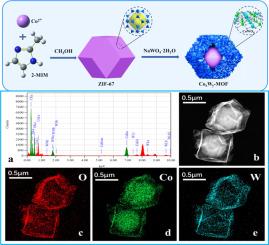
The low selectivity of cyclohexene allylic oxidation products (2-cyclohexene-1-one and 2-cyclohexene-1-ol) is the main barrier hindering the industrialization process of the cyclohexene allylic oxidation reaction. Improving the selectivity of 2-cyclohexene-1-one through cascade catalysis is an innovative strategy for the preparation of a single-target product from cyclohexene. In this paper, based on the “dissolution-regeneration” process, the Co-based metal-organic framework ZIF-67 was reconstructed using Na₂WO₄·4H₂O (as the W sources). a series of core-shell nanostructured catalysts (CoxWy-MOF) composed of a ZIF-67 core and a CoWO₄ shell layer were obtained. These catalysts have a specific surface area one order of magnitude higher than that of the porous CoWO₄ composite oxide. Thus, the significantly abundant active Co and W sites were evenly dispersed on such a high specific surface area for the cyclohexene allylic cascade reaction to generate 2-cyclohexene-1-one. Compared with porous CoWO4 composite oxide, the conversion rate of Co0.5W0.5-MOF catalyst to cyclohexene increased by 9.8 %, and the value was 87.6 %. The selectivity for 2-cyclohexene-1-one is increased by 12.5 %, and the value was 83.3 %. Moreover, it can maintain its catalytic performance after five catalytic cycles of repeated use. The reasons for further intensified the cyclohexene allylic cascade oxidation mechanism are the full exposure of the active sites in the CoWO₄ shell layer and the synergistic catalytic effect between the ZIF-67 core and the CoWO₄ shell layer. The new material of CoWO₄ surface reconstruction based on the ZIF-67 precursor is an efficient catalyst for the cyclohexene allylic oxidation to produce 2-cyclohexene-1-one.
期刊介绍:
Molecular Catalysis publishes full papers that are original, rigorous, and scholarly contributions examining the molecular and atomic aspects of catalytic activation and reaction mechanisms. The fields covered are:
Heterogeneous catalysis including immobilized molecular catalysts
Homogeneous catalysis including organocatalysis, organometallic catalysis and biocatalysis
Photo- and electrochemistry
Theoretical aspects of catalysis analyzed by computational methods



 京公网安备 11010802042870号
京ICP备2023020795号-1
京公网安备 11010802042870号
京ICP备2023020795号-1

 分享
分享
 求助内容:
求助内容: 应助结果提醒方式:
 扫码关注我们
