Jiali Chen , Chen Huang , Yuqing Zhang , Liya Zhou , Li Ma , Lihui Wang , Yanjun Jiang , Yunting Liu
{"title":"Continuous-flow chemoenzymatic conversion of racemic alcohols to enantiopure alcohols and amines","authors":"Jiali Chen , Chen Huang , Yuqing Zhang , Liya Zhou , Li Ma , Lihui Wang , Yanjun Jiang , Yunting Liu","doi":"10.1016/j.mcat.2025.115094","DOIUrl":null,"url":null,"abstract":"<div><div>The conversion of racemic alcohols to enantiopure alcohols and amines is of significant importance yet presents considerable challenges. Herein, we achieved this goal by developing continuous-flow chemoenzymatic systems. In chemical module, a ruthenium (II)-N-heterocyclic carbene (Ru-NHC) catalyst immobilized on dendritic organosilica nanoparticle (DON) was prepared, which exhibited high activity and selectivity in the dehydrogenative oxidation of racemic alcohols to ketones. In enzymatic module, a ketoreductase and an amine dehydrogenase were individually co-immobilized with a cofactor-regenerating enzyme (glucose dehydrogenase) on DON for the enantioselective conversion of ketones to chiral alcohols and amines, respectively. The integration of the two modules in continuous-flow systems enabled the efficient chemoenzymatic deracemization and asymmetric amination of racemic alcohols (9 examples) with the maximum space-time yields of 6.8 and 5.8 g L<sup>-1</sup> h<sup>-1</sup>, respectively, underscoring the practical utility of the continuous-flow chemoenzymatic systems.</div></div>","PeriodicalId":393,"journal":{"name":"Molecular Catalysis","volume":"580 ","pages":"Article 115094"},"PeriodicalIF":4.9000,"publicationDate":"2025-04-07","publicationTypes":"Journal Article","fieldsOfStudy":null,"isOpenAccess":false,"openAccessPdf":"","citationCount":"0","resultStr":null,"platform":"Semanticscholar","paperid":null,"PeriodicalName":"Molecular Catalysis","FirstCategoryId":"92","ListUrlMain":"https://www.sciencedirect.com/science/article/pii/S2468823125002809","RegionNum":2,"RegionCategory":"化学","ArticlePicture":[],"TitleCN":null,"AbstractTextCN":null,"PMCID":null,"EPubDate":"","PubModel":"","JCR":"Q2","JCRName":"CHEMISTRY, PHYSICAL","Score":null,"Total":0}
引用次数: 0
Abstract
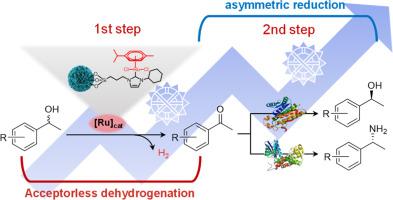
The conversion of racemic alcohols to enantiopure alcohols and amines is of significant importance yet presents considerable challenges. Herein, we achieved this goal by developing continuous-flow chemoenzymatic systems. In chemical module, a ruthenium (II)-N-heterocyclic carbene (Ru-NHC) catalyst immobilized on dendritic organosilica nanoparticle (DON) was prepared, which exhibited high activity and selectivity in the dehydrogenative oxidation of racemic alcohols to ketones. In enzymatic module, a ketoreductase and an amine dehydrogenase were individually co-immobilized with a cofactor-regenerating enzyme (glucose dehydrogenase) on DON for the enantioselective conversion of ketones to chiral alcohols and amines, respectively. The integration of the two modules in continuous-flow systems enabled the efficient chemoenzymatic deracemization and asymmetric amination of racemic alcohols (9 examples) with the maximum space-time yields of 6.8 and 5.8 g L-1 h-1, respectively, underscoring the practical utility of the continuous-flow chemoenzymatic systems.
将外消旋醇转化为对映纯醇和对映纯胺具有重要意义,但也存在相当大的挑战。在这里,我们通过开发连续流化学酶系统实现了这一目标。在化学模块中,制备了树突状有机二氧化硅纳米颗粒(DON)固定化钌- n -杂环碳(Ru-NHC)催化剂,该催化剂对外消旋醇脱氢氧化制酮具有较高的活性和选择性。在酶模块中,酮还原酶和胺脱氢酶分别与辅助因子再生酶(葡萄糖脱氢酶)在DON上共固定,分别用于酮对映选择性转化为手性醇和胺。这两个模块在连续流系统中的集成使得外消旋醇的高效去消旋化和不对称胺化(9个例子)的最大时空产率分别为6.8 g L-1 h-1和5.8 g L-1 h-1,强调了连续流化学酶系统的实用性。
期刊介绍:
Molecular Catalysis publishes full papers that are original, rigorous, and scholarly contributions examining the molecular and atomic aspects of catalytic activation and reaction mechanisms. The fields covered are:
Heterogeneous catalysis including immobilized molecular catalysts
Homogeneous catalysis including organocatalysis, organometallic catalysis and biocatalysis
Photo- and electrochemistry
Theoretical aspects of catalysis analyzed by computational methods



 京公网安备 11010802042870号
京ICP备2023020795号-1
京公网安备 11010802042870号
京ICP备2023020795号-1

 分享
分享
 求助内容:
求助内容: 应助结果提醒方式:
 扫码关注我们
