Yaxin Zhao , Tingting Li , Jiajia Zhao , Waleed AL-Ansi , Mingcong Fan , K. AboGhaneima Wafaa , Haifeng Qian , Yan Li , Li Wang
{"title":"Effects of sea buckthorn residue protein hydrolysate on the quality of frozen pre-baked bread: Water state and gluten structures","authors":"Yaxin Zhao , Tingting Li , Jiajia Zhao , Waleed AL-Ansi , Mingcong Fan , K. AboGhaneima Wafaa , Haifeng Qian , Yan Li , Li Wang","doi":"10.1016/j.foodhyd.2025.111404","DOIUrl":null,"url":null,"abstract":"<div><div>Fluctuations in temperature during freeze-thaw (F/T) cycles can lead to large ice crystal formation and recrystallization, resulting in the deterioration of the dough gluten network and degradation of the final product. This study aimed to explore the influence of protein hydrolysate of sea buckthorn residue (SRPH) on moisture status, gluten network structure, and prebaked bread-making properties during F/T cycles, as compared with a commercially available ice-structured protein (ISP). The results demonstrated that following six F/T cycles, the freezable moisture content of the blank control (BC), ISP, and SRPH groups exhibited increases of 12.25 %, 6.35 %, and 5.92 %, respectively. Furthermore, the free sulfhydryl groups decreased by 18.95 % and 19.32 %, the disulfide bonds increased by 16.1 % and 21.38 %, and the α-helical structure increased by 3.61 % and 3.09 % in the ISP and SPPH groups, respectively, compared to the BC group. These results indicate that the addition of SRPH to doughs can maintain the intact structure and functional properties of doughs by controlling moisture migration. This may be attributed to the fact that SRPH exhibits certain thermal hysteretic activity (0.18 °C), contains a substantial amount of hydrophilic amino acids (64.86 %), and has a high supercooling point (−11.40 °C). These results substantiate the protective effects against the freezing activity of SPPH on frozen dough during F/T cycles, thereby providing a foundation for the future creation of prebaked frozen food items.</div></div>","PeriodicalId":320,"journal":{"name":"Food Hydrocolloids","volume":"167 ","pages":"Article 111404"},"PeriodicalIF":11.0000,"publicationDate":"2025-11-01","publicationTypes":"Journal Article","fieldsOfStudy":null,"isOpenAccess":false,"openAccessPdf":"","citationCount":"0","resultStr":null,"platform":"Semanticscholar","paperid":null,"PeriodicalName":"Food Hydrocolloids","FirstCategoryId":"97","ListUrlMain":"https://www.sciencedirect.com/science/article/pii/S0268005X25003649","RegionNum":1,"RegionCategory":"农林科学","ArticlePicture":[],"TitleCN":null,"AbstractTextCN":null,"PMCID":null,"EPubDate":"2025/4/1 0:00:00","PubModel":"Epub","JCR":"Q1","JCRName":"CHEMISTRY, APPLIED","Score":null,"Total":0}
引用次数: 0
Abstract
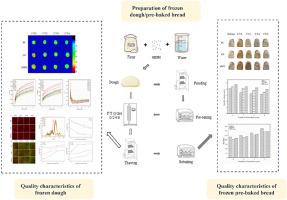
Fluctuations in temperature during freeze-thaw (F/T) cycles can lead to large ice crystal formation and recrystallization, resulting in the deterioration of the dough gluten network and degradation of the final product. This study aimed to explore the influence of protein hydrolysate of sea buckthorn residue (SRPH) on moisture status, gluten network structure, and prebaked bread-making properties during F/T cycles, as compared with a commercially available ice-structured protein (ISP). The results demonstrated that following six F/T cycles, the freezable moisture content of the blank control (BC), ISP, and SRPH groups exhibited increases of 12.25 %, 6.35 %, and 5.92 %, respectively. Furthermore, the free sulfhydryl groups decreased by 18.95 % and 19.32 %, the disulfide bonds increased by 16.1 % and 21.38 %, and the α-helical structure increased by 3.61 % and 3.09 % in the ISP and SPPH groups, respectively, compared to the BC group. These results indicate that the addition of SRPH to doughs can maintain the intact structure and functional properties of doughs by controlling moisture migration. This may be attributed to the fact that SRPH exhibits certain thermal hysteretic activity (0.18 °C), contains a substantial amount of hydrophilic amino acids (64.86 %), and has a high supercooling point (−11.40 °C). These results substantiate the protective effects against the freezing activity of SPPH on frozen dough during F/T cycles, thereby providing a foundation for the future creation of prebaked frozen food items.
期刊介绍:
Food Hydrocolloids publishes original and innovative research focused on the characterization, functional properties, and applications of hydrocolloid materials used in food products. These hydrocolloids, defined as polysaccharides and proteins of commercial importance, are added to control aspects such as texture, stability, rheology, and sensory properties. The research's primary emphasis should be on the hydrocolloids themselves, with thorough descriptions of their source, nature, and physicochemical characteristics. Manuscripts are expected to clearly outline specific aims and objectives, include a fundamental discussion of research findings at the molecular level, and address the significance of the results. Studies on hydrocolloids in complex formulations should concentrate on their overall properties and mechanisms of action, while simple formulation development studies may not be considered for publication.
The main areas of interest are:
-Chemical and physicochemical characterisation
Thermal properties including glass transitions and conformational changes-
Rheological properties including viscosity, viscoelastic properties and gelation behaviour-
The influence on organoleptic properties-
Interfacial properties including stabilisation of dispersions, emulsions and foams-
Film forming properties with application to edible films and active packaging-
Encapsulation and controlled release of active compounds-
The influence on health including their role as dietary fibre-
Manipulation of hydrocolloid structure and functionality through chemical, biochemical and physical processes-
New hydrocolloids and hydrocolloid sources of commercial potential.
The Journal also publishes Review articles that provide an overview of the latest developments in topics of specific interest to researchers in this field of activity.



 京公网安备 11010802042870号
京ICP备2023020795号-1
京公网安备 11010802042870号
京ICP备2023020795号-1

 分享
分享
 求助内容:
求助内容: 应助结果提醒方式:
 扫码关注我们
