Hao Li , Michael Nigen , Christian Sanchez , Denis Renard
{"title":"Enzymatic hydrolysis alters the structure and surface properties of Acacia senegal Gum","authors":"Hao Li , Michael Nigen , Christian Sanchez , Denis Renard","doi":"10.1016/j.foodhyd.2025.111402","DOIUrl":null,"url":null,"abstract":"<div><div>Acacia gum is a naturally occurring, heterogeneous mixture of arabinogalactan-proteins, valued for its surface properties in industrial applications. However, the impact of enzymatic treatments on its structural and functional characteristics remains poorly understood. In this study, the effect of four proteases (papain, subtilisin A, proteinase K, pronase) and three glycosidases (β-galactosidase, β-glucuronidase, α-rhamnosidase) on the structure and surface properties of Acacia <em>senegal (A. senegal)</em> gum were investigated using high-performance size exclusion chromatography with multiangle laser light scattering (HPSEC-MALLS), small angle X-ray scattering (SAXS), and quartz crystal microbalance with dissipation monitoring (QCM-D). The proteolysis effects on <em>A. senegal</em> gum were dependent on the molecular weight (M<sub>w</sub>) and protein content of its macromolecular fractions separated by hydrophobic interaction chromatography. The high-M<sub>w</sub> arabinogalactan-protein (AGP) fraction, HIC-F2, which constitutes ∼10 % of the total gum with an average M<sub>w</sub> of ∼1.6 × 10<sup>6</sup> g mol<sup>−1</sup>, was significantly hydrolyzed by all tested proteases, albeit to varying extents. By contrast, the arabinogalactan-peptide (AG-peptide) fraction, HIC-F1, which represents the predominant fraction (∼90 %) with a M<sub>w</sub> of ∼3 × 10<sup>5</sup> g mol<sup>−1</sup>, exhibited negligible proteolysis. Notably, HIC-F2 hydrolyzed by mixed proteases yielded species with a M<sub>w</sub> comparable to HIC-F1. SAXS structural analysis revealed three distinct correlation lengths in both HIC-F2 and HIC-F1, which remained unchanged following proteolysis, likely reflecting multiple length scales of the carbohydrate units. Also, HIC-F2 population was primarily responsible for the surface adsorption of <em>A. senegal</em> gum, whereas HIC-F1 demonstrated minimal interfacial activity. Regardless of their specificity, all proteases significantly reduced the surface load and interfacial viscoelasticity of <em>A</em>. <em>senegal</em> gum, with a strong correlation between the M<sub>w</sub> of hydrolyzed AGPs and their adsorption capacity. Conversely, the tested glycosidases did not affect the macromolecular structure of <em>A. senegal</em> gum. This study offers valuable insights into how the structural and functional properties of Acacia gums can be tailored through enzymatic treatments.</div></div>","PeriodicalId":320,"journal":{"name":"Food Hydrocolloids","volume":"167 ","pages":"Article 111402"},"PeriodicalIF":11.0000,"publicationDate":"2025-11-01","publicationTypes":"Journal Article","fieldsOfStudy":null,"isOpenAccess":false,"openAccessPdf":"","citationCount":"0","resultStr":null,"platform":"Semanticscholar","paperid":null,"PeriodicalName":"Food Hydrocolloids","FirstCategoryId":"97","ListUrlMain":"https://www.sciencedirect.com/science/article/pii/S0268005X25003625","RegionNum":1,"RegionCategory":"农林科学","ArticlePicture":[],"TitleCN":null,"AbstractTextCN":null,"PMCID":null,"EPubDate":"2025/4/1 0:00:00","PubModel":"Epub","JCR":"Q1","JCRName":"CHEMISTRY, APPLIED","Score":null,"Total":0}
引用次数: 0
Abstract
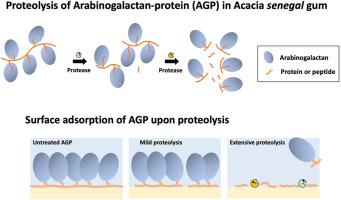
Acacia gum is a naturally occurring, heterogeneous mixture of arabinogalactan-proteins, valued for its surface properties in industrial applications. However, the impact of enzymatic treatments on its structural and functional characteristics remains poorly understood. In this study, the effect of four proteases (papain, subtilisin A, proteinase K, pronase) and three glycosidases (β-galactosidase, β-glucuronidase, α-rhamnosidase) on the structure and surface properties of Acacia senegal (A. senegal) gum were investigated using high-performance size exclusion chromatography with multiangle laser light scattering (HPSEC-MALLS), small angle X-ray scattering (SAXS), and quartz crystal microbalance with dissipation monitoring (QCM-D). The proteolysis effects on A. senegal gum were dependent on the molecular weight (Mw) and protein content of its macromolecular fractions separated by hydrophobic interaction chromatography. The high-Mw arabinogalactan-protein (AGP) fraction, HIC-F2, which constitutes ∼10 % of the total gum with an average Mw of ∼1.6 × 10⁶ g mol−1, was significantly hydrolyzed by all tested proteases, albeit to varying extents. By contrast, the arabinogalactan-peptide (AG-peptide) fraction, HIC-F1, which represents the predominant fraction (∼90 %) with a Mw of ∼3 × 10⁵ g mol−1, exhibited negligible proteolysis. Notably, HIC-F2 hydrolyzed by mixed proteases yielded species with a Mw comparable to HIC-F1. SAXS structural analysis revealed three distinct correlation lengths in both HIC-F2 and HIC-F1, which remained unchanged following proteolysis, likely reflecting multiple length scales of the carbohydrate units. Also, HIC-F2 population was primarily responsible for the surface adsorption of A. senegal gum, whereas HIC-F1 demonstrated minimal interfacial activity. Regardless of their specificity, all proteases significantly reduced the surface load and interfacial viscoelasticity of A. senegal gum, with a strong correlation between the Mw of hydrolyzed AGPs and their adsorption capacity. Conversely, the tested glycosidases did not affect the macromolecular structure of A. senegal gum. This study offers valuable insights into how the structural and functional properties of Acacia gums can be tailored through enzymatic treatments.
期刊介绍:
Food Hydrocolloids publishes original and innovative research focused on the characterization, functional properties, and applications of hydrocolloid materials used in food products. These hydrocolloids, defined as polysaccharides and proteins of commercial importance, are added to control aspects such as texture, stability, rheology, and sensory properties. The research's primary emphasis should be on the hydrocolloids themselves, with thorough descriptions of their source, nature, and physicochemical characteristics. Manuscripts are expected to clearly outline specific aims and objectives, include a fundamental discussion of research findings at the molecular level, and address the significance of the results. Studies on hydrocolloids in complex formulations should concentrate on their overall properties and mechanisms of action, while simple formulation development studies may not be considered for publication.
The main areas of interest are:
-Chemical and physicochemical characterisation
Thermal properties including glass transitions and conformational changes-
Rheological properties including viscosity, viscoelastic properties and gelation behaviour-
The influence on organoleptic properties-
Interfacial properties including stabilisation of dispersions, emulsions and foams-
Film forming properties with application to edible films and active packaging-
Encapsulation and controlled release of active compounds-
The influence on health including their role as dietary fibre-
Manipulation of hydrocolloid structure and functionality through chemical, biochemical and physical processes-
New hydrocolloids and hydrocolloid sources of commercial potential.
The Journal also publishes Review articles that provide an overview of the latest developments in topics of specific interest to researchers in this field of activity.



 京公网安备 11010802042870号
京ICP备2023020795号-1
京公网安备 11010802042870号
京ICP备2023020795号-1

 分享
分享
 求助内容:
求助内容: 应助结果提醒方式:
 扫码关注我们
