Dylan G. Ramanan, Roshan T. Bandara, Ranjit Thakuria and Nadeesh M. Adassooriya
{"title":"Nanococrystals: a promising strategy for improved drug performance","authors":"Dylan G. Ramanan, Roshan T. Bandara, Ranjit Thakuria and Nadeesh M. Adassooriya","doi":"10.1039/D5CE00144G","DOIUrl":null,"url":null,"abstract":"<p >The process of producing a nanosized cocrystal employing two or more components that possess hydrogen bonds, pi–pi stacking, and van der Waals interactions is known as nanococrystallization. Because of their high surface area to volume ratio, nanococrystals are unique, similar to cocrystals in construction, but with vastly superior qualities. The surface area-to-volume ratio increases as the particle size approaches the nanoscale, which will have an impact on properties including dissolution, bioavailability, efficacy, and surface energy, benefitting their use in the pharmaceutical industry. Since nanococrystallization is a recent concept, extensive research is still being done on its potential applications. The synthesis method, particle size, and components used for every medicine that has been tested and is currently available are set out. Here, we examine the critical steps involved in generating nanococrystals on a commercial scale, the pros and cons of preparative methods, nanococrystal formation mechanisms, selection of coformers, characterization techniques, and future prospects. Furthermore, we discuss real-world applications and challenges found in nanococrystal technology, which will aid future researchers in creating successful nanococrystal formulations.</p>","PeriodicalId":70,"journal":{"name":"CrystEngComm","volume":" 15","pages":" 2062-2082"},"PeriodicalIF":2.4000,"publicationDate":"2025-03-11","publicationTypes":"Journal Article","fieldsOfStudy":null,"isOpenAccess":false,"openAccessPdf":"","citationCount":"0","resultStr":null,"platform":"Semanticscholar","paperid":null,"PeriodicalName":"CrystEngComm","FirstCategoryId":"92","ListUrlMain":"https://pubs.rsc.org/en/content/articlelanding/2025/ce/d5ce00144g","RegionNum":3,"RegionCategory":"化学","ArticlePicture":[],"TitleCN":null,"AbstractTextCN":null,"PMCID":null,"EPubDate":"","PubModel":"","JCR":"Q2","JCRName":"CHEMISTRY, MULTIDISCIPLINARY","Score":null,"Total":0}
引用次数: 0
Abstract
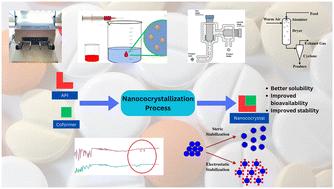
The process of producing a nanosized cocrystal employing two or more components that possess hydrogen bonds, pi–pi stacking, and van der Waals interactions is known as nanococrystallization. Because of their high surface area to volume ratio, nanococrystals are unique, similar to cocrystals in construction, but with vastly superior qualities. The surface area-to-volume ratio increases as the particle size approaches the nanoscale, which will have an impact on properties including dissolution, bioavailability, efficacy, and surface energy, benefitting their use in the pharmaceutical industry. Since nanococrystallization is a recent concept, extensive research is still being done on its potential applications. The synthesis method, particle size, and components used for every medicine that has been tested and is currently available are set out. Here, we examine the critical steps involved in generating nanococrystals on a commercial scale, the pros and cons of preparative methods, nanococrystal formation mechanisms, selection of coformers, characterization techniques, and future prospects. Furthermore, we discuss real-world applications and challenges found in nanococrystal technology, which will aid future researchers in creating successful nanococrystal formulations.




 京公网安备 11010802042870号
京ICP备2023020795号-1
京公网安备 11010802042870号
京ICP备2023020795号-1

 分享
分享
 求助内容:
求助内容: 应助结果提醒方式:
 扫码关注我们
