Andrew Michael Peseski, Christopher J Vail, Maragatha Kuchibhatla, Jillian Hauser, Jonathan Bae, Richard P Shannon, Devdutta Sangvai, Thomas L Ortel, Momen M Wahidi
{"title":"Multimodal quality improvement project on reducing hospital perioperative thromboembolic events (Patient Safety Indicator-12).","authors":"Andrew Michael Peseski, Christopher J Vail, Maragatha Kuchibhatla, Jillian Hauser, Jonathan Bae, Richard P Shannon, Devdutta Sangvai, Thomas L Ortel, Momen M Wahidi","doi":"10.1136/bmjoq-2024-002937","DOIUrl":null,"url":null,"abstract":"<p><strong>Background: </strong>Venous thromboembolism (VTE), which includes both pulmonary embolism and deep vein thrombosis, is a common yet significant postoperative complication. Patient Safety Indicator (PSI)-12 was introduced by Centers for Medicare & Medicaid Services and Agency for Healthcare Research and Quality to track this potentially preventable complication. We initiated a multifaceted process to reduce our postoperative VTE rates through a four-pillar initiative structure. Our objective was to assess the impact of a multifaceted process and quality improvement initiative on the rate of postoperative VTE at an academic medical centre.</p><p><strong>Methods: </strong>Our study was conducted at Duke University Medical Center. Our intervention consisted of a four-pillar initiative structure: building a consensus on appropriate VTE prophylaxis through surgical specialty champions; incorporating VTE prophylaxis recommendations in the provider electronic health record workflow; using a measurement dashboard; and reviewing all individual postoperative VTE cases with clinical champions. We collected pre-intervention data on PSI-12 rates for 12 months ending in September 2019, initiated improvement strategies in September 2020 and reviewed results of our improvement strategies at the end of December 2021 for a 15-month timespan.</p><p><strong>Results: </strong>In 2019, we identified 94 postoperative VTE events per 13 522 adult surgical discharges for a rate of 0.695%. In 2021, we identified 71 postoperative VTE events per 12 292 adult surgical discharges for a rate of 0.578%. This represents a gross reduction in postoperative VTE event rate by 23 when comparing our pre-intervention and post-intervention timeframes which was both a clinically and statistically significant difference (p<0.0001, 95% CI: 0.1050 to 0.1288).</p><p><strong>Conclusions: </strong>The four-pillar initiative structure implemented was successful in reducing postoperative VTE rates, reducing costs and lowering hospital length of stay.</p>","PeriodicalId":9052,"journal":{"name":"BMJ Open Quality","volume":"14 2","pages":""},"PeriodicalIF":1.6000,"publicationDate":"2025-04-03","publicationTypes":"Journal Article","fieldsOfStudy":null,"isOpenAccess":false,"openAccessPdf":"https://www.ncbi.nlm.nih.gov/pmc/articles/PMC11969604/pdf/","citationCount":"0","resultStr":null,"platform":"Semanticscholar","paperid":null,"PeriodicalName":"BMJ Open Quality","FirstCategoryId":"1085","ListUrlMain":"https://doi.org/10.1136/bmjoq-2024-002937","RegionNum":0,"RegionCategory":null,"ArticlePicture":[],"TitleCN":null,"AbstractTextCN":null,"PMCID":null,"EPubDate":"","PubModel":"","JCR":"Q4","JCRName":"HEALTH CARE SCIENCES & SERVICES","Score":null,"Total":0}
引用次数: 0
Abstract
Background: Venous thromboembolism (VTE), which includes both pulmonary embolism and deep vein thrombosis, is a common yet significant postoperative complication. Patient Safety Indicator (PSI)-12 was introduced by Centers for Medicare & Medicaid Services and Agency for Healthcare Research and Quality to track this potentially preventable complication. We initiated a multifaceted process to reduce our postoperative VTE rates through a four-pillar initiative structure. Our objective was to assess the impact of a multifaceted process and quality improvement initiative on the rate of postoperative VTE at an academic medical centre.
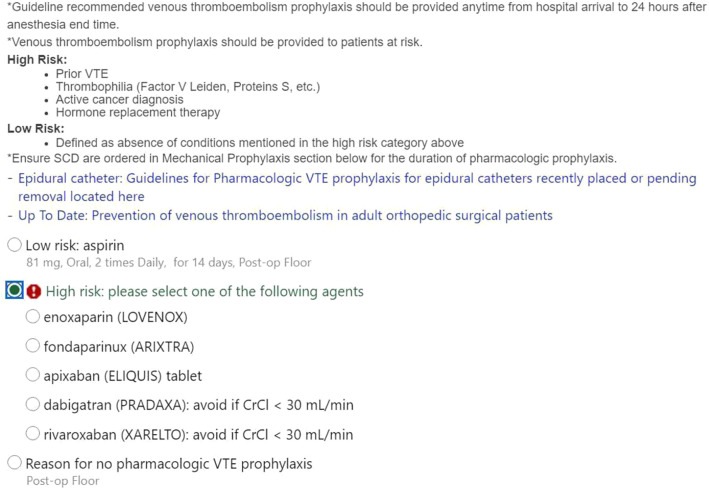
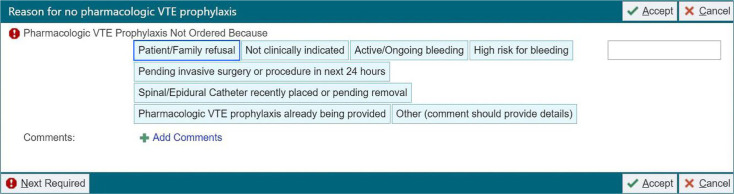
Methods: Our study was conducted at Duke University Medical Center. Our intervention consisted of a four-pillar initiative structure: building a consensus on appropriate VTE prophylaxis through surgical specialty champions; incorporating VTE prophylaxis recommendations in the provider electronic health record workflow; using a measurement dashboard; and reviewing all individual postoperative VTE cases with clinical champions. We collected pre-intervention data on PSI-12 rates for 12 months ending in September 2019, initiated improvement strategies in September 2020 and reviewed results of our improvement strategies at the end of December 2021 for a 15-month timespan.
Results: In 2019, we identified 94 postoperative VTE events per 13 522 adult surgical discharges for a rate of 0.695%. In 2021, we identified 71 postoperative VTE events per 12 292 adult surgical discharges for a rate of 0.578%. This represents a gross reduction in postoperative VTE event rate by 23 when comparing our pre-intervention and post-intervention timeframes which was both a clinically and statistically significant difference (p<0.0001, 95% CI: 0.1050 to 0.1288).
Conclusions: The four-pillar initiative structure implemented was successful in reducing postoperative VTE rates, reducing costs and lowering hospital length of stay.




 京公网安备 11010802042870号
京ICP备2023020795号-1
京公网安备 11010802042870号
京ICP备2023020795号-1

 分享
分享
 求助内容:
求助内容: 应助结果提醒方式:
 扫码关注我们
