Angela O'Dea, Mahnaz Sharafkhani, Margaret Codd, Mary Browne, Paul O'Connor, Marie E Ward
{"title":"Principles for the conduct of human factors/ergonomics in healthcare: a scoping study of the published evidence.","authors":"Angela O'Dea, Mahnaz Sharafkhani, Margaret Codd, Mary Browne, Paul O'Connor, Marie E Ward","doi":"10.1136/bmjoq-2024-003222","DOIUrl":null,"url":null,"abstract":"<p><strong>Background: </strong>There is a need for guidance to support human factors/ergonomics (HFE) practitioners to conceive and design HFE interventions that live up to the fundamental principles underpinning the discipline of HFE. The principles are that HFE has a systems focus, is design driven and focuses on both performance and well-being outcomes.</p><p><strong>Objectives: </strong>The objectives of this scoping review are to: identify studies that meet these principles in order to discover how commonly HFE studies meet the principles for the practice of HFE; the scope and characteristics of studies that meet the principles; and the learning that can be gleaned from these studies.</p><p><strong>Eligibility criteria: </strong>The principles were operationalised into four criteria that were used to select studies: (1) The intervention acts on more than one aspect or element of the system; (2) a context-relevant needs assessment or systems analysis phase is undertaken to design the intervention; (3) the intervention has an active element that is designed to enhance safety, quality, efficiency, effectiveness or well-being and (4) the intervention is evaluated.</p><p><strong>Sources of evidence: </strong>The review considered all studies published in peer-reviewed journals between 2010 and July 2024 in which an HFE or related intervention is presented and evaluated. Electronic searches were conducted across five databases plus Google Scholar.</p><p><strong>Charting methods: </strong>Data extraction was done by consensus using extraction forms and following two stages: (1) data extraction and (2) data interpretation.</p><p><strong>Results: </strong>A total of 13 intervention studies met the inclusion criteria, suggesting that adherence to core HFE principles is rare. All included studies self-identified as HFE intervention studies. All interventions had a clearly defined scope and most targeted at least four system elements, that is, person, tools, technology, task, process, organisation, environment. The 'people' element was the one most commonly targeted. A wide range of organisational level and patient outcomes were measured, but no employee safety or well-being outcomes were measured in the included studies. In all cases, the intervention team included healthcare providers working with HFE/systems engineering/improvement experts, who often led the project.</p>","PeriodicalId":9052,"journal":{"name":"BMJ Open Quality","volume":"14 2","pages":""},"PeriodicalIF":1.6000,"publicationDate":"2025-04-03","publicationTypes":"Journal Article","fieldsOfStudy":null,"isOpenAccess":false,"openAccessPdf":"https://www.ncbi.nlm.nih.gov/pmc/articles/PMC11969590/pdf/","citationCount":"0","resultStr":null,"platform":"Semanticscholar","paperid":null,"PeriodicalName":"BMJ Open Quality","FirstCategoryId":"1085","ListUrlMain":"https://doi.org/10.1136/bmjoq-2024-003222","RegionNum":0,"RegionCategory":null,"ArticlePicture":[],"TitleCN":null,"AbstractTextCN":null,"PMCID":null,"EPubDate":"","PubModel":"","JCR":"Q4","JCRName":"HEALTH CARE SCIENCES & SERVICES","Score":null,"Total":0}
引用次数: 0
Abstract
Background: There is a need for guidance to support human factors/ergonomics (HFE) practitioners to conceive and design HFE interventions that live up to the fundamental principles underpinning the discipline of HFE. The principles are that HFE has a systems focus, is design driven and focuses on both performance and well-being outcomes.
Objectives: The objectives of this scoping review are to: identify studies that meet these principles in order to discover how commonly HFE studies meet the principles for the practice of HFE; the scope and characteristics of studies that meet the principles; and the learning that can be gleaned from these studies.
Eligibility criteria: The principles were operationalised into four criteria that were used to select studies: (1) The intervention acts on more than one aspect or element of the system; (2) a context-relevant needs assessment or systems analysis phase is undertaken to design the intervention; (3) the intervention has an active element that is designed to enhance safety, quality, efficiency, effectiveness or well-being and (4) the intervention is evaluated.
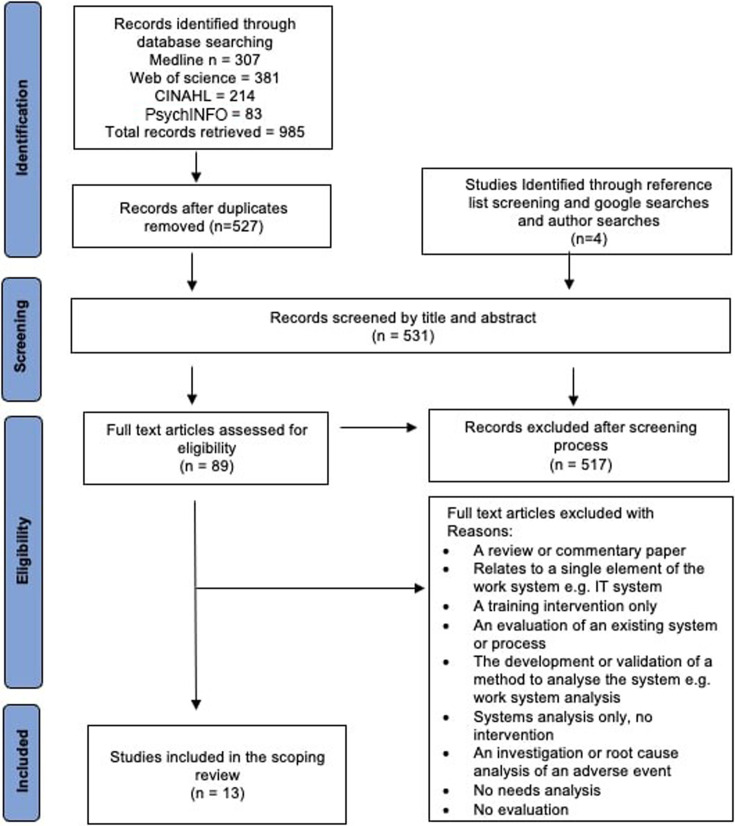
Sources of evidence: The review considered all studies published in peer-reviewed journals between 2010 and July 2024 in which an HFE or related intervention is presented and evaluated. Electronic searches were conducted across five databases plus Google Scholar.
Charting methods: Data extraction was done by consensus using extraction forms and following two stages: (1) data extraction and (2) data interpretation.
Results: A total of 13 intervention studies met the inclusion criteria, suggesting that adherence to core HFE principles is rare. All included studies self-identified as HFE intervention studies. All interventions had a clearly defined scope and most targeted at least four system elements, that is, person, tools, technology, task, process, organisation, environment. The 'people' element was the one most commonly targeted. A wide range of organisational level and patient outcomes were measured, but no employee safety or well-being outcomes were measured in the included studies. In all cases, the intervention team included healthcare providers working with HFE/systems engineering/improvement experts, who often led the project.




 京公网安备 11010802042870号
京ICP备2023020795号-1
京公网安备 11010802042870号
京ICP备2023020795号-1

 分享
分享
 求助内容:
求助内容: 应助结果提醒方式:
 扫码关注我们
