Liang Liu, Liu Zhang, Daohai Zhang, Tao Guan, Ting He, Bo Liang, Jinghong Zhao
{"title":"Risk prediction of cardiovascular events in peritoneal dialysis patients.","authors":"Liang Liu, Liu Zhang, Daohai Zhang, Tao Guan, Ting He, Bo Liang, Jinghong Zhao","doi":"10.1186/s12882-025-04091-6","DOIUrl":null,"url":null,"abstract":"<p><strong>Background: </strong>Cardiovascular events (CVEs), which refer to a spectrum of conditions including heart attacks, stroke and peripheral vascular disease, are the primary cause of death among peritoneal dialysis (PD) patients, accounting for nearly 40% of deaths. Early identification of high-risk individuals is essential to lessen this burden. Machine learning is particularly suited for this task due to its ability to discern complex, non-linear relationships between various clinical variables, which is essential for accurately predicting CVEs in the context of PD. Our study aimed to develop a predictive machine learning model to identify PD patients at risk of CVEs, offering healthcare providers a tool for proactive intervention.</p><p><strong>Methods: </strong>A total of 251 PD patients were enrolled in the study, with an additional 42 patients included for external validation. Initially, 37 variables were collected but reduced to 25 via Lasso regression. Six supervised machine learning algorithms were evaluated, and XGBoost was chosen as the optimal model based on AUC. Both internal and external validation confirmed the model's efficacy, and a web application was developed using the final XGBoost model, which utilized 12 selected variables.</p><p><strong>Results: </strong>Among the 251 patients, 40 (15.94%) developed CVEs. The XGBoost model demonstrated an AUC of 0.94 in 5-fold cross-validation. A simplified XGBoost model using 12 variables demonstrated robust prediction capabilities with an AUC of 0.88 in 5-fold cross-validation and 0.78 in external validation. The top five predictors of CVEs were age at catheterization, height, HDL, gender and hemoglobin. According to the SHAP summary plot, older age at catheterization, shorter height, male gender, higher serum HDL and lower hemoglobin levels correlated with increased CVEs risk in PD patients.</p><p><strong>Conclusions: </strong>The machine learning model, based on 12 key variables, offers an effective tool for predicting CVEs in PD patients, enabling early identification of high-risk cases. This model has been integrated into a web application.</p>","PeriodicalId":9089,"journal":{"name":"BMC Nephrology","volume":"26 1","pages":"177"},"PeriodicalIF":2.4000,"publicationDate":"2025-04-05","publicationTypes":"Journal Article","fieldsOfStudy":null,"isOpenAccess":false,"openAccessPdf":"https://www.ncbi.nlm.nih.gov/pmc/articles/PMC11972494/pdf/","citationCount":"0","resultStr":null,"platform":"Semanticscholar","paperid":null,"PeriodicalName":"BMC Nephrology","FirstCategoryId":"3","ListUrlMain":"https://doi.org/10.1186/s12882-025-04091-6","RegionNum":4,"RegionCategory":"医学","ArticlePicture":[],"TitleCN":null,"AbstractTextCN":null,"PMCID":null,"EPubDate":"","PubModel":"","JCR":"Q2","JCRName":"UROLOGY & NEPHROLOGY","Score":null,"Total":0}
引用次数: 0
Abstract
Background: Cardiovascular events (CVEs), which refer to a spectrum of conditions including heart attacks, stroke and peripheral vascular disease, are the primary cause of death among peritoneal dialysis (PD) patients, accounting for nearly 40% of deaths. Early identification of high-risk individuals is essential to lessen this burden. Machine learning is particularly suited for this task due to its ability to discern complex, non-linear relationships between various clinical variables, which is essential for accurately predicting CVEs in the context of PD. Our study aimed to develop a predictive machine learning model to identify PD patients at risk of CVEs, offering healthcare providers a tool for proactive intervention.
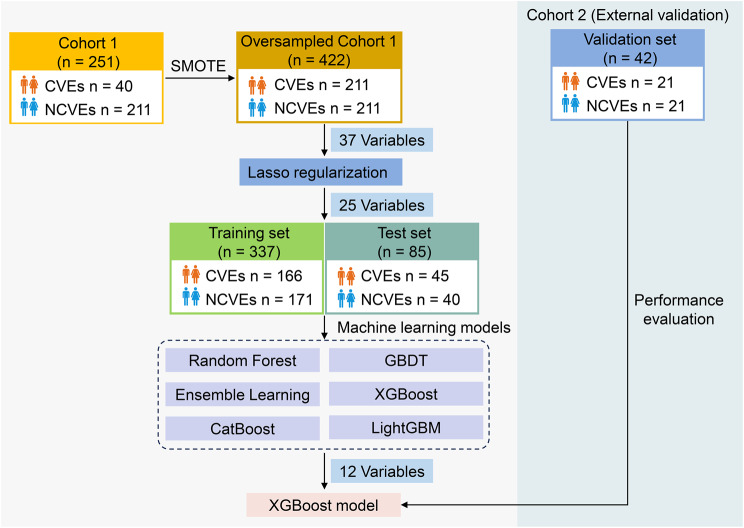
Methods: A total of 251 PD patients were enrolled in the study, with an additional 42 patients included for external validation. Initially, 37 variables were collected but reduced to 25 via Lasso regression. Six supervised machine learning algorithms were evaluated, and XGBoost was chosen as the optimal model based on AUC. Both internal and external validation confirmed the model's efficacy, and a web application was developed using the final XGBoost model, which utilized 12 selected variables.
Results: Among the 251 patients, 40 (15.94%) developed CVEs. The XGBoost model demonstrated an AUC of 0.94 in 5-fold cross-validation. A simplified XGBoost model using 12 variables demonstrated robust prediction capabilities with an AUC of 0.88 in 5-fold cross-validation and 0.78 in external validation. The top five predictors of CVEs were age at catheterization, height, HDL, gender and hemoglobin. According to the SHAP summary plot, older age at catheterization, shorter height, male gender, higher serum HDL and lower hemoglobin levels correlated with increased CVEs risk in PD patients.
Conclusions: The machine learning model, based on 12 key variables, offers an effective tool for predicting CVEs in PD patients, enabling early identification of high-risk cases. This model has been integrated into a web application.
期刊介绍:
BMC Nephrology is an open access journal publishing original peer-reviewed research articles in all aspects of the prevention, diagnosis and management of kidney and associated disorders, as well as related molecular genetics, pathophysiology, and epidemiology.






 京公网安备 11010802042870号
京ICP备2023020795号-1
京公网安备 11010802042870号
京ICP备2023020795号-1

 分享
分享
 求助内容:
求助内容: 应助结果提醒方式:
 扫码关注我们
