{"title":"The association between deep vein thrombosis at admission and the time from injury to admission in hip fractures.","authors":"Jian Liu, Miao He, Ruoyu Song, Jie Li","doi":"10.1186/s12877-025-05875-z","DOIUrl":null,"url":null,"abstract":"<p><strong>Objective: </strong>This study aims to explore the association between deep vein thrombosis (DVT) of the lower limbs at admission and the time from injury to admission (TFITA), providing clinical references for the prevention of DVT at admission.</p><p><strong>Patients and methods: </strong>Data was collected from patients who were admitted to our hospital for hip fractures between January 2017 and December 2023. Univariable and multivariable logistic regression analyses were conducted to examine the relationship between TFITA and DVT at admission, using both continuous and categorized variables based on thresholds for TFITA. Propensity score matching (PSM) and subanalyses stratified by TFITA and characteristics of DVT at admission were further employed to investigate the relationship. Additionally, restricted cubic splines (RCS) analysis was performed to determine whether a non-linear association exists between TFITA and DVT at admission.</p><p><strong>Results: </strong>A total of 1230 patients were included in the statistical analysis, comprising 116 patients with DVT at admission and 1114 without. Both Univariable and multivariable logistic regression analyses indicated a positive association between TFITA and DVT at admission before and after matching. Subanalyses revealed significant associations for older age, low-energy injuries, high D-dimer levels, and low platelet counts subgroup with TFITA and DVT at admission. RCS analysis indicated no non-linear relationship between TFITA and DVT at admission.</p><p><strong>Conclusion: </strong>For patients with hip fractures, longer TFITA is positively correlated with the incidence of DVT at admission. These findings support the potential of TFITA as an intervention strategy for managing DVT at admission.</p>","PeriodicalId":9056,"journal":{"name":"BMC Geriatrics","volume":"25 1","pages":"222"},"PeriodicalIF":3.8000,"publicationDate":"2025-04-05","publicationTypes":"Journal Article","fieldsOfStudy":null,"isOpenAccess":false,"openAccessPdf":"https://www.ncbi.nlm.nih.gov/pmc/articles/PMC11971877/pdf/","citationCount":"0","resultStr":null,"platform":"Semanticscholar","paperid":null,"PeriodicalName":"BMC Geriatrics","FirstCategoryId":"3","ListUrlMain":"https://doi.org/10.1186/s12877-025-05875-z","RegionNum":2,"RegionCategory":"医学","ArticlePicture":[],"TitleCN":null,"AbstractTextCN":null,"PMCID":null,"EPubDate":"","PubModel":"","JCR":"Q2","JCRName":"GERIATRICS & GERONTOLOGY","Score":null,"Total":0}
引用次数: 0
Abstract
Objective: This study aims to explore the association between deep vein thrombosis (DVT) of the lower limbs at admission and the time from injury to admission (TFITA), providing clinical references for the prevention of DVT at admission.
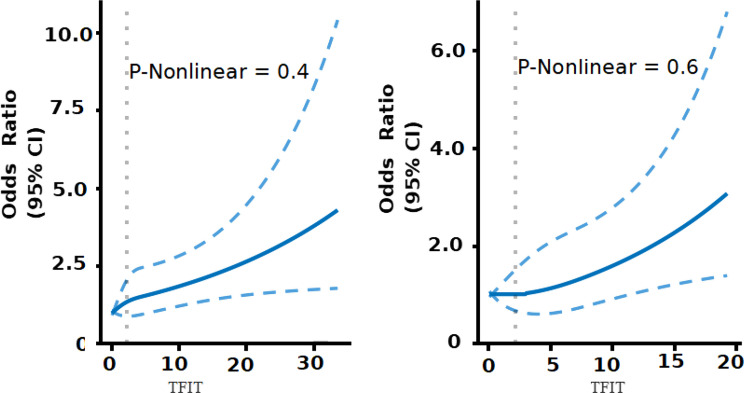
Patients and methods: Data was collected from patients who were admitted to our hospital for hip fractures between January 2017 and December 2023. Univariable and multivariable logistic regression analyses were conducted to examine the relationship between TFITA and DVT at admission, using both continuous and categorized variables based on thresholds for TFITA. Propensity score matching (PSM) and subanalyses stratified by TFITA and characteristics of DVT at admission were further employed to investigate the relationship. Additionally, restricted cubic splines (RCS) analysis was performed to determine whether a non-linear association exists between TFITA and DVT at admission.
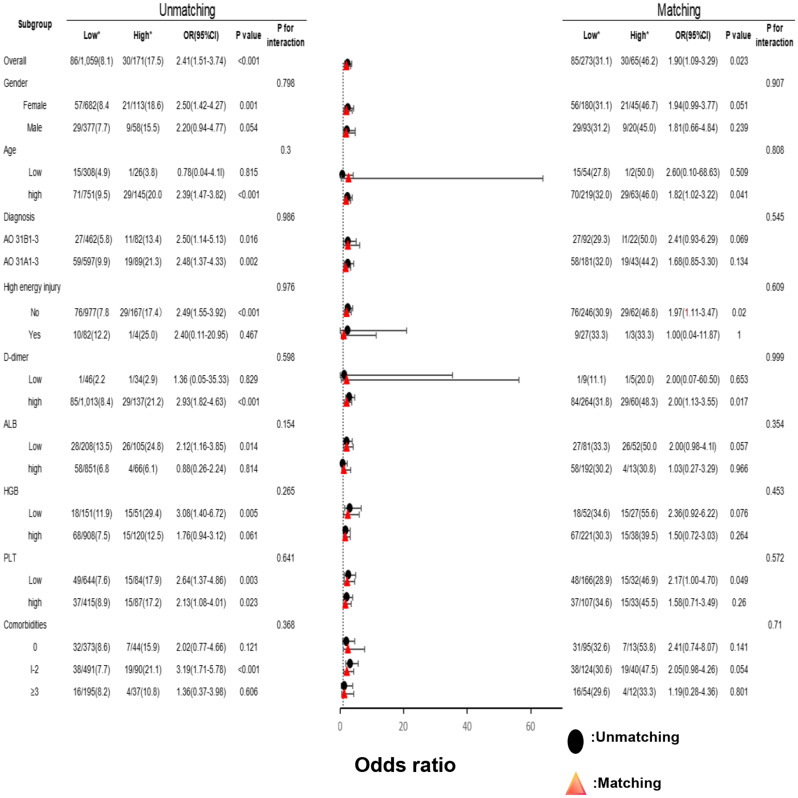
Results: A total of 1230 patients were included in the statistical analysis, comprising 116 patients with DVT at admission and 1114 without. Both Univariable and multivariable logistic regression analyses indicated a positive association between TFITA and DVT at admission before and after matching. Subanalyses revealed significant associations for older age, low-energy injuries, high D-dimer levels, and low platelet counts subgroup with TFITA and DVT at admission. RCS analysis indicated no non-linear relationship between TFITA and DVT at admission.
Conclusion: For patients with hip fractures, longer TFITA is positively correlated with the incidence of DVT at admission. These findings support the potential of TFITA as an intervention strategy for managing DVT at admission.
期刊介绍:
BMC Geriatrics is an open access journal publishing original peer-reviewed research articles in all aspects of the health and healthcare of older people, including the effects of healthcare systems and policies. The journal also welcomes research focused on the aging process, including cellular, genetic, and physiological processes and cognitive modifications.





 京公网安备 11010802042870号
京ICP备2023020795号-1
京公网安备 11010802042870号
京ICP备2023020795号-1

 分享
分享
 求助内容:
求助内容: 应助结果提醒方式:
 扫码关注我们
