Yingjie Wu, Fengli Wu, Jun Li, Hao Zhou, Long Ma, Xinsheng Yao
{"title":"scTCR-seq and HTS reveal a special novel TRBD2-TRBJ1 rearrangement in mammalian TRB CDR3 repertoire.","authors":"Yingjie Wu, Fengli Wu, Jun Li, Hao Zhou, Long Ma, Xinsheng Yao","doi":"10.1186/s12864-025-11506-z","DOIUrl":null,"url":null,"abstract":"<p><p>Mammalian T cell receptor (TCR) beta-chain (TRB) V-D-J rearrangement mainly follows the \"12/23 rule\", and the \"D-J rearrangement preceding the V-(D-J) rearrangement\". Owing to the physical position of the D-J-C cluster in the TRB locus, the TRBD2 (D2) gene cannot directly perform inversional rearrangement or deletional/loop-out rearrangement with the TRBJ1 (J1) gene. Our previous studies revealed a single reverse TRBV30 (TRBV31 in mice) gene in the mammalian TRB locus, which can cause indirect rearrangement of the D2 gene and J1 gene; however, the mechanism and proportion involved in germline gene rearrangement are unknown. We obtained TRB CDR3 repertoires of thymus and peripheral tissues from humans and mice by HTS and scTCR-seq and found that 14% of the rearrangements in which the D2 gene is involved are D2-J1 rearrangements (D2-J2 rearrangements account for approximately 86%). The mechanism is that the reverse V30 gene preferentially performs inversional rearrangement with the D2 gene (V30-D2), leading to V30-D2-J1 rearrangement in humans, or the reverse V30 gene preferentially performs inversional rearrangement with the D1 gene (V30-D1), allowing the forward V genes (Vx) to perform Vx-D2-J1 rearrangement. We further found that D2-J1 rearrangements were present in more than 24% and more than 15% of the D2 gene rearrangements in rhesus monkeys and bats, respectively. Moreover, in bovine containing D1J1C1, D3J3C3, and D2J2C2 clusters, more than 11% D3-J1 and D2-J1 rearrangements and more than 22% D2-J3 rearrangements were found. This study provides a new perspective and feasible solution for further research on the significance of the special V-D-J recombination pattern in the mammalian TRB locus and the CDR3 repertoire formed by D2-J1 rearrangement.</p>","PeriodicalId":9030,"journal":{"name":"BMC Genomics","volume":"26 1","pages":"341"},"PeriodicalIF":3.7000,"publicationDate":"2025-04-04","publicationTypes":"Journal Article","fieldsOfStudy":null,"isOpenAccess":false,"openAccessPdf":"https://www.ncbi.nlm.nih.gov/pmc/articles/PMC11971796/pdf/","citationCount":"0","resultStr":null,"platform":"Semanticscholar","paperid":null,"PeriodicalName":"BMC Genomics","FirstCategoryId":"99","ListUrlMain":"https://doi.org/10.1186/s12864-025-11506-z","RegionNum":2,"RegionCategory":"生物学","ArticlePicture":[],"TitleCN":null,"AbstractTextCN":null,"PMCID":null,"EPubDate":"","PubModel":"","JCR":"Q2","JCRName":"BIOTECHNOLOGY & APPLIED MICROBIOLOGY","Score":null,"Total":0}
引用次数: 0
Abstract
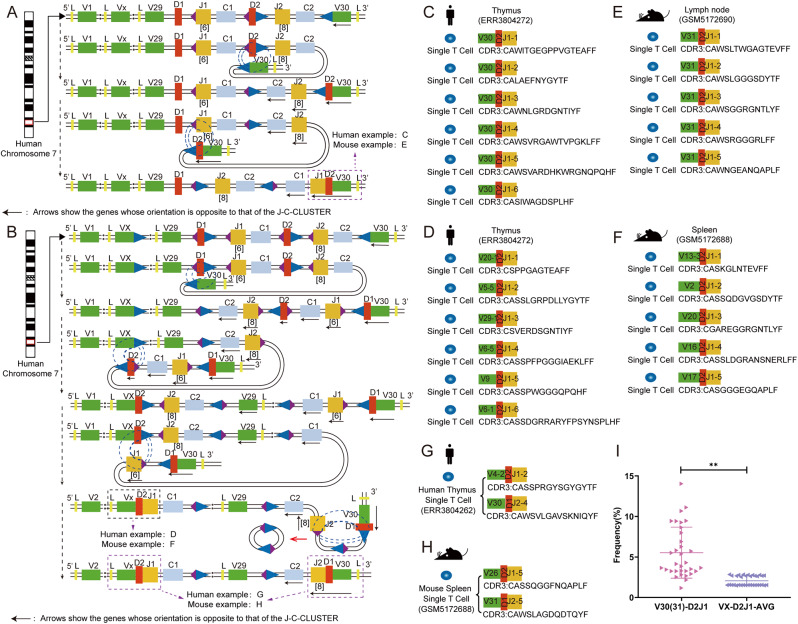
Mammalian T cell receptor (TCR) beta-chain (TRB) V-D-J rearrangement mainly follows the "12/23 rule", and the "D-J rearrangement preceding the V-(D-J) rearrangement". Owing to the physical position of the D-J-C cluster in the TRB locus, the TRBD2 (D2) gene cannot directly perform inversional rearrangement or deletional/loop-out rearrangement with the TRBJ1 (J1) gene. Our previous studies revealed a single reverse TRBV30 (TRBV31 in mice) gene in the mammalian TRB locus, which can cause indirect rearrangement of the D2 gene and J1 gene; however, the mechanism and proportion involved in germline gene rearrangement are unknown. We obtained TRB CDR3 repertoires of thymus and peripheral tissues from humans and mice by HTS and scTCR-seq and found that 14% of the rearrangements in which the D2 gene is involved are D2-J1 rearrangements (D2-J2 rearrangements account for approximately 86%). The mechanism is that the reverse V30 gene preferentially performs inversional rearrangement with the D2 gene (V30-D2), leading to V30-D2-J1 rearrangement in humans, or the reverse V30 gene preferentially performs inversional rearrangement with the D1 gene (V30-D1), allowing the forward V genes (Vx) to perform Vx-D2-J1 rearrangement. We further found that D2-J1 rearrangements were present in more than 24% and more than 15% of the D2 gene rearrangements in rhesus monkeys and bats, respectively. Moreover, in bovine containing D1J1C1, D3J3C3, and D2J2C2 clusters, more than 11% D3-J1 and D2-J1 rearrangements and more than 22% D2-J3 rearrangements were found. This study provides a new perspective and feasible solution for further research on the significance of the special V-D-J recombination pattern in the mammalian TRB locus and the CDR3 repertoire formed by D2-J1 rearrangement.
期刊介绍:
BMC Genomics is an open access, peer-reviewed journal that considers articles on all aspects of genome-scale analysis, functional genomics, and proteomics.
BMC Genomics is part of the BMC series which publishes subject-specific journals focused on the needs of individual research communities across all areas of biology and medicine. We offer an efficient, fair and friendly peer review service, and are committed to publishing all sound science, provided that there is some advance in knowledge presented by the work.






 京公网安备 11010802042870号
京ICP备2023020795号-1
京公网安备 11010802042870号
京ICP备2023020795号-1

 分享
分享
 求助内容:
求助内容: 应助结果提醒方式:
 扫码关注我们
