Personalised selection of medication for newly diagnosed adult epilepsy: study protocol of a first-in-class, double-blind, randomised controlled trial.
Daniel Thom, Richard Shek-Kwan Chang, Natasha A Lannin, Zanfina Ademi, Zongyuan Ge, David Reutens, Terence O'Brien, Wendyl D'Souza, Piero Perucca, Sandra Reeder, Armin Nikpour, Chong Wong, Michelle Kiley, Jacqui-Lyn Saw, John-Paul Nicolo, Udaya Seneviratne, Patrick Carney, Dean Jones, Ernest Somerville, Clare Stapleton, Emma Foster, Lata Vadlamudi, David N Vaughan, James Lee, Tania Farrar, Mark Howard, Robert Sparrow, Zhibin Chen, Patrick Kwan
{"title":"Personalised selection of medication for newly diagnosed adult epilepsy: study protocol of a first-in-class, double-blind, randomised controlled trial.","authors":"Daniel Thom, Richard Shek-Kwan Chang, Natasha A Lannin, Zanfina Ademi, Zongyuan Ge, David Reutens, Terence O'Brien, Wendyl D'Souza, Piero Perucca, Sandra Reeder, Armin Nikpour, Chong Wong, Michelle Kiley, Jacqui-Lyn Saw, John-Paul Nicolo, Udaya Seneviratne, Patrick Carney, Dean Jones, Ernest Somerville, Clare Stapleton, Emma Foster, Lata Vadlamudi, David N Vaughan, James Lee, Tania Farrar, Mark Howard, Robert Sparrow, Zhibin Chen, Patrick Kwan","doi":"10.1136/bmjopen-2024-086607","DOIUrl":null,"url":null,"abstract":"<p><strong>Introduction: </strong>Selection of antiseizure medications (ASMs) for newly diagnosed epilepsy remains largely a trial-and-error process. We have developed a machine learning (ML) model using retrospective data collected from five international cohorts that predicts response to different ASMs as the initial treatment for individual adults with new-onset epilepsy. This study aims to prospectively evaluate this model in Australia using a randomised controlled trial design.</p><p><strong>Methods and analysis: </strong>At least 234 adult patients with newly diagnosed epilepsy will be recruited from 14 centres in Australia. Patients will be randomised 1:1 to the ML group or usual care group. The ML group will receive the ASM recommended by the model unless it is considered contraindicated by the neurologist. The usual care group will receive the ASM selected by the neurologist alone. Both the patient and neurologists conducting the follow-up will be blinded to the group assignment. Both groups will be followed up for 52 weeks to assess treatment outcomes. Additional information on adverse events, quality of life, mood and use of healthcare services and productivity will be collected using validated questionnaires. Acceptability of the model will also be assessed.The primary outcome will be the proportion of participants who achieve seizure-freedom (defined as no seizures during the 12-month follow-up period) while taking the initially prescribed ASM. Secondary outcomes include time to treatment failure, time to first seizure after randomisation, changes in mood assessment score and quality of life score, direct healthcare costs, and loss of productivity during the treatment period.This trial will provide class I evidence for the effectiveness of a ML model as a decision support tool for neurologists to select the first ASM for adults with newly diagnosed epilepsy.</p><p><strong>Ethics and dissemination: </strong>This study is approved by the Alfred Health Human Research Ethics Committee (Project 130/23). Findings will be presented in academic conferences and submitted to peer-reviewed journals for publication.</p><p><strong>Trial registration number: </strong>ACTRN12623000209695.</p>","PeriodicalId":9158,"journal":{"name":"BMJ Open","volume":"15 4","pages":"e086607"},"PeriodicalIF":2.3000,"publicationDate":"2025-04-05","publicationTypes":"Journal Article","fieldsOfStudy":null,"isOpenAccess":false,"openAccessPdf":"https://www.ncbi.nlm.nih.gov/pmc/articles/PMC11973792/pdf/","citationCount":"0","resultStr":null,"platform":"Semanticscholar","paperid":null,"PeriodicalName":"BMJ Open","FirstCategoryId":"3","ListUrlMain":"https://doi.org/10.1136/bmjopen-2024-086607","RegionNum":3,"RegionCategory":"医学","ArticlePicture":[],"TitleCN":null,"AbstractTextCN":null,"PMCID":null,"EPubDate":"","PubModel":"","JCR":"Q1","JCRName":"MEDICINE, GENERAL & INTERNAL","Score":null,"Total":0}
引用次数: 0
Abstract
Introduction: Selection of antiseizure medications (ASMs) for newly diagnosed epilepsy remains largely a trial-and-error process. We have developed a machine learning (ML) model using retrospective data collected from five international cohorts that predicts response to different ASMs as the initial treatment for individual adults with new-onset epilepsy. This study aims to prospectively evaluate this model in Australia using a randomised controlled trial design.
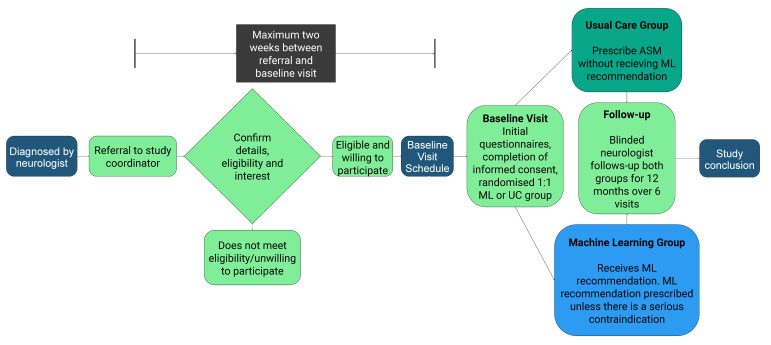
Methods and analysis: At least 234 adult patients with newly diagnosed epilepsy will be recruited from 14 centres in Australia. Patients will be randomised 1:1 to the ML group or usual care group. The ML group will receive the ASM recommended by the model unless it is considered contraindicated by the neurologist. The usual care group will receive the ASM selected by the neurologist alone. Both the patient and neurologists conducting the follow-up will be blinded to the group assignment. Both groups will be followed up for 52 weeks to assess treatment outcomes. Additional information on adverse events, quality of life, mood and use of healthcare services and productivity will be collected using validated questionnaires. Acceptability of the model will also be assessed.The primary outcome will be the proportion of participants who achieve seizure-freedom (defined as no seizures during the 12-month follow-up period) while taking the initially prescribed ASM. Secondary outcomes include time to treatment failure, time to first seizure after randomisation, changes in mood assessment score and quality of life score, direct healthcare costs, and loss of productivity during the treatment period.This trial will provide class I evidence for the effectiveness of a ML model as a decision support tool for neurologists to select the first ASM for adults with newly diagnosed epilepsy.
Ethics and dissemination: This study is approved by the Alfred Health Human Research Ethics Committee (Project 130/23). Findings will be presented in academic conferences and submitted to peer-reviewed journals for publication.
期刊介绍:
BMJ Open is an online, open access journal, dedicated to publishing medical research from all disciplines and therapeutic areas. The journal publishes all research study types, from study protocols to phase I trials to meta-analyses, including small or specialist studies. Publishing procedures are built around fully open peer review and continuous publication, publishing research online as soon as the article is ready.



 京公网安备 11010802042870号
京ICP备2023020795号-1
京公网安备 11010802042870号
京ICP备2023020795号-1

 分享
分享
 求助内容:
求助内容: 应助结果提醒方式:
 扫码关注我们
