{"title":"Different risk factors for elevated blood pressure according to abdominal obesity in overweight children and adolescents.","authors":"Soo In Jeong, Hae-Rim Kim, Sung Hye Kim","doi":"10.1186/s12887-025-05634-4","DOIUrl":null,"url":null,"abstract":"<p><strong>Background: </strong>The increasing hypertension (HTN) prevalence in children, largely driven by obesity, highlights the need to investigate its risk factors, including the role of abdominal obesity.</p><p><strong>Methods: </strong>We analysed data from the Korea National Health and Nutrition Examination Survey (2007-2021) to assess the prevalence of overweight and obesity (OW-OB), elevated blood pressure (EBP), and HTN among 11,554 participants aged 10-18 years. EBP and HTN were defined according to the 2017 American Academy of Pediatrics guidelines, and abdominal obesity was defined as a waist-to-height ratio (WHtR) of ≥ 0.5. Secular trends in the prevalence of OW-OB and EBP-HTN were examined across five time periods, and risk factors for EBP-HTN were evaluated in OW-OB children stratified by abdominal obesity status.</p><p><strong>Results: </strong>The prevalence of EBP, HTN, and OW-OB was 8.22% (95% confidence interval [CI], 7.60-8.86), 10.46% (95% CI, 9.72-11.20), and 25.11% (95% CI, 24.17-26.05), respectively. Among the 3,015 participants with OW-OB, 13.53% (95% CI, 12.03-15.04) and 17.64% (95% CI, 15.98-19.31) were diagnosed with EBP and HTN, respectively. Although the prevalence of OW-OB and EBP-HTN had increasing trends from 2007 to 2009 to 2019-2021, these trends were not statistically significant. In the children with OW-OB, obesity severity, male sex, older age, and paternal HTN were associated with EBP-HTN. The HTN risk factors differed according to abdominal obesity status. In participants with abdominal obesity, male sex (OR 2.32, 95% CI 1.643-3.299; p < 0.0001), older age (OR 1.16, 95% CI 1.102-1.233; p < 0.0001), and severe obesity (OR 3.12, 95% CI 1.991-4.895; p < 0.0001) were significant risk factors; whereas, in those without abdominal obesity, paternal HTN (OR 1.66, 95% CI 1.207-2.303; p = 0.0025), hypercholesterolemia (OR 1.85, 95% CI 1.114-3.083; p = 0.0178), male sex (OR 1.83, 95% CI 1.329-2.530; p = 0.0002), and older age (OR 1.11, 95% CI 1.036-1.198; p = 0.0038) were significant risk factors.</p><p><strong>Conclusions: </strong>In children with overweight or obesity, the risk factors for EBP-HTN vary depending on the presence of abdominal obesity. These findings highlight the need for differentiated surveillance and prevention strategies based on abdominal obesity status in this high-risk population.</p><p><strong>Clinical trial number: </strong>Not applicable.</p>","PeriodicalId":9144,"journal":{"name":"BMC Pediatrics","volume":"25 1","pages":"278"},"PeriodicalIF":2.0000,"publicationDate":"2025-04-04","publicationTypes":"Journal Article","fieldsOfStudy":null,"isOpenAccess":false,"openAccessPdf":"https://www.ncbi.nlm.nih.gov/pmc/articles/PMC11970025/pdf/","citationCount":"0","resultStr":null,"platform":"Semanticscholar","paperid":null,"PeriodicalName":"BMC Pediatrics","FirstCategoryId":"3","ListUrlMain":"https://doi.org/10.1186/s12887-025-05634-4","RegionNum":3,"RegionCategory":"医学","ArticlePicture":[],"TitleCN":null,"AbstractTextCN":null,"PMCID":null,"EPubDate":"","PubModel":"","JCR":"Q2","JCRName":"PEDIATRICS","Score":null,"Total":0}
引用次数: 0
Abstract
Background: The increasing hypertension (HTN) prevalence in children, largely driven by obesity, highlights the need to investigate its risk factors, including the role of abdominal obesity.
Methods: We analysed data from the Korea National Health and Nutrition Examination Survey (2007-2021) to assess the prevalence of overweight and obesity (OW-OB), elevated blood pressure (EBP), and HTN among 11,554 participants aged 10-18 years. EBP and HTN were defined according to the 2017 American Academy of Pediatrics guidelines, and abdominal obesity was defined as a waist-to-height ratio (WHtR) of ≥ 0.5. Secular trends in the prevalence of OW-OB and EBP-HTN were examined across five time periods, and risk factors for EBP-HTN were evaluated in OW-OB children stratified by abdominal obesity status.
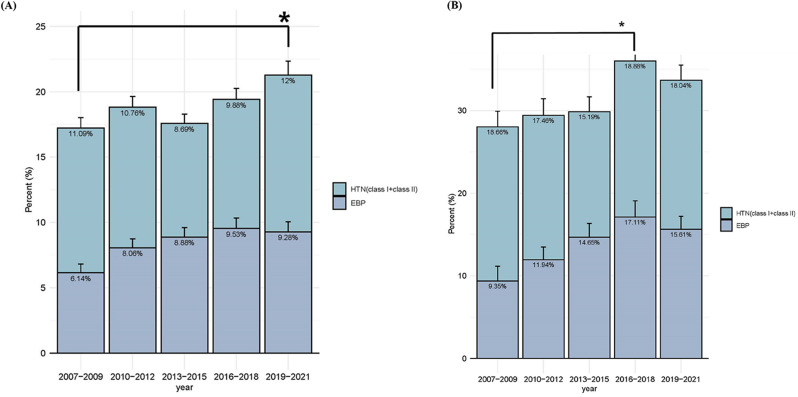
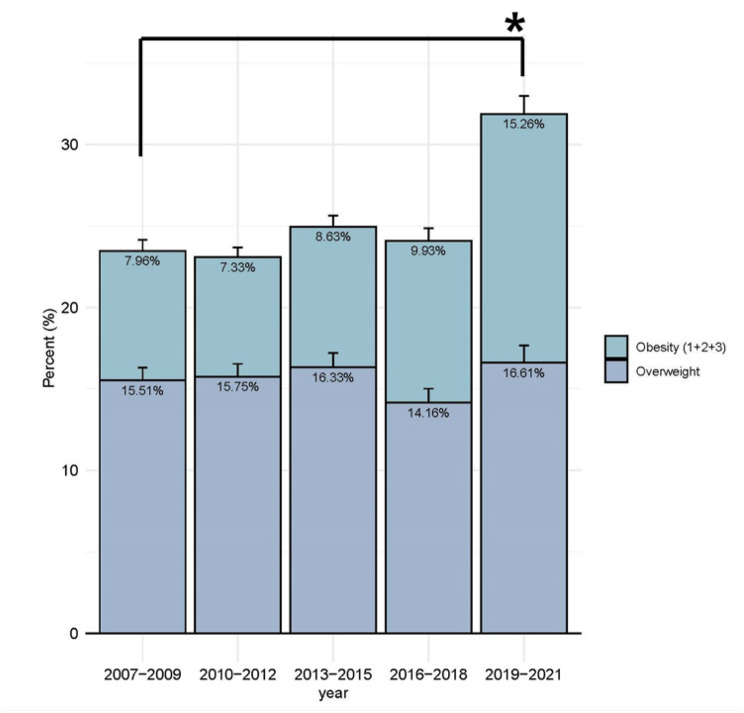
Results: The prevalence of EBP, HTN, and OW-OB was 8.22% (95% confidence interval [CI], 7.60-8.86), 10.46% (95% CI, 9.72-11.20), and 25.11% (95% CI, 24.17-26.05), respectively. Among the 3,015 participants with OW-OB, 13.53% (95% CI, 12.03-15.04) and 17.64% (95% CI, 15.98-19.31) were diagnosed with EBP and HTN, respectively. Although the prevalence of OW-OB and EBP-HTN had increasing trends from 2007 to 2009 to 2019-2021, these trends were not statistically significant. In the children with OW-OB, obesity severity, male sex, older age, and paternal HTN were associated with EBP-HTN. The HTN risk factors differed according to abdominal obesity status. In participants with abdominal obesity, male sex (OR 2.32, 95% CI 1.643-3.299; p < 0.0001), older age (OR 1.16, 95% CI 1.102-1.233; p < 0.0001), and severe obesity (OR 3.12, 95% CI 1.991-4.895; p < 0.0001) were significant risk factors; whereas, in those without abdominal obesity, paternal HTN (OR 1.66, 95% CI 1.207-2.303; p = 0.0025), hypercholesterolemia (OR 1.85, 95% CI 1.114-3.083; p = 0.0178), male sex (OR 1.83, 95% CI 1.329-2.530; p = 0.0002), and older age (OR 1.11, 95% CI 1.036-1.198; p = 0.0038) were significant risk factors.
Conclusions: In children with overweight or obesity, the risk factors for EBP-HTN vary depending on the presence of abdominal obesity. These findings highlight the need for differentiated surveillance and prevention strategies based on abdominal obesity status in this high-risk population.
期刊介绍:
BMC Pediatrics is an open access journal publishing peer-reviewed research articles in all aspects of health care in neonates, children and adolescents, as well as related molecular genetics, pathophysiology, and epidemiology.



 京公网安备 11010802042870号
京ICP备2023020795号-1
京公网安备 11010802042870号
京ICP备2023020795号-1

 分享
分享
 求助内容:
求助内容: 应助结果提醒方式:
 扫码关注我们
