Moneeb Khalaph MD , Philipp Lucas MD , Niklas Schenker MD , Andreas Rillig MD , Christian-Hendrik Heeger MD , Mustapha El Hamriti MD , Maxim Didenko MD , Sebastian Beyer MD , Denise Guckel MD , Thomas Fink MD , Vanessa Sciacca MD , Max Mörsdorf MD , Martin Braun MD , Maria Ivannikova MD , Werner Scholtz MD , Volker Rudolph MD , Guram Imnadze MD , Christian Sohns MD , Andreas Metzner MD , Philipp Sommer MD, FHRS
{"title":"Transseptal puncture for catheter ablation of atrial fibrillation in patients with septal occluder devices","authors":"Moneeb Khalaph MD , Philipp Lucas MD , Niklas Schenker MD , Andreas Rillig MD , Christian-Hendrik Heeger MD , Mustapha El Hamriti MD , Maxim Didenko MD , Sebastian Beyer MD , Denise Guckel MD , Thomas Fink MD , Vanessa Sciacca MD , Max Mörsdorf MD , Martin Braun MD , Maria Ivannikova MD , Werner Scholtz MD , Volker Rudolph MD , Guram Imnadze MD , Christian Sohns MD , Andreas Metzner MD , Philipp Sommer MD, FHRS","doi":"10.1016/j.hrthm.2025.03.1996","DOIUrl":null,"url":null,"abstract":"<div><h3>Background</h3><div>Transseptal puncture (TSP) is critical for atrial fibrillation (AF) ablation. However, patients with atrial septal occluders (ASOs) for atrial septal defects (ASDs) or persistent foramen ovale (PFO) pose unique challenges.</div></div><div><h3>Objective</h3><div>This study aimed to evaluate the peri- and postprocedural safety, AF recurrence, and incidence of newly developed ASD/PFO up to 12 months postprocedure.</div></div><div><h3>Methods</h3><div>This multicenter, prospective observational study included 59 patients (mean age 61.2 ± 12.1 years, 56% male) with drug-refractory AF who underwent pulmonary vein isolation (PVI) between 2019 and 2024. Of these patients, 38 had ASDs and 21 had PFOs, with ASOs <em>in situ.</em> All punctures (single TSP) were performed under fluoroscopic guidance.</div></div><div><h3>Results</h3><div>The majority of TSP positions in the interatrial septum related to the ASO was inferior-posterior to the ASO (66.1%) or inferior-anterior (23.7%). In case of failure of the inferior part, puncture was performed in superior-posterior puncture (8.5%) or puncture through the occluder (1.7%). Mean ablation time was 14.9 ± 8.4 minutes, including radiofrequency (83.0%), cryoballoon (11.9%), and pulsed field ablation (5.1%). No major complications were observed, except for 1 transient phrenic nerve palsy during cryoballoon ablation, which recovered intraprocedurally. Voltage mapping revealed no additional substrate related to the occluder. During 12-month follow-up, 7 patients (11.9%) experienced AF recurrence.</div></div><div><h3>Conclusion</h3><div>TSP and PVI are safe and can be safely performed in patients with an ASO. No additional substrate related to the occluder was seen. Although no direct comparison was made, outcomes align with existing literature. Further studies are needed.</div></div>","PeriodicalId":12886,"journal":{"name":"Heart rhythm","volume":"22 9","pages":"Pages e578-e585"},"PeriodicalIF":5.7000,"publicationDate":"2025-09-01","publicationTypes":"Journal Article","fieldsOfStudy":null,"isOpenAccess":false,"openAccessPdf":"","citationCount":"0","resultStr":null,"platform":"Semanticscholar","paperid":null,"PeriodicalName":"Heart rhythm","FirstCategoryId":"3","ListUrlMain":"https://www.sciencedirect.com/science/article/pii/S1547527125022994","RegionNum":2,"RegionCategory":"医学","ArticlePicture":[],"TitleCN":null,"AbstractTextCN":null,"PMCID":null,"EPubDate":"2025/4/3 0:00:00","PubModel":"Epub","JCR":"Q1","JCRName":"CARDIAC & CARDIOVASCULAR SYSTEMS","Score":null,"Total":0}
引用次数: 0
Abstract
Background
Transseptal puncture (TSP) is critical for atrial fibrillation (AF) ablation. However, patients with atrial septal occluders (ASOs) for atrial septal defects (ASDs) or persistent foramen ovale (PFO) pose unique challenges.
Objective
This study aimed to evaluate the peri- and postprocedural safety, AF recurrence, and incidence of newly developed ASD/PFO up to 12 months postprocedure.
Methods
This multicenter, prospective observational study included 59 patients (mean age 61.2 ± 12.1 years, 56% male) with drug-refractory AF who underwent pulmonary vein isolation (PVI) between 2019 and 2024. Of these patients, 38 had ASDs and 21 had PFOs, with ASOs in situ. All punctures (single TSP) were performed under fluoroscopic guidance.
Results
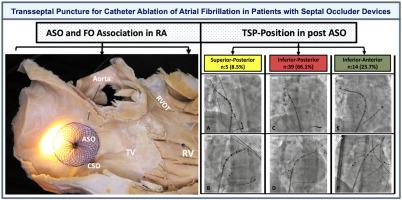
The majority of TSP positions in the interatrial septum related to the ASO was inferior-posterior to the ASO (66.1%) or inferior-anterior (23.7%). In case of failure of the inferior part, puncture was performed in superior-posterior puncture (8.5%) or puncture through the occluder (1.7%). Mean ablation time was 14.9 ± 8.4 minutes, including radiofrequency (83.0%), cryoballoon (11.9%), and pulsed field ablation (5.1%). No major complications were observed, except for 1 transient phrenic nerve palsy during cryoballoon ablation, which recovered intraprocedurally. Voltage mapping revealed no additional substrate related to the occluder. During 12-month follow-up, 7 patients (11.9%) experienced AF recurrence.
Conclusion
TSP and PVI are safe and can be safely performed in patients with an ASO. No additional substrate related to the occluder was seen. Although no direct comparison was made, outcomes align with existing literature. Further studies are needed.
期刊介绍:
HeartRhythm, the official Journal of the Heart Rhythm Society and the Cardiac Electrophysiology Society, is a unique journal for fundamental discovery and clinical applicability.
HeartRhythm integrates the entire cardiac electrophysiology (EP) community from basic and clinical academic researchers, private practitioners, engineers, allied professionals, industry, and trainees, all of whom are vital and interdependent members of our EP community.
The Heart Rhythm Society is the international leader in science, education, and advocacy for cardiac arrhythmia professionals and patients, and the primary information resource on heart rhythm disorders. Its mission is to improve the care of patients by promoting research, education, and optimal health care policies and standards.



 京公网安备 11010802042870号
京ICP备2023020795号-1
京公网安备 11010802042870号
京ICP备2023020795号-1

 分享
分享
 求助内容:
求助内容: 应助结果提醒方式:
 扫码关注我们
