{"title":"Personality, eating behaviour, and body weight: results from the population study of women in Gothenburg 2016/17","authors":"Lena Farhan, Dominique Hange, Tore Hällström, Cecilia Björkelund, Lauren Lissner, Lisbeth Stahre, Kirsten Mehlig","doi":"10.1038/s41366-025-01764-y","DOIUrl":null,"url":null,"abstract":"The aim was to investigate the cross-sectional associations between personality traits, psychogenic needs and eating behaviour, and to describe the extent to which personality influences the association between eating behaviour and weight status. In 2016/17, a population-based sample of 573 women in Gothenburg, Sweden aged either 38 or 50 participated in a health examination. They completed the Three-Factor Eating Questionnaire, measuring uncontrolled eating, emotional eating and cognitive restraint on a scale of zero to 100. Scores higher than 50 defined excessive eating behaviour. The Cesarec-Marke Personality Schedule was used to measure psychogenic needs, characterised by pursuits and objectives that define personality and influence actions. Extraversion and neuroticism were assessed using the Eysenck-Personality Inventory. Regression models for excessive eating behaviour and for logarithmic body mass index (BMI) as a function of standardised personality scores were adjusted for sociodemographic, lifestyle and health factors. A higher need to defend one’s status (DST) was positively associated with excessive uncontrolled eating, odds ratio (OR) = 1.44, 95% confidence interval = (1.11, 1.86) per standard deviation (SD) of DST. The need to defend one’s status was more strongly associated with excessive emotional eating, OR = 1.61 (1.18, 2.20) than neuroticism, OR = 1.45 (1.06, 1.97), in a mutually adjusted model. Needs for achievement and autonomy were associated with excessive cognitive restraint, OR = 1.39 (1.09, 1.76) and 0.78 (0.62, 0.97), respectively. Excessive emotional eating was associated with 5.3 (1.1, 9.6) % higher values of BMI when adjusted for the need of DST, which was associated with −2.7 (−4.1, −1.3) % lower BMI per SD. Psychogenic needs were more closely associated with eating behaviour than personality traits. A lower need to defend one’s status and excessive emotional eating were independently associated with higher BMI, suggesting different pathways to obesity and treatment strategies.","PeriodicalId":14183,"journal":{"name":"International Journal of Obesity","volume":"49 7","pages":"1272-1279"},"PeriodicalIF":3.8000,"publicationDate":"2025-04-04","publicationTypes":"Journal Article","fieldsOfStudy":null,"isOpenAccess":false,"openAccessPdf":"https://www.ncbi.nlm.nih.gov/pmc/articles/PMC12283360/pdf/","citationCount":"0","resultStr":null,"platform":"Semanticscholar","paperid":null,"PeriodicalName":"International Journal of Obesity","FirstCategoryId":"3","ListUrlMain":"https://www.nature.com/articles/s41366-025-01764-y","RegionNum":2,"RegionCategory":"医学","ArticlePicture":[],"TitleCN":null,"AbstractTextCN":null,"PMCID":null,"EPubDate":"","PubModel":"","JCR":"Q1","JCRName":"ENDOCRINOLOGY & METABOLISM","Score":null,"Total":0}
引用次数: 0
Abstract
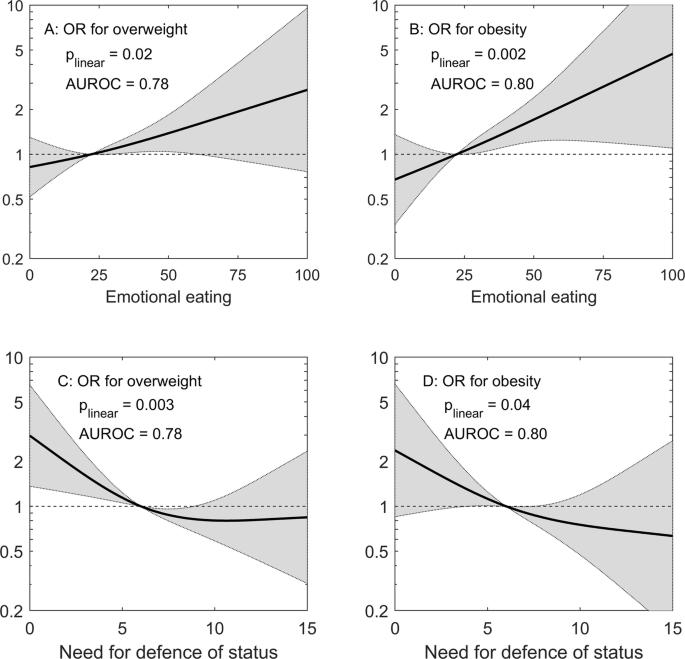
The aim was to investigate the cross-sectional associations between personality traits, psychogenic needs and eating behaviour, and to describe the extent to which personality influences the association between eating behaviour and weight status. In 2016/17, a population-based sample of 573 women in Gothenburg, Sweden aged either 38 or 50 participated in a health examination. They completed the Three-Factor Eating Questionnaire, measuring uncontrolled eating, emotional eating and cognitive restraint on a scale of zero to 100. Scores higher than 50 defined excessive eating behaviour. The Cesarec-Marke Personality Schedule was used to measure psychogenic needs, characterised by pursuits and objectives that define personality and influence actions. Extraversion and neuroticism were assessed using the Eysenck-Personality Inventory. Regression models for excessive eating behaviour and for logarithmic body mass index (BMI) as a function of standardised personality scores were adjusted for sociodemographic, lifestyle and health factors. A higher need to defend one’s status (DST) was positively associated with excessive uncontrolled eating, odds ratio (OR) = 1.44, 95% confidence interval = (1.11, 1.86) per standard deviation (SD) of DST. The need to defend one’s status was more strongly associated with excessive emotional eating, OR = 1.61 (1.18, 2.20) than neuroticism, OR = 1.45 (1.06, 1.97), in a mutually adjusted model. Needs for achievement and autonomy were associated with excessive cognitive restraint, OR = 1.39 (1.09, 1.76) and 0.78 (0.62, 0.97), respectively. Excessive emotional eating was associated with 5.3 (1.1, 9.6) % higher values of BMI when adjusted for the need of DST, which was associated with −2.7 (−4.1, −1.3) % lower BMI per SD. Psychogenic needs were more closely associated with eating behaviour than personality traits. A lower need to defend one’s status and excessive emotional eating were independently associated with higher BMI, suggesting different pathways to obesity and treatment strategies.
期刊介绍:
The International Journal of Obesity is a multi-disciplinary forum for research describing basic, clinical and applied studies in biochemistry, physiology, genetics and nutrition, molecular, metabolic, psychological and epidemiological aspects of obesity and related disorders.
We publish a range of content types including original research articles, technical reports, reviews, correspondence and brief communications that elaborate on significant advances in the field and cover topical issues.



 京公网安备 11010802042870号
京ICP备2023020795号-1
京公网安备 11010802042870号
京ICP备2023020795号-1

 分享
分享
 求助内容:
求助内容: 应助结果提醒方式:
 扫码关注我们
