Seshiru Nakazawa MD, PhD , Federica Pecci MD , Biagio Ricciuti MD, PhD , Felix H. Gottlieb BS , Francesco Facchinetti MD, PhD , Guilherme Harada MD , Monica F. Chen MD , Matteo Repetto MD , Flavia Giacomini MSc , Jie Jiang PhD , Marie-Anaïs Locquet PhD , Maisam Makarem MD, PhD , Joao V. Alessi MD , Alessandro Di Federico MD , Mihaela Aldea MD, PhD , Edoardo Garbo MD , Malini M. Gandhi MD , Arushi Saini , Danielle Haradon , Magda Bahcall PhD , Pasi A. Jänne MD, PhD
{"title":"Activating Mutations in the MET Kinase Domain Co-Occur With Other Driver Oncogenes and Mediate Resistance to Targeted Therapy in NSCLC","authors":"Seshiru Nakazawa MD, PhD , Federica Pecci MD , Biagio Ricciuti MD, PhD , Felix H. Gottlieb BS , Francesco Facchinetti MD, PhD , Guilherme Harada MD , Monica F. Chen MD , Matteo Repetto MD , Flavia Giacomini MSc , Jie Jiang PhD , Marie-Anaïs Locquet PhD , Maisam Makarem MD, PhD , Joao V. Alessi MD , Alessandro Di Federico MD , Mihaela Aldea MD, PhD , Edoardo Garbo MD , Malini M. Gandhi MD , Arushi Saini , Danielle Haradon , Magda Bahcall PhD , Pasi A. Jänne MD, PhD","doi":"10.1016/j.jtho.2025.03.045","DOIUrl":null,"url":null,"abstract":"<div><h3>Introduction</h3><div><em>MET</em> tyrosine kinase domain (TKD) mutations have recently been characterized as de novo oncogenic drivers in NSCLC. Nevertheless, whether activating <em>MET</em> TKD mutations can confer resistance to targeted therapy in non-<em>MET</em>, oncogene-driven NSCLCs remains unclear.</div></div><div><h3>Methods</h3><div>To characterize the genomic features of tumors with <em>MET</em> TKD mutations in oncogene-driven NSCLC, we performed tumor genomic profiling on two different cohorts of patients with NSCLC. Preclinical models of the most frequently observed <em>MET</em> TKD mutations were generated to determine the effect on sensitivity to targeted therapy. Treatment strategies to overcome <em>MET</em> TKD mutation-mediated resistance were further explored.</div></div><div><h3>Results</h3><div>Genomic profiling of more than 115,000 patients with NSCLC found that activating <em>MET</em> TKD mutations are prevalent in 0.15% of cases, and that about half of them co-occur with another oncogenic driver, with a differential pattern in co-occurring <em>MET</em> TKD mutations according to the oncogenic alteration. A review of eight cases with sequential genomic testing revealed that the <em>MET</em> TKD mutation was acquired after systemic therapy in 88% of cases, with a potential contribution of APOBEC mutagenesis underlying this process. In vitro, <em>MET</em> TKD mutation conferred resistance to targeted therapy in diverse oncogene-driven models, which could be overcome by combinatorial treatment against both the primary oncogene and the <em>MET</em> TKD mutation.</div></div><div><h3>Conclusions</h3><div><em>MET</em> TKD mutation can act as an off-target resistance mechanism in diverse oncogene-driven NSCLC. Combination therapy with an effective MET-targeted therapy can potentially overcome <em>MET</em> TKD mutation-mediated resistance.</div></div>","PeriodicalId":17515,"journal":{"name":"Journal of Thoracic Oncology","volume":"20 8","pages":"Pages 1035-1049"},"PeriodicalIF":20.8000,"publicationDate":"2025-08-01","publicationTypes":"Journal Article","fieldsOfStudy":null,"isOpenAccess":false,"openAccessPdf":"","citationCount":"0","resultStr":null,"platform":"Semanticscholar","paperid":null,"PeriodicalName":"Journal of Thoracic Oncology","FirstCategoryId":"3","ListUrlMain":"https://www.sciencedirect.com/science/article/pii/S1556086425006501","RegionNum":1,"RegionCategory":"医学","ArticlePicture":[],"TitleCN":null,"AbstractTextCN":null,"PMCID":null,"EPubDate":"2025/4/2 0:00:00","PubModel":"Epub","JCR":"Q1","JCRName":"ONCOLOGY","Score":null,"Total":0}
引用次数: 0
Abstract
Introduction
MET tyrosine kinase domain (TKD) mutations have recently been characterized as de novo oncogenic drivers in NSCLC. Nevertheless, whether activating MET TKD mutations can confer resistance to targeted therapy in non-MET, oncogene-driven NSCLCs remains unclear.
Methods
To characterize the genomic features of tumors with MET TKD mutations in oncogene-driven NSCLC, we performed tumor genomic profiling on two different cohorts of patients with NSCLC. Preclinical models of the most frequently observed MET TKD mutations were generated to determine the effect on sensitivity to targeted therapy. Treatment strategies to overcome MET TKD mutation-mediated resistance were further explored.
Results
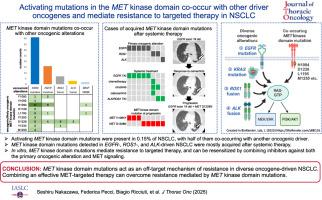
Genomic profiling of more than 115,000 patients with NSCLC found that activating MET TKD mutations are prevalent in 0.15% of cases, and that about half of them co-occur with another oncogenic driver, with a differential pattern in co-occurring MET TKD mutations according to the oncogenic alteration. A review of eight cases with sequential genomic testing revealed that the MET TKD mutation was acquired after systemic therapy in 88% of cases, with a potential contribution of APOBEC mutagenesis underlying this process. In vitro, MET TKD mutation conferred resistance to targeted therapy in diverse oncogene-driven models, which could be overcome by combinatorial treatment against both the primary oncogene and the MET TKD mutation.
Conclusions
MET TKD mutation can act as an off-target resistance mechanism in diverse oncogene-driven NSCLC. Combination therapy with an effective MET-targeted therapy can potentially overcome MET TKD mutation-mediated resistance.
期刊介绍:
Journal of Thoracic Oncology (JTO), the official journal of the International Association for the Study of Lung Cancer,is the primary educational and informational publication for topics relevant to the prevention, detection, diagnosis, and treatment of all thoracic malignancies.The readship includes epidemiologists, medical oncologists, radiation oncologists, thoracic surgeons, pulmonologists, radiologists, pathologists, nuclear medicine physicians, and research scientists with a special interest in thoracic oncology.



 京公网安备 11010802042870号
京ICP备2023020795号-1
京公网安备 11010802042870号
京ICP备2023020795号-1

 分享
分享
 求助内容:
求助内容: 应助结果提醒方式:
 扫码关注我们
