Allancer Nunes, Tianpeng Zhang, Xiaodong Mu, Paul D Robbins
{"title":"Therapeutic application of extracellular vesicles in human diseases.","authors":"Allancer Nunes, Tianpeng Zhang, Xiaodong Mu, Paul D Robbins","doi":"10.1016/j.ymthe.2025.04.002","DOIUrl":null,"url":null,"abstract":"<p><p>Extracellular vesicles (EVs) are membrane vesicles released or secreted from almost all cell types. EVs are derived from multivesicular bodies or from the plasma membrane and contain a subset of proteins, lipids, and nucleic acids (e.g., DNA, RNA, and microRNA [miRNA]) derived from the parent cell. EVs play important roles in intercellular communication by efficiently transferring the content between cells both locally and systemically. Given their natural ability to transfer cargo to cells, sometimes in a targeted manner, and their apparent lack of immunogenicity, EVs are being engineered for delivery of therapeutic RNAs, DNAs, miRNAs, viral particles, drugs, and even proteins. In addition, many of the therapeutic effects of stem cell treatments are mediated by stem cell-derived EVs, which are safer and potentially more effective than the parental stem cells. Here we provide an overview of the use of EVs for delivery of different therapeutic nucleic acids, viruses, and drugs, as well as the use of therapeutic stem cell-derived EVs.</p>","PeriodicalId":19020,"journal":{"name":"Molecular Therapy","volume":" ","pages":"2243-2251"},"PeriodicalIF":12.0000,"publicationDate":"2025-05-07","publicationTypes":"Journal Article","fieldsOfStudy":null,"isOpenAccess":false,"openAccessPdf":"https://www.ncbi.nlm.nih.gov/pmc/articles/PMC12126785/pdf/","citationCount":"0","resultStr":null,"platform":"Semanticscholar","paperid":null,"PeriodicalName":"Molecular Therapy","FirstCategoryId":"3","ListUrlMain":"https://doi.org/10.1016/j.ymthe.2025.04.002","RegionNum":1,"RegionCategory":"医学","ArticlePicture":[],"TitleCN":null,"AbstractTextCN":null,"PMCID":null,"EPubDate":"2025/4/3 0:00:00","PubModel":"Epub","JCR":"Q1","JCRName":"BIOTECHNOLOGY & APPLIED MICROBIOLOGY","Score":null,"Total":0}
引用次数: 0
Abstract
Extracellular vesicles (EVs) are membrane vesicles released or secreted from almost all cell types. EVs are derived from multivesicular bodies or from the plasma membrane and contain a subset of proteins, lipids, and nucleic acids (e.g., DNA, RNA, and microRNA [miRNA]) derived from the parent cell. EVs play important roles in intercellular communication by efficiently transferring the content between cells both locally and systemically. Given their natural ability to transfer cargo to cells, sometimes in a targeted manner, and their apparent lack of immunogenicity, EVs are being engineered for delivery of therapeutic RNAs, DNAs, miRNAs, viral particles, drugs, and even proteins. In addition, many of the therapeutic effects of stem cell treatments are mediated by stem cell-derived EVs, which are safer and potentially more effective than the parental stem cells. Here we provide an overview of the use of EVs for delivery of different therapeutic nucleic acids, viruses, and drugs, as well as the use of therapeutic stem cell-derived EVs.
期刊介绍:
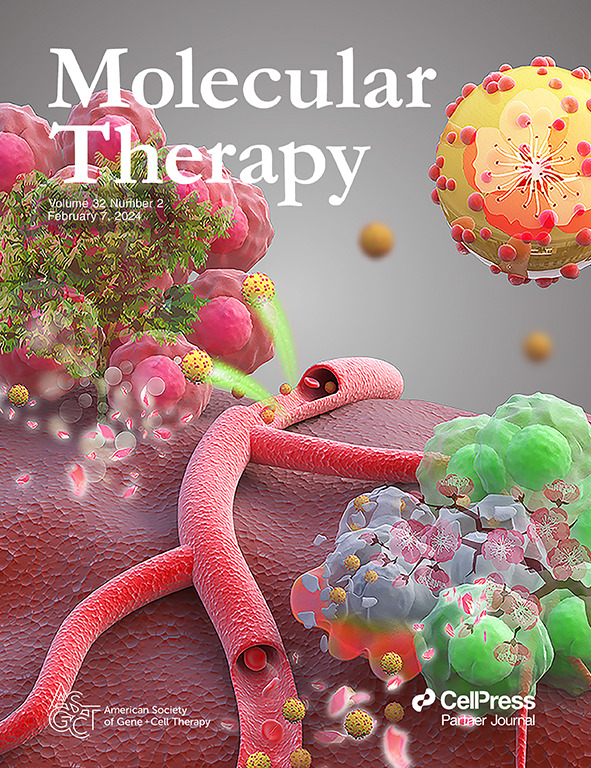
Molecular Therapy is the leading journal for research in gene transfer, vector development, stem cell manipulation, and therapeutic interventions. It covers a broad spectrum of topics including genetic and acquired disease correction, vaccine development, pre-clinical validation, safety/efficacy studies, and clinical trials. With a focus on advancing genetics, medicine, and biotechnology, Molecular Therapy publishes peer-reviewed research, reviews, and commentaries to showcase the latest advancements in the field. With an impressive impact factor of 12.4 in 2022, it continues to attract top-tier contributions.



 京公网安备 11010802042870号
京ICP备2023020795号-1
京公网安备 11010802042870号
京ICP备2023020795号-1

 分享
分享
 求助内容:
求助内容: 应助结果提醒方式:
 扫码关注我们
