{"title":"Mediating role of disease acceptance in the relationship between social support and adherence to treatment in patients with type 2 diabetes.","authors":"Gülyeter Erdoğan Yüce, Heja Yıldırım","doi":"10.1007/s10865-025-00567-w","DOIUrl":null,"url":null,"abstract":"<p><p>Type 2 diabetes is a widespread, chronic metabolic disease with significant consequences for public health. Poor adherence to treatment in type 2 diabetes patients is associated with inadequate glycemic control, increased medical costs, increased use of healthcare services, and increased mortality. Understanding how social support and disease acceptance influence treatment adherence can inform more effective diabetes management strategies. This study investigated the relationship between social support, disease acceptance, and treatment adherence in adults with type 2 diabetes. This cross-sectional correlational study was conducted on 332 individuals with type 2 diabetes in Türkiye. Data were collected using a patient information form, Acceptance of Illness Scale, Multidimensional Perceived Social Support Scale, and type 2 Diabetes Treatment Adherence Scale. Relationships between variables were analyzed using Pearson correlation coefficients, linear regression, and mediation analysis. The regression analysis indicated significant effects of social support on treatment adherence (β=-0.312, p < 0.001) and disease acceptance (β = 0.267, p < 0.001) and of disease acceptance on treatment adherence (β=-0.378, p < 0.001). Additionally, disease acceptance partially mediated the relationship between social support and treatment adherence (β=-0.101, %95 Cl [-0.154, -0.055]). The findings showed that high levels of social support and illness acceptance can improve treatment adherence and that social support may also indirectly enhance treatment adherence by promoting illness acceptance.</p>","PeriodicalId":48329,"journal":{"name":"Journal of Behavioral Medicine","volume":" ","pages":"572-582"},"PeriodicalIF":2.9000,"publicationDate":"2025-08-01","publicationTypes":"Journal Article","fieldsOfStudy":null,"isOpenAccess":false,"openAccessPdf":"https://www.ncbi.nlm.nih.gov/pmc/articles/PMC12307531/pdf/","citationCount":"0","resultStr":null,"platform":"Semanticscholar","paperid":null,"PeriodicalName":"Journal of Behavioral Medicine","FirstCategoryId":"102","ListUrlMain":"https://doi.org/10.1007/s10865-025-00567-w","RegionNum":3,"RegionCategory":"医学","ArticlePicture":[],"TitleCN":null,"AbstractTextCN":null,"PMCID":null,"EPubDate":"2025/4/5 0:00:00","PubModel":"Epub","JCR":"Q2","JCRName":"PSYCHOLOGY, CLINICAL","Score":null,"Total":0}
引用次数: 0
Abstract
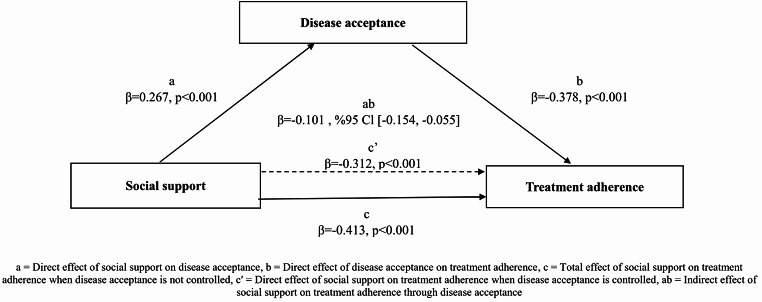
Type 2 diabetes is a widespread, chronic metabolic disease with significant consequences for public health. Poor adherence to treatment in type 2 diabetes patients is associated with inadequate glycemic control, increased medical costs, increased use of healthcare services, and increased mortality. Understanding how social support and disease acceptance influence treatment adherence can inform more effective diabetes management strategies. This study investigated the relationship between social support, disease acceptance, and treatment adherence in adults with type 2 diabetes. This cross-sectional correlational study was conducted on 332 individuals with type 2 diabetes in Türkiye. Data were collected using a patient information form, Acceptance of Illness Scale, Multidimensional Perceived Social Support Scale, and type 2 Diabetes Treatment Adherence Scale. Relationships between variables were analyzed using Pearson correlation coefficients, linear regression, and mediation analysis. The regression analysis indicated significant effects of social support on treatment adherence (β=-0.312, p < 0.001) and disease acceptance (β = 0.267, p < 0.001) and of disease acceptance on treatment adherence (β=-0.378, p < 0.001). Additionally, disease acceptance partially mediated the relationship between social support and treatment adherence (β=-0.101, %95 Cl [-0.154, -0.055]). The findings showed that high levels of social support and illness acceptance can improve treatment adherence and that social support may also indirectly enhance treatment adherence by promoting illness acceptance.
期刊介绍:
The Journal of Behavioral Medicine is a broadly conceived interdisciplinary publication devoted to furthering understanding of physical health and illness through the knowledge, methods, and techniques of behavioral science. A significant function of the journal is the application of this knowledge to prevention, treatment, and rehabilitation and to the promotion of health at the individual, community, and population levels.The content of the journal spans all areas of basic and applied behavioral medicine research, conducted in and informed by all related disciplines including but not limited to: psychology, medicine, the public health sciences, sociology, anthropology, health economics, nursing, and biostatistics. Topics welcomed include but are not limited to: prevention of disease and health promotion; the effects of psychological stress on physical and psychological functioning; sociocultural influences on health and illness; adherence to medical regimens; the study of health related behaviors including tobacco use, substance use, sexual behavior, physical activity, and obesity; health services research; and behavioral factors in the prevention and treatment of somatic disorders. Reports of interdisciplinary approaches to research are particularly welcomed.




 京公网安备 11010802042870号
京ICP备2023020795号-1
京公网安备 11010802042870号
京ICP备2023020795号-1

 分享
分享
 求助内容:
求助内容: 应助结果提醒方式:
 扫码关注我们
