Huihui Hu, Rong Liu, Yan-Bing Zhu, Tai-Ting Sha, Xiao-Xing Cao, Zi-Jie Feng, Hao-Ran Ji, Qiang Pan, Ren-Gen Xiong, Yu-Meng You
{"title":"Application of Molecular Ferroelectric in Photocatalytic Selective Oxidization of C(sp3)─H Bonds","authors":"Huihui Hu, Rong Liu, Yan-Bing Zhu, Tai-Ting Sha, Xiao-Xing Cao, Zi-Jie Feng, Hao-Ran Ji, Qiang Pan, Ren-Gen Xiong, Yu-Meng You","doi":"10.1002/anie.202500176","DOIUrl":null,"url":null,"abstract":"<p>Molecular ferroelectrics utilize metal nodes and organic groups as catalytic active sites, with the surrounding ferroelectric polarization significantly enhancing catalytic activity and showcasing tremendous application potential. However, their application in photocatalysis remains underexplored. This study presents the first investigation of the molecular perovskite ferroelectric CuCl<sub>4</sub>-[R-MPA] (MPA = β-methylphenethylamine) as a photocatalyst for alkane oxidation. Under the combined effects of light and ultrasound, this catalyst exhibited a notable turnover number (TON) of 6286 ± 491, which is 10<sup>4</sup> times higher than that of inorganic ferroelectrics like barium titanate (BaTiO<sub>3</sub>). The molecular ferroelectric exhibits excellent recyclability, good functional group tolerance, and broad substrate applicability. Mechanistic studies indicate that the built-in electric field within the molecular ferroelectric facilitates the separation of photo-generated charge carriers, thereby enhancing its ferroelectric photocatalytic activity. Electron paramagnetic resonance (EPR) results further reveal that the synergistic effects of light and ultrasound effectively generate reactive oxygen species. These findings underscore the unique advantages of molecular ferroelectrics compared to rigid inorganic counterparts, including their distinctive structural features and finely tunable catalytic performance, highlighting their potential for developing homogeneous, precisely active sites and efficient photocatalysts. This research lays the foundation for the broader application of molecular ferroelectrics in the field of photocatalysis.</p>","PeriodicalId":125,"journal":{"name":"Angewandte Chemie International Edition","volume":"64 24","pages":""},"PeriodicalIF":16.9000,"publicationDate":"2025-04-07","publicationTypes":"Journal Article","fieldsOfStudy":null,"isOpenAccess":false,"openAccessPdf":"","citationCount":"0","resultStr":null,"platform":"Semanticscholar","paperid":null,"PeriodicalName":"Angewandte Chemie International Edition","FirstCategoryId":"92","ListUrlMain":"https://onlinelibrary.wiley.com/doi/10.1002/anie.202500176","RegionNum":1,"RegionCategory":"化学","ArticlePicture":[],"TitleCN":null,"AbstractTextCN":null,"PMCID":null,"EPubDate":"","PubModel":"","JCR":"Q1","JCRName":"CHEMISTRY, MULTIDISCIPLINARY","Score":null,"Total":0}
引用次数: 0
Abstract
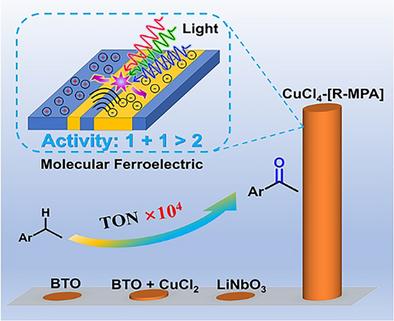
Molecular ferroelectrics utilize metal nodes and organic groups as catalytic active sites, with the surrounding ferroelectric polarization significantly enhancing catalytic activity and showcasing tremendous application potential. However, their application in photocatalysis remains underexplored. This study presents the first investigation of the molecular perovskite ferroelectric CuCl4-[R-MPA] (MPA = β-methylphenethylamine) as a photocatalyst for alkane oxidation. Under the combined effects of light and ultrasound, this catalyst exhibited a notable turnover number (TON) of 6286 ± 491, which is 104 times higher than that of inorganic ferroelectrics like barium titanate (BaTiO3). The molecular ferroelectric exhibits excellent recyclability, good functional group tolerance, and broad substrate applicability. Mechanistic studies indicate that the built-in electric field within the molecular ferroelectric facilitates the separation of photo-generated charge carriers, thereby enhancing its ferroelectric photocatalytic activity. Electron paramagnetic resonance (EPR) results further reveal that the synergistic effects of light and ultrasound effectively generate reactive oxygen species. These findings underscore the unique advantages of molecular ferroelectrics compared to rigid inorganic counterparts, including their distinctive structural features and finely tunable catalytic performance, highlighting their potential for developing homogeneous, precisely active sites and efficient photocatalysts. This research lays the foundation for the broader application of molecular ferroelectrics in the field of photocatalysis.
期刊介绍:
Angewandte Chemie, a journal of the German Chemical Society (GDCh), maintains a leading position among scholarly journals in general chemistry with an impressive Impact Factor of 16.6 (2022 Journal Citation Reports, Clarivate, 2023). Published weekly in a reader-friendly format, it features new articles almost every day. Established in 1887, Angewandte Chemie is a prominent chemistry journal, offering a dynamic blend of Review-type articles, Highlights, Communications, and Research Articles on a weekly basis, making it unique in the field.



 京公网安备 11010802042870号
京ICP备2023020795号-1
京公网安备 11010802042870号
京ICP备2023020795号-1

 分享
分享
 求助内容:
求助内容: 应助结果提醒方式:
 扫码关注我们
