{"title":"Hydrogen Atom Transfer-Based C(sp3)–H Bond Oxygenation of Lactams and Cycloalkenes: The Influence of Ring Size on Reactivity and Site Selectivity","authors":"Sergio Sisti, Fabio Ioele, Filippo Scarchilli, Simona Laparelli, Marco Galeotti, Omid Hosseinzadeh, Zhehan Jia, Gino A. DiLabio, Michela Salamone, Massimo Bietti","doi":"10.1021/acs.joc.5c00092","DOIUrl":null,"url":null,"abstract":"Kinetic and product studies on the reactions of the cumyloxyl (CumO<sup>•</sup>) and <i>tert</i>-butoxyl (<i>t</i>BuO<sup>•</sup>) radicals with secondary and tertiary <i>N</i>-methyl and <i>N</i>-benzyl lactams and with cycloalkenes, accompanied by BDE calculations of the substrate C–H bonds involved in these reactions, are reported. Within the lactams, the rate constants for HAT (<i>k</i><sub>H</sub>) from the C–H bonds to CumO<sup>•</sup> decrease by a factor ∼4 going from the 5- and 6-membered derivatives to the 8-membered ones. Product distributions obtained through oxygenation initiated by <i>t</i>BuO<sup>•</sup> show that HAT preferentially occurs from the most electron-rich α-C–H bonds, with site selectivity that, within the <i>N</i>-methyl and <i>N</i>-benzyl series, progressively shifts from the endocyclic to the exocyclic α-C–H bonds with increasing ring size, indicative of deactivation of the former bonds that, for the 8-membered derivatives, translates into competitive oxygenation at different sites. Similar trends have been observed for the corresponding reactions of the cycloalkenes, with <i>k</i><sub>H</sub> values that decrease by a factor of ∼4 together with site selectivity for HAT from the activated allylic C–H bonds, going from cyclopentene to cyclooctene. It is proposed that the greater flexibility of the medium-sized rings decreases the extent of hyperconjugative overlap between the α-C–H bonds and the amide or C═C π-systems, increasing the kinetic barrier for HAT from these sites, with decreases in reactivity that approach factors of 83 and 18, for the endocyclic α-C–H bonds of tertiary <i>N</i>-methyl lactams and the allylic C–H bonds of cycloalkenes, respectively.","PeriodicalId":57,"journal":{"name":"Journal of Organic Chemistry","volume":"89 1","pages":""},"PeriodicalIF":3.6000,"publicationDate":"2025-04-07","publicationTypes":"Journal Article","fieldsOfStudy":null,"isOpenAccess":false,"openAccessPdf":"","citationCount":"0","resultStr":null,"platform":"Semanticscholar","paperid":null,"PeriodicalName":"Journal of Organic Chemistry","FirstCategoryId":"1","ListUrlMain":"https://doi.org/10.1021/acs.joc.5c00092","RegionNum":2,"RegionCategory":"化学","ArticlePicture":[],"TitleCN":null,"AbstractTextCN":null,"PMCID":null,"EPubDate":"","PubModel":"","JCR":"Q1","JCRName":"CHEMISTRY, ORGANIC","Score":null,"Total":0}
引用次数: 0
Abstract
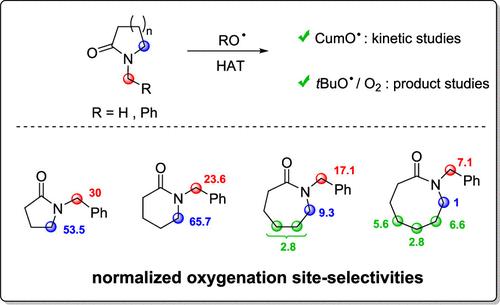
Kinetic and product studies on the reactions of the cumyloxyl (CumO•) and tert-butoxyl (tBuO•) radicals with secondary and tertiary N-methyl and N-benzyl lactams and with cycloalkenes, accompanied by BDE calculations of the substrate C–H bonds involved in these reactions, are reported. Within the lactams, the rate constants for HAT (kH) from the C–H bonds to CumO• decrease by a factor ∼4 going from the 5- and 6-membered derivatives to the 8-membered ones. Product distributions obtained through oxygenation initiated by tBuO• show that HAT preferentially occurs from the most electron-rich α-C–H bonds, with site selectivity that, within the N-methyl and N-benzyl series, progressively shifts from the endocyclic to the exocyclic α-C–H bonds with increasing ring size, indicative of deactivation of the former bonds that, for the 8-membered derivatives, translates into competitive oxygenation at different sites. Similar trends have been observed for the corresponding reactions of the cycloalkenes, with kH values that decrease by a factor of ∼4 together with site selectivity for HAT from the activated allylic C–H bonds, going from cyclopentene to cyclooctene. It is proposed that the greater flexibility of the medium-sized rings decreases the extent of hyperconjugative overlap between the α-C–H bonds and the amide or C═C π-systems, increasing the kinetic barrier for HAT from these sites, with decreases in reactivity that approach factors of 83 and 18, for the endocyclic α-C–H bonds of tertiary N-methyl lactams and the allylic C–H bonds of cycloalkenes, respectively.
期刊介绍:
Journal of Organic Chemistry welcomes original contributions of fundamental research in all branches of the theory and practice of organic chemistry. In selecting manuscripts for publication, the editors place emphasis on the quality and novelty of the work, as well as the breadth of interest to the organic chemistry community.



 京公网安备 11010802042870号
京ICP备2023020795号-1
京公网安备 11010802042870号
京ICP备2023020795号-1

 分享
分享
 求助内容:
求助内容: 应助结果提醒方式:
 扫码关注我们
