Villads R. M. Nielsen, Olivia Aalling-Frederiksen, Kirsten M. Ø. Jensen, Thomas Just Sørensen
{"title":"Exploring the Crystallization of Lanthanum(III) and Neodymium(III) Hydroxides from Solution","authors":"Villads R. M. Nielsen, Olivia Aalling-Frederiksen, Kirsten M. Ø. Jensen, Thomas Just Sørensen","doi":"10.1021/acs.inorgchem.4c04907","DOIUrl":null,"url":null,"abstract":"Understanding the mechanics of crystallization from solution is crucial for advancing material discovery and design. Studying these complex processes requires a combination of experimental techniques. Here, the crystallization of lanthanum(III)- and neodymium(III) hydroxides was studied with in situ and ex situ X-ray techniques in combination with pair distribution function analysis, scanning electron microscopy, light scattering, pH titrations, simulations, and optical spectroscopy. Starting from the Ln(III) aqua ions in nitric acid, the pH is increased to start the precipitation of hydroxides. In situ optical spectroscopy and potentiometry revealed that at pH = 6, an initial gel phase with a composition of [Ln(NO<sub>3</sub>)(OH)(H<sub>2</sub>O)<sub><i>z</i></sub>]OH was formed. At pH > 10, the nitrate ligands were replaced by hydroxides, resulting in gels with a composition of [Ln(OH)<sub>2</sub>(H<sub>2</sub>O)<sub>7</sub>]OH. Upon washing and dehydration, X-ray scattering and Rietveld analysis showed that the gels crystallize into Ln(OH)<sub>2</sub>(NO<sub>3</sub>)(H<sub>2</sub>O)<sub><i>z</i></sub> at pH < 10 and Ln(OH)<sub>3</sub> at pH > 10. Ln(OH)<sub>3</sub> was obtained at all pH values if hydrothermal treatment was performed prior to the dehydration. In situ total X-ray scattering and pair distribution function analysis was used to show that no crystallization occurs in solution and that the hydrothermal treatment removes water from the gel. The size and morphology of the isolated lanthanide(III) hydroxides were found to be dependent on the pH value, but our results showed that the gel structure is found in all cases, suggesting that crystallization occurs within gel particles and not in solution.","PeriodicalId":40,"journal":{"name":"Inorganic Chemistry","volume":"6 1","pages":""},"PeriodicalIF":4.7000,"publicationDate":"2025-04-07","publicationTypes":"Journal Article","fieldsOfStudy":null,"isOpenAccess":false,"openAccessPdf":"","citationCount":"0","resultStr":null,"platform":"Semanticscholar","paperid":null,"PeriodicalName":"Inorganic Chemistry","FirstCategoryId":"92","ListUrlMain":"https://doi.org/10.1021/acs.inorgchem.4c04907","RegionNum":2,"RegionCategory":"化学","ArticlePicture":[],"TitleCN":null,"AbstractTextCN":null,"PMCID":null,"EPubDate":"","PubModel":"","JCR":"Q1","JCRName":"CHEMISTRY, INORGANIC & NUCLEAR","Score":null,"Total":0}
引用次数: 0
Abstract
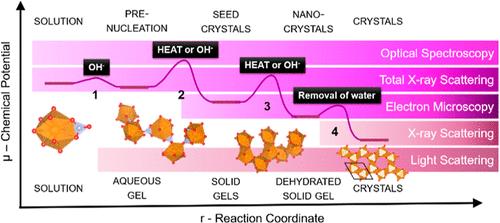
Understanding the mechanics of crystallization from solution is crucial for advancing material discovery and design. Studying these complex processes requires a combination of experimental techniques. Here, the crystallization of lanthanum(III)- and neodymium(III) hydroxides was studied with in situ and ex situ X-ray techniques in combination with pair distribution function analysis, scanning electron microscopy, light scattering, pH titrations, simulations, and optical spectroscopy. Starting from the Ln(III) aqua ions in nitric acid, the pH is increased to start the precipitation of hydroxides. In situ optical spectroscopy and potentiometry revealed that at pH = 6, an initial gel phase with a composition of [Ln(NO3)(OH)(H2O)z]OH was formed. At pH > 10, the nitrate ligands were replaced by hydroxides, resulting in gels with a composition of [Ln(OH)2(H2O)7]OH. Upon washing and dehydration, X-ray scattering and Rietveld analysis showed that the gels crystallize into Ln(OH)2(NO3)(H2O)z at pH < 10 and Ln(OH)3 at pH > 10. Ln(OH)3 was obtained at all pH values if hydrothermal treatment was performed prior to the dehydration. In situ total X-ray scattering and pair distribution function analysis was used to show that no crystallization occurs in solution and that the hydrothermal treatment removes water from the gel. The size and morphology of the isolated lanthanide(III) hydroxides were found to be dependent on the pH value, but our results showed that the gel structure is found in all cases, suggesting that crystallization occurs within gel particles and not in solution.
期刊介绍:
Inorganic Chemistry publishes fundamental studies in all phases of inorganic chemistry. Coverage includes experimental and theoretical reports on quantitative studies of structure and thermodynamics, kinetics, mechanisms of inorganic reactions, bioinorganic chemistry, and relevant aspects of organometallic chemistry, solid-state phenomena, and chemical bonding theory. Emphasis is placed on the synthesis, structure, thermodynamics, reactivity, spectroscopy, and bonding properties of significant new and known compounds.



 京公网安备 11010802042870号
京ICP备2023020795号-1
京公网安备 11010802042870号
京ICP备2023020795号-1

 分享
分享
 求助内容:
求助内容: 应助结果提醒方式:
 扫码关注我们
