Chenyi Yu, Keke Wang, Beiyu Zhao, Yiming Lin, Changjiang Zhou, Xianliang Huo, Bo Xie, Hui-Min Wen, Yuanbin She, Jun Hu
{"title":"Engineering Supramolecular Binding Sites in an Ultrastable and Hydrophobic Metal–Organic Framework for C2H6/C2H4 Separation","authors":"Chenyi Yu, Keke Wang, Beiyu Zhao, Yiming Lin, Changjiang Zhou, Xianliang Huo, Bo Xie, Hui-Min Wen, Yuanbin She, Jun Hu","doi":"10.1021/acs.inorgchem.5c00745","DOIUrl":null,"url":null,"abstract":"The separation of ethane (C<sub>2</sub>H<sub>6</sub>) from ethylene (C<sub>2</sub>H<sub>4</sub>) is critical for obtaining polymer-grade C<sub>2</sub>H<sub>4</sub>. Adsorptive separation with C<sub>2</sub>H<sub>6</sub>-selective MOFs offers a viable alternative to energy-intensive cryogenic distillation, enabling the direct production of high-purity C<sub>2</sub>H<sub>4</sub>. In this study, we developed an ultrastable ethane-selective metal–organic framework, UiO-67-(CH<sub>3</sub>)<sub>2</sub>, which demonstrates enhanced C<sub>2</sub>H<sub>6</sub> adsorption (4.10 mmol g<sup>–1</sup> at 1 bar and 298 K), higher C<sub>2</sub>H<sub>6</sub>/C<sub>2</sub>H<sub>4</sub> selectivity of 1.70, and an increased C<sub>2</sub>H<sub>6</sub>/C<sub>2</sub>H<sub>4</sub> adsorption ratio of 1.53 compared to unmodified UiO-67. GCMC simulations demonstrate that C<sub>2</sub>H<sub>6</sub> forms more C–H···π interactions with the surrounding benzene rings and more C–H···C interactions with methyl groups compared to C<sub>2</sub>H<sub>4</sub>, highlighting the synergistic effects of supramolecular interactions. Furthermore, the hydrophobic pore environment also minimizes water interference, with exceptionally low water uptake (0.019 g g<sup>–1</sup> at 60% RH), ensuring robust separation capacity under high humid conditions. The introduction of methyl groups not only significantly enhances C<sub>2</sub>H<sub>6</sub> adsorption performance and C<sub>2</sub>H<sub>6</sub>/C<sub>2</sub>H<sub>4</sub> separation selectivity but also improves material’s hydrophobicity.","PeriodicalId":40,"journal":{"name":"Inorganic Chemistry","volume":"191 1","pages":""},"PeriodicalIF":4.7000,"publicationDate":"2025-04-07","publicationTypes":"Journal Article","fieldsOfStudy":null,"isOpenAccess":false,"openAccessPdf":"","citationCount":"0","resultStr":null,"platform":"Semanticscholar","paperid":null,"PeriodicalName":"Inorganic Chemistry","FirstCategoryId":"92","ListUrlMain":"https://doi.org/10.1021/acs.inorgchem.5c00745","RegionNum":2,"RegionCategory":"化学","ArticlePicture":[],"TitleCN":null,"AbstractTextCN":null,"PMCID":null,"EPubDate":"","PubModel":"","JCR":"Q1","JCRName":"CHEMISTRY, INORGANIC & NUCLEAR","Score":null,"Total":0}
引用次数: 0
Abstract
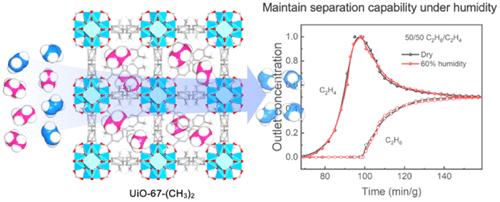
The separation of ethane (C2H6) from ethylene (C2H4) is critical for obtaining polymer-grade C2H4. Adsorptive separation with C2H6-selective MOFs offers a viable alternative to energy-intensive cryogenic distillation, enabling the direct production of high-purity C2H4. In this study, we developed an ultrastable ethane-selective metal–organic framework, UiO-67-(CH3)2, which demonstrates enhanced C2H6 adsorption (4.10 mmol g–1 at 1 bar and 298 K), higher C2H6/C2H4 selectivity of 1.70, and an increased C2H6/C2H4 adsorption ratio of 1.53 compared to unmodified UiO-67. GCMC simulations demonstrate that C2H6 forms more C–H···π interactions with the surrounding benzene rings and more C–H···C interactions with methyl groups compared to C2H4, highlighting the synergistic effects of supramolecular interactions. Furthermore, the hydrophobic pore environment also minimizes water interference, with exceptionally low water uptake (0.019 g g–1 at 60% RH), ensuring robust separation capacity under high humid conditions. The introduction of methyl groups not only significantly enhances C2H6 adsorption performance and C2H6/C2H4 separation selectivity but also improves material’s hydrophobicity.
期刊介绍:
Inorganic Chemistry publishes fundamental studies in all phases of inorganic chemistry. Coverage includes experimental and theoretical reports on quantitative studies of structure and thermodynamics, kinetics, mechanisms of inorganic reactions, bioinorganic chemistry, and relevant aspects of organometallic chemistry, solid-state phenomena, and chemical bonding theory. Emphasis is placed on the synthesis, structure, thermodynamics, reactivity, spectroscopy, and bonding properties of significant new and known compounds.



 京公网安备 11010802042870号
京ICP备2023020795号-1
京公网安备 11010802042870号
京ICP备2023020795号-1

 分享
分享
 求助内容:
求助内容: 应助结果提醒方式:
 扫码关注我们
