{"title":"Proton Conductivity in Photomagnetic CuII2-[MIV(CN)8] Frameworks (M = MoIV and WIV) Facilitated by the Tetracarboxy-Derivative of Cyclam","authors":"Mateusz Reczyński, Maciej Pazera, Michał Magott","doi":"10.1021/acs.inorgchem.4c05576","DOIUrl":null,"url":null,"abstract":"Two 3D bimetallic cyanido-bridged coordination polymers, [Cu<sup>II</sup>(H<sub>4</sub>tetac)]<sub>2</sub>[M<sup>IV</sup>(CN)<sub>8</sub>]·4H<sub>2</sub>O (M = Mo<sup>IV</sup> (<b>1</b>) and W<sup>IV</sup> (<b>2</b>)), based on copper(II) complex of tetracarboxylic-derivative of cyclam, H<sub>4</sub>tetac (=1,4,8,11-tetrazacyclotetradecane-6,6,13,13-tetracarboxylic acid), have been synthesized and characterized in terms of structure, proton conductivity, and the photomagnetic effect. The isostructural compounds crystallize in the polar <i>Fdd</i>2 space group and present a diamond-like topology. The carboxylic groups in the structure yield proton conductivities of 5.4(3) × 10<sup>–7</sup> S cm<sup>–1</sup> (<b>1</b>) and 8.6(3) × 10<sup>–7</sup> S cm<sup>–1</sup> (<b>2</b>) at 298 K and 98% relative humidity. A strong humidity dependence of conductivity and activation energy values of 0.34 eV (<b>1</b>) and 0.36 eV (<b>2</b>) indicate the Grotthuss mechanism of proton transport that is mediated by crystallization water molecules. In the ground state, <b>1</b> and <b>2</b> are paramagnets due to Cu<sup>II</sup> (<i>S</i> = 1/2) centers separated by diamagnetic [M<sup>IV</sup>(CN)<sub>8</sub>]<sup>4–</sup> anions (<i>S</i> = 0). Upon 450 nm light irradiation at 10 K, both compounds show a photomagnetic response. The Mo<sup>IV</sup> system shows higher photoconversion rates, while the W<sup>IV</sup> analogue exhibits full reversibility. Compounds <b>1</b> and <b>2</b> are the first examples of cyanido-bridged assemblies combining proton conductivity and the photomagnetic effect, advancing the reticular chemistry of cyanido-bridged frameworks.","PeriodicalId":40,"journal":{"name":"Inorganic Chemistry","volume":"20 1","pages":""},"PeriodicalIF":4.7000,"publicationDate":"2025-04-06","publicationTypes":"Journal Article","fieldsOfStudy":null,"isOpenAccess":false,"openAccessPdf":"","citationCount":"0","resultStr":null,"platform":"Semanticscholar","paperid":null,"PeriodicalName":"Inorganic Chemistry","FirstCategoryId":"92","ListUrlMain":"https://doi.org/10.1021/acs.inorgchem.4c05576","RegionNum":2,"RegionCategory":"化学","ArticlePicture":[],"TitleCN":null,"AbstractTextCN":null,"PMCID":null,"EPubDate":"","PubModel":"","JCR":"Q1","JCRName":"CHEMISTRY, INORGANIC & NUCLEAR","Score":null,"Total":0}
引用次数: 0
Abstract
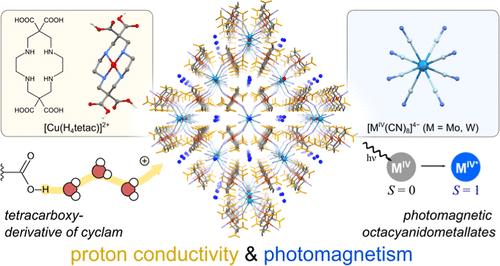
Two 3D bimetallic cyanido-bridged coordination polymers, [CuII(H4tetac)]2[MIV(CN)8]·4H2O (M = MoIV (1) and WIV (2)), based on copper(II) complex of tetracarboxylic-derivative of cyclam, H4tetac (=1,4,8,11-tetrazacyclotetradecane-6,6,13,13-tetracarboxylic acid), have been synthesized and characterized in terms of structure, proton conductivity, and the photomagnetic effect. The isostructural compounds crystallize in the polar Fdd2 space group and present a diamond-like topology. The carboxylic groups in the structure yield proton conductivities of 5.4(3) × 10–7 S cm–1 (1) and 8.6(3) × 10–7 S cm–1 (2) at 298 K and 98% relative humidity. A strong humidity dependence of conductivity and activation energy values of 0.34 eV (1) and 0.36 eV (2) indicate the Grotthuss mechanism of proton transport that is mediated by crystallization water molecules. In the ground state, 1 and 2 are paramagnets due to CuII (S = 1/2) centers separated by diamagnetic [MIV(CN)8]4– anions (S = 0). Upon 450 nm light irradiation at 10 K, both compounds show a photomagnetic response. The MoIV system shows higher photoconversion rates, while the WIV analogue exhibits full reversibility. Compounds 1 and 2 are the first examples of cyanido-bridged assemblies combining proton conductivity and the photomagnetic effect, advancing the reticular chemistry of cyanido-bridged frameworks.
期刊介绍:
Inorganic Chemistry publishes fundamental studies in all phases of inorganic chemistry. Coverage includes experimental and theoretical reports on quantitative studies of structure and thermodynamics, kinetics, mechanisms of inorganic reactions, bioinorganic chemistry, and relevant aspects of organometallic chemistry, solid-state phenomena, and chemical bonding theory. Emphasis is placed on the synthesis, structure, thermodynamics, reactivity, spectroscopy, and bonding properties of significant new and known compounds.



 京公网安备 11010802042870号
京ICP备2023020795号-1
京公网安备 11010802042870号
京ICP备2023020795号-1

 分享
分享
 求助内容:
求助内容: 应助结果提醒方式:
 扫码关注我们
