{"title":"Comparative Study on Covalent and Noncovalent Endogenous Albumin-Binding β-Glucuronidase-Activated SN38 Prodrugs for Antitumor Efficacy","authors":"Yingxin Lu, Xing Jiang, Biyu Yang, Mengyuan Ding, Yanyan Shen, Jiyu Jin, Jiahui Yu, Wei Lu, Yi Chen, Shulei Zhu","doi":"10.1021/acs.jmedchem.4c03096","DOIUrl":null,"url":null,"abstract":"Albumin-binding prodrugs have been explored to overcome the limitations of small-molecule anticancer chemotherapy agents, such as inadequate physiological and pharmaceutical compatibility, as well as rapid renal clearance. Herein, we investigated two endogenous albumin-binding prodrugs, <b>M-g-SN38</b> and <b>S-g-SN38</b>, forming macromolecular conjugates. Both prodrugs exhibited robust stability in murine and human plasma, crucial for their therapeutic potential. Selective activation by β-glucuronidase ensures minimal toxicity in their inactive state. Notably, <b>M-g-SN38</b> exhibited higher cellular uptake, a longer circulation half-life, and enhanced tumor accumulation compared to <b>S-g-SN38</b>, suggesting its greater potential for improved antitumor efficacy. In vivo, <b>M-g-SN38</b> exhibited significant antitumor activity, leading to profound tumor reduction and, in many cases, marked depletion and complete eradication in all treated mice in the HCT116 xenograft model. Furthermore, <b>M-g-SN38</b> also demonstrated pronounced antitumor efficacy in the BxPC-3 xenograft model. Together, these findings provide new insights for the development of albumin-binding prodrugs.","PeriodicalId":46,"journal":{"name":"Journal of Medicinal Chemistry","volume":"59 1","pages":""},"PeriodicalIF":6.8000,"publicationDate":"2025-04-06","publicationTypes":"Journal Article","fieldsOfStudy":null,"isOpenAccess":false,"openAccessPdf":"","citationCount":"0","resultStr":null,"platform":"Semanticscholar","paperid":null,"PeriodicalName":"Journal of Medicinal Chemistry","FirstCategoryId":"3","ListUrlMain":"https://doi.org/10.1021/acs.jmedchem.4c03096","RegionNum":1,"RegionCategory":"医学","ArticlePicture":[],"TitleCN":null,"AbstractTextCN":null,"PMCID":null,"EPubDate":"","PubModel":"","JCR":"Q1","JCRName":"CHEMISTRY, MEDICINAL","Score":null,"Total":0}
引用次数: 0
Abstract
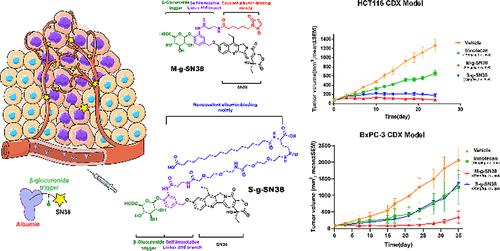
Albumin-binding prodrugs have been explored to overcome the limitations of small-molecule anticancer chemotherapy agents, such as inadequate physiological and pharmaceutical compatibility, as well as rapid renal clearance. Herein, we investigated two endogenous albumin-binding prodrugs, M-g-SN38 and S-g-SN38, forming macromolecular conjugates. Both prodrugs exhibited robust stability in murine and human plasma, crucial for their therapeutic potential. Selective activation by β-glucuronidase ensures minimal toxicity in their inactive state. Notably, M-g-SN38 exhibited higher cellular uptake, a longer circulation half-life, and enhanced tumor accumulation compared to S-g-SN38, suggesting its greater potential for improved antitumor efficacy. In vivo, M-g-SN38 exhibited significant antitumor activity, leading to profound tumor reduction and, in many cases, marked depletion and complete eradication in all treated mice in the HCT116 xenograft model. Furthermore, M-g-SN38 also demonstrated pronounced antitumor efficacy in the BxPC-3 xenograft model. Together, these findings provide new insights for the development of albumin-binding prodrugs.
期刊介绍:
The Journal of Medicinal Chemistry is a prestigious biweekly peer-reviewed publication that focuses on the multifaceted field of medicinal chemistry. Since its inception in 1959 as the Journal of Medicinal and Pharmaceutical Chemistry, it has evolved to become a cornerstone in the dissemination of research findings related to the design, synthesis, and development of therapeutic agents.
The Journal of Medicinal Chemistry is recognized for its significant impact in the scientific community, as evidenced by its 2022 impact factor of 7.3. This metric reflects the journal's influence and the importance of its content in shaping the future of drug discovery and development. The journal serves as a vital resource for chemists, pharmacologists, and other researchers interested in the molecular mechanisms of drug action and the optimization of therapeutic compounds.



 京公网安备 11010802042870号
京ICP备2023020795号-1
京公网安备 11010802042870号
京ICP备2023020795号-1

 分享
分享
 求助内容:
求助内容: 应助结果提醒方式:
 扫码关注我们
