{"title":"Brønsted-Lewis acidic ionic liquid-derived ZnS quantum dots: synthesis, characterization, and multifunctional applications in pollutant degradation and iodine sorption†","authors":"Debanga Bhusan Bora, Sukanya Das, Abhilekha Phukan, Sangeeta Kalita, Prapti Priyam Handique and Ruli Borah","doi":"10.1039/D5NR00043B","DOIUrl":null,"url":null,"abstract":"<p >A pair of Brønsted-Lewis acidic chlorozincate ionic liquids based on 2-alkyl-1,3-disulfoimidazolium cations (<strong>1a</strong> & <strong>1b</strong>) was developed with complex anionic speciation [Zn<small><sub>2</sub></small>Cl<small><sub>6</sub></small>]<small><sup>2−</sup></small>/[ZnCl<small><sub>4</sub></small>]<small><sup>2−</sup></small>. These ionic liquids were further used as templates for fabricating ZnS quantum dots (QDs) <em>via</em> a grinding method. The ZnS QDs were characterized using various techniques. The use of ionic liquids (ILs) containing complex metal chloride anions resulted in small size and porous nature of the QDs. The presence of various types of defects was verified through XPS, EPR and photoluminescence spectroscopic analyses. These two QDs were used as reusable and recyclable catalysts for the degradation of a broad spectrum of pollutants such as crystal violet (CV), methylene blue (MB), malachite green (MG), morin hydrate, and oxytetracycline (OTC) under UV light irradiation. Free radical scavenging experiments showed that ˙OH and ˙O<small><sub>2</sub></small><small><sup>−</sup></small> acted as primary reactive species during the degradation process. These QDs were further employed for iodine sorption experiments in water and hexane solutions. The XPS analysis revealed that the adsorption process occurred in molecular (I<small><sub>2</sub></small>) and polyiodide (I<small><sub>3</sub></small><small><sup>−</sup></small>) forms. The recyclability study of the iodine sorption revealed that the QDs could retain 90.6% and 89.4% of their initial efficiency after the 5th cycle in water and hexane solution, respectively. No such reports regarding the use of Brønsted-Lewis acidic chlorozincate ionic liquids for the synthesis of mesoporous defective ZnS QDs has been published. Moreover, the utilization of the pristine ZnS QDs for iodine capture experiments is reported for the first time.</p>","PeriodicalId":92,"journal":{"name":"Nanoscale","volume":" 17","pages":" 10718-10731"},"PeriodicalIF":5.1000,"publicationDate":"2025-04-07","publicationTypes":"Journal Article","fieldsOfStudy":null,"isOpenAccess":false,"openAccessPdf":"","citationCount":"0","resultStr":null,"platform":"Semanticscholar","paperid":null,"PeriodicalName":"Nanoscale","FirstCategoryId":"88","ListUrlMain":"https://pubs.rsc.org/en/content/articlelanding/2025/nr/d5nr00043b","RegionNum":3,"RegionCategory":"材料科学","ArticlePicture":[],"TitleCN":null,"AbstractTextCN":null,"PMCID":null,"EPubDate":"","PubModel":"","JCR":"Q1","JCRName":"CHEMISTRY, MULTIDISCIPLINARY","Score":null,"Total":0}
引用次数: 0
Abstract
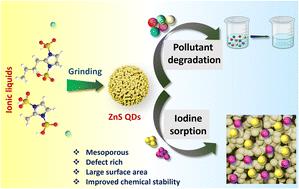
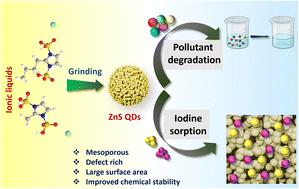
A pair of Brønsted-Lewis acidic chlorozincate ionic liquids based on 2-alkyl-1,3-disulfoimidazolium cations (1a & 1b) was developed with complex anionic speciation [Zn2Cl6]2−/[ZnCl4]2−. These ionic liquids were further used as templates for fabricating ZnS quantum dots (QDs) via a grinding method. The ZnS QDs were characterized using various techniques. The use of ionic liquids (ILs) containing complex metal chloride anions resulted in small size and porous nature of the QDs. The presence of various types of defects was verified through XPS, EPR and photoluminescence spectroscopic analyses. These two QDs were used as reusable and recyclable catalysts for the degradation of a broad spectrum of pollutants such as crystal violet (CV), methylene blue (MB), malachite green (MG), morin hydrate, and oxytetracycline (OTC) under UV light irradiation. Free radical scavenging experiments showed that ˙OH and ˙O2− acted as primary reactive species during the degradation process. These QDs were further employed for iodine sorption experiments in water and hexane solutions. The XPS analysis revealed that the adsorption process occurred in molecular (I2) and polyiodide (I3−) forms. The recyclability study of the iodine sorption revealed that the QDs could retain 90.6% and 89.4% of their initial efficiency after the 5th cycle in water and hexane solution, respectively. No such reports regarding the use of Brønsted-Lewis acidic chlorozincate ionic liquids for the synthesis of mesoporous defective ZnS QDs has been published. Moreover, the utilization of the pristine ZnS QDs for iodine capture experiments is reported for the first time.
期刊介绍:
Nanoscale is a high-impact international journal, publishing high-quality research across nanoscience and nanotechnology. Nanoscale publishes a full mix of research articles on experimental and theoretical work, including reviews, communications, and full papers.Highly interdisciplinary, this journal appeals to scientists, researchers and professionals interested in nanoscience and nanotechnology, quantum materials and quantum technology, including the areas of physics, chemistry, biology, medicine, materials, energy/environment, information technology, detection science, healthcare and drug discovery, and electronics.



 京公网安备 11010802042870号
京ICP备2023020795号-1
京公网安备 11010802042870号
京ICP备2023020795号-1

 分享
分享
 求助内容:
求助内容: 应助结果提醒方式:
 扫码关注我们
