Metabolomics analysis Reveals enhancement of flavor and nutritional profile in fermented complex pomegranate milk by Lactiplantibacillus plantarum CCFM 1291
Yi Wei , Wenyi Zhang , Bingyong Mao , Xin Tang , Jian He , Jinrui Du , Qiuyue Jiang , Qiuxiang Zhang , Haotian Feng , Jianxin Zhao , Wei Chen , Shumao Cui
{"title":"Metabolomics analysis Reveals enhancement of flavor and nutritional profile in fermented complex pomegranate milk by Lactiplantibacillus plantarum CCFM 1291","authors":"Yi Wei , Wenyi Zhang , Bingyong Mao , Xin Tang , Jian He , Jinrui Du , Qiuyue Jiang , Qiuxiang Zhang , Haotian Feng , Jianxin Zhao , Wei Chen , Shumao Cui","doi":"10.1016/j.lwt.2025.117703","DOIUrl":null,"url":null,"abstract":"<div><div>Pomegranate, rich in polyphenols and ellagitannins, imparts distinctive flavor profiles and nutritional advantages to fermented dairy products. This study investigated the growth dynamics of <em>Lactiplantibacillus plantarum</em> in a milk-based matrix and characterized the biotransformation of bioactive compounds during fermentation. Through integrated targeted and untargeted metabolomic approaches, we systematically evaluated metabolic alterations induced by <em>L. plantarum</em> CCFM1291 during pomegranate milk fermentation. Targeted quantification revealed significant production of urolithin M5 (3.21 ± 0.06 mg/L), while untargeted analysis identified metabolic shifts, including the generation of hydroxyisocaproic acid and <em>p</em>-aminobenzoic acid. Multidimensional sensory evaluation coupled with GC-MS flavor profiling demonstrated statistically significant enhancements in fermented pomegranate milk quality. These findings provide novel insights into pomegranate milk fermentation and establish a scientific framework for developing functional dairy products.</div></div>","PeriodicalId":382,"journal":{"name":"LWT - Food Science and Technology","volume":"223 ","pages":"Article 117703"},"PeriodicalIF":6.6000,"publicationDate":"2025-05-01","publicationTypes":"Journal Article","fieldsOfStudy":null,"isOpenAccess":false,"openAccessPdf":"","citationCount":"0","resultStr":null,"platform":"Semanticscholar","paperid":null,"PeriodicalName":"LWT - Food Science and Technology","FirstCategoryId":"97","ListUrlMain":"https://www.sciencedirect.com/science/article/pii/S0023643825003871","RegionNum":1,"RegionCategory":"农林科学","ArticlePicture":[],"TitleCN":null,"AbstractTextCN":null,"PMCID":null,"EPubDate":"2025/3/26 0:00:00","PubModel":"Epub","JCR":"Q1","JCRName":"FOOD SCIENCE & TECHNOLOGY","Score":null,"Total":0}
引用次数: 0
Abstract
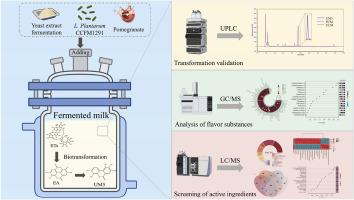
Pomegranate, rich in polyphenols and ellagitannins, imparts distinctive flavor profiles and nutritional advantages to fermented dairy products. This study investigated the growth dynamics of Lactiplantibacillus plantarum in a milk-based matrix and characterized the biotransformation of bioactive compounds during fermentation. Through integrated targeted and untargeted metabolomic approaches, we systematically evaluated metabolic alterations induced by L. plantarum CCFM1291 during pomegranate milk fermentation. Targeted quantification revealed significant production of urolithin M5 (3.21 ± 0.06 mg/L), while untargeted analysis identified metabolic shifts, including the generation of hydroxyisocaproic acid and p-aminobenzoic acid. Multidimensional sensory evaluation coupled with GC-MS flavor profiling demonstrated statistically significant enhancements in fermented pomegranate milk quality. These findings provide novel insights into pomegranate milk fermentation and establish a scientific framework for developing functional dairy products.
石榴富含多酚和鞣花单宁,赋予发酵乳制品独特的风味和营养优势。本研究研究了植物乳杆菌在乳基基质中的生长动态,并对发酵过程中生物活性化合物的生物转化进行了表征。通过整合靶向和非靶向代谢组学方法,我们系统地评估了L. plantarum CCFM1291在石榴乳发酵过程中引起的代谢改变。靶向定量分析显示尿石素M5的产量显著(3.21±0.06 mg/L),而非靶向分析发现代谢变化,包括羟基异己酸和对氨基苯甲酸的产生。多维感官评价结合气相色谱-质谱风味分析表明,发酵石榴乳的质量有统计学意义的提高。这些发现为研究石榴乳发酵提供了新的思路,并为开发功能性乳制品建立了科学框架。
期刊介绍:
LWT - Food Science and Technology is an international journal that publishes innovative papers in the fields of food chemistry, biochemistry, microbiology, technology and nutrition. The work described should be innovative either in the approach or in the methods used. The significance of the results either for the science community or for the food industry must also be specified. Contributions written in English are welcomed in the form of review articles, short reviews, research papers, and research notes. Papers featuring animal trials and cell cultures are outside the scope of the journal and will not be considered for publication.



 京公网安备 11010802042870号
京ICP备2023020795号-1
京公网安备 11010802042870号
京ICP备2023020795号-1

 分享
分享
 求助内容:
求助内容: 应助结果提醒方式:
 扫码关注我们
