In situ extraction of lithium from the aqueous phase using chemically modified Hylocereus undatus peel: kinetics, thermodynamics and in-field optimization
{"title":"In situ extraction of lithium from the aqueous phase using chemically modified Hylocereus undatus peel: kinetics, thermodynamics and in-field optimization","authors":"Dipti Chaudhary, Roshni Kumari and Anirbid Sircar","doi":"10.1039/D4NJ04873C","DOIUrl":null,"url":null,"abstract":"<p >Lithium is one of the most widely used industrial reagents for energy storage, battery production and electronic materials production. Among various agro-wastes, dragon fruit peel is one of the most promising substitutes for metal recovery. The present study aims to synthesize a novel low-cost and sustainable biosorbent, dragon fruit (<em>Hylocereus undatus</em>) peel impregnated with dibenzoyl methane (DBM), for lithium recovery from the aqueous phase. The biosorbent is characterized using SEM, FTIR, XRD, BET, XPS and DFT calculation techniques to understand the composition, structure and surface complexation. The kinetics study suggested that adsorption followed pseudo-second order kinetics with a correlation coefficient (<em>R</em><small><sup>2</sup></small>) value of 0.99 and a rate constant of 29.28 × 10<small><sup>−4</sup></small> g mg<small><sup>−1</sup></small> min<small><sup>−1</sup></small>. The isotherm studies evaluated the reaction to be heterogeneous with effective binding energies as depicted by Freundlich and Temkin isotherm models. The mechanistic forces include weak van der Waals forces, metal–surface complexation and valence forces. The thermodynamics study revealed the process to be exothermic (Δ<em>H</em>° = −18.28 kJ mol<small><sup>−1</sup></small>) and spontaneous with negative Gibbs free energy values. The maximum lithium uptake capacity was found to be 13.6 mg g<small><sup>−1</sup></small>. Acidic media favoured the recovery of the metal ion up to three cycles. The long term stability study using a fixed bed column showed 84% lithium extraction efficiency for the CMB. The lab scale study is validated using the CMB for lithium extraction from the real geothermal water sample of the Dholera region, Gujarat.</p>","PeriodicalId":95,"journal":{"name":"New Journal of Chemistry","volume":" 15","pages":" 6443-6460"},"PeriodicalIF":2.5000,"publicationDate":"2025-03-27","publicationTypes":"Journal Article","fieldsOfStudy":null,"isOpenAccess":false,"openAccessPdf":"","citationCount":"0","resultStr":null,"platform":"Semanticscholar","paperid":null,"PeriodicalName":"New Journal of Chemistry","FirstCategoryId":"92","ListUrlMain":"https://pubs.rsc.org/en/content/articlelanding/2025/nj/d4nj04873c","RegionNum":3,"RegionCategory":"化学","ArticlePicture":[],"TitleCN":null,"AbstractTextCN":null,"PMCID":null,"EPubDate":"","PubModel":"","JCR":"Q2","JCRName":"CHEMISTRY, MULTIDISCIPLINARY","Score":null,"Total":0}
引用次数: 0
Abstract
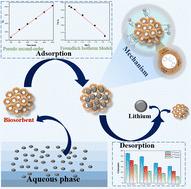
Lithium is one of the most widely used industrial reagents for energy storage, battery production and electronic materials production. Among various agro-wastes, dragon fruit peel is one of the most promising substitutes for metal recovery. The present study aims to synthesize a novel low-cost and sustainable biosorbent, dragon fruit (Hylocereus undatus) peel impregnated with dibenzoyl methane (DBM), for lithium recovery from the aqueous phase. The biosorbent is characterized using SEM, FTIR, XRD, BET, XPS and DFT calculation techniques to understand the composition, structure and surface complexation. The kinetics study suggested that adsorption followed pseudo-second order kinetics with a correlation coefficient (R2) value of 0.99 and a rate constant of 29.28 × 10⁻⁴ g mg−1 min−1. The isotherm studies evaluated the reaction to be heterogeneous with effective binding energies as depicted by Freundlich and Temkin isotherm models. The mechanistic forces include weak van der Waals forces, metal–surface complexation and valence forces. The thermodynamics study revealed the process to be exothermic (ΔH° = −18.28 kJ mol−1) and spontaneous with negative Gibbs free energy values. The maximum lithium uptake capacity was found to be 13.6 mg g−1. Acidic media favoured the recovery of the metal ion up to three cycles. The long term stability study using a fixed bed column showed 84% lithium extraction efficiency for the CMB. The lab scale study is validated using the CMB for lithium extraction from the real geothermal water sample of the Dholera region, Gujarat.




 京公网安备 11010802042870号
京ICP备2023020795号-1
京公网安备 11010802042870号
京ICP备2023020795号-1

 分享
分享
 求助内容:
求助内容: 应助结果提醒方式:
 扫码关注我们
