{"title":"Machine learning-based prediction and optimization of plasma-based conversion of CO2 and CH4 in an atmospheric pressure glow discharge plasma†","authors":"Jiayin Li , Jing Xu , Evgeny Rebrov , Bart Wanten , Annemie Bogaerts","doi":"10.1039/d5gc00301f","DOIUrl":null,"url":null,"abstract":"<div><div>We developed a uniform, hybrid machine learning (ML) model, integrating both supervised learning (SL) and reinforcement learning (RL), based on several datasets across different CO<sub>2</sub> and CH<sub>4</sub> conversion reactions in an atmospheric pressure glow discharge plasma, to advance plasma-based CO<sub>2</sub> and CH<sub>4</sub> conversion. Given its complex and dynamic characteristics, the SL model employs artificial neural networks (ANN) to predict performance, demonstrating excellent alignment with the entire experimental data. The RL model subsequently provides the optimization protocol, which prioritizes coarse adjustments to high-impact parameters then fine-tuning low-impact ones, to obtain the best performance. Furthermore, we also investigated the simultaneous optimization of the syngas ratio (SR) and energy cost (EC), resulting in a maximum SR of 2.12, combined with a minimum EC (syngas) of 2.04 eV per molecule (<em>i.e.</em>, 352 kJ mol<sup>−1</sup>), which is close to the best experimental data obtained for further methanol synthesis, when accounting for suitable weighting between SR and EC in the model. Our study emphasizes the importance of interpreting ML results based on prior knowledge and human analysis. We hope this work encourages a more critical view on the application of ML when studying plasma-based gas conversion.</div></div>","PeriodicalId":78,"journal":{"name":"Green Chemistry","volume":"27 15","pages":"Pages 3916-3931"},"PeriodicalIF":9.2000,"publicationDate":"2025-03-06","publicationTypes":"Journal Article","fieldsOfStudy":null,"isOpenAccess":false,"openAccessPdf":"","citationCount":"0","resultStr":null,"platform":"Semanticscholar","paperid":null,"PeriodicalName":"Green Chemistry","FirstCategoryId":"92","ListUrlMain":"https://www.sciencedirect.com/org/science/article/pii/S1463926225001918","RegionNum":1,"RegionCategory":"化学","ArticlePicture":[],"TitleCN":null,"AbstractTextCN":null,"PMCID":null,"EPubDate":"","PubModel":"","JCR":"Q1","JCRName":"CHEMISTRY, MULTIDISCIPLINARY","Score":null,"Total":0}
引用次数: 0
Abstract
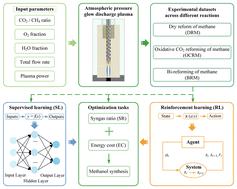
We developed a uniform, hybrid machine learning (ML) model, integrating both supervised learning (SL) and reinforcement learning (RL), based on several datasets across different CO2 and CH4 conversion reactions in an atmospheric pressure glow discharge plasma, to advance plasma-based CO2 and CH4 conversion. Given its complex and dynamic characteristics, the SL model employs artificial neural networks (ANN) to predict performance, demonstrating excellent alignment with the entire experimental data. The RL model subsequently provides the optimization protocol, which prioritizes coarse adjustments to high-impact parameters then fine-tuning low-impact ones, to obtain the best performance. Furthermore, we also investigated the simultaneous optimization of the syngas ratio (SR) and energy cost (EC), resulting in a maximum SR of 2.12, combined with a minimum EC (syngas) of 2.04 eV per molecule (i.e., 352 kJ mol−1), which is close to the best experimental data obtained for further methanol synthesis, when accounting for suitable weighting between SR and EC in the model. Our study emphasizes the importance of interpreting ML results based on prior knowledge and human analysis. We hope this work encourages a more critical view on the application of ML when studying plasma-based gas conversion.
期刊介绍:
Green Chemistry is a journal that provides a unique forum for the publication of innovative research on the development of alternative green and sustainable technologies. The scope of Green Chemistry is based on the definition proposed by Anastas and Warner (Green Chemistry: Theory and Practice, P T Anastas and J C Warner, Oxford University Press, Oxford, 1998), which defines green chemistry as the utilisation of a set of principles that reduces or eliminates the use or generation of hazardous substances in the design, manufacture and application of chemical products. Green Chemistry aims to reduce the environmental impact of the chemical enterprise by developing a technology base that is inherently non-toxic to living things and the environment. The journal welcomes submissions on all aspects of research relating to this endeavor and publishes original and significant cutting-edge research that is likely to be of wide general appeal. For a work to be published, it must present a significant advance in green chemistry, including a comparison with existing methods and a demonstration of advantages over those methods.



 京公网安备 11010802042870号
京ICP备2023020795号-1
京公网安备 11010802042870号
京ICP备2023020795号-1

 分享
分享
 求助内容:
求助内容: 应助结果提醒方式:
 扫码关注我们
