{"title":"Metallic Pollution Around Reghaïa Lake: Tolerance Assessment of Oxalis Pes-caprae L. as Remediative Plant","authors":"Lamia Benhabyles, Réda Djebbar, Manhattan Lebrun, Sylvain Bourgerie","doi":"10.1007/s11270-025-07942-y","DOIUrl":null,"url":null,"abstract":"<div><p>The Reghaïa Nature Reserve (Algeria) comprises a freshwater lake surrounded by natural soils covered by spontaneous vegetation with a habitat for wildlife. It is exposed to 3 mains sources of pollution i.e. an industrial zone, agricultural lands and the urban area. Abnormal high levels of metallic trace elements (MTEs) have been already reported in lake’s water and natural topsoil. In the present study, we explore the tolerance and phytoremediation capacity of <i>Oxalis pes-caprae</i> L., growing spontaneously on Reghaïa lake’s bank, toward Pb, Zn and Cd, the 3 main metal pollutants from anthropogenic activities. Sampling was carried out over 4 months, for <i>Oxalis pes-caprae</i> L. plants and rhizosphere soils, harvested in 3 sites along a gradient of proximity to lake’s water. Firstly, we estimated the degree of contamination of the sampled sites by Pb, Zn and Cd and we determined soils parameters which influence metals distribution in soil and their absorption by <i>O. pes-caprae</i> L. roots. Secondly, we examined the distribution and the accumulation of Pb, Zn and Cd within <i>O. pes-caprae</i> shoots and roots. The results revealed that Pb and Cd were the main soil pollutants and that <i>O. pes-caprae</i> L. adopted different remediation strategies such as an exclusion strategy for Pb in soil and a phytoextraction strategy for Cd.</p></div>","PeriodicalId":808,"journal":{"name":"Water, Air, & Soil Pollution","volume":"236 5","pages":""},"PeriodicalIF":3.0000,"publicationDate":"2025-04-08","publicationTypes":"Journal Article","fieldsOfStudy":null,"isOpenAccess":false,"openAccessPdf":"","citationCount":"0","resultStr":null,"platform":"Semanticscholar","paperid":null,"PeriodicalName":"Water, Air, & Soil Pollution","FirstCategoryId":"6","ListUrlMain":"https://link.springer.com/article/10.1007/s11270-025-07942-y","RegionNum":4,"RegionCategory":"环境科学与生态学","ArticlePicture":[],"TitleCN":null,"AbstractTextCN":null,"PMCID":null,"EPubDate":"","PubModel":"","JCR":"Q2","JCRName":"ENVIRONMENTAL SCIENCES","Score":null,"Total":0}
引用次数: 0
Abstract
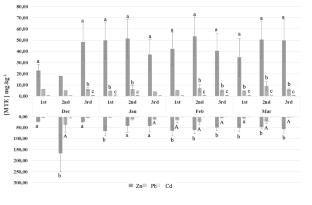
The Reghaïa Nature Reserve (Algeria) comprises a freshwater lake surrounded by natural soils covered by spontaneous vegetation with a habitat for wildlife. It is exposed to 3 mains sources of pollution i.e. an industrial zone, agricultural lands and the urban area. Abnormal high levels of metallic trace elements (MTEs) have been already reported in lake’s water and natural topsoil. In the present study, we explore the tolerance and phytoremediation capacity of Oxalis pes-caprae L., growing spontaneously on Reghaïa lake’s bank, toward Pb, Zn and Cd, the 3 main metal pollutants from anthropogenic activities. Sampling was carried out over 4 months, for Oxalis pes-caprae L. plants and rhizosphere soils, harvested in 3 sites along a gradient of proximity to lake’s water. Firstly, we estimated the degree of contamination of the sampled sites by Pb, Zn and Cd and we determined soils parameters which influence metals distribution in soil and their absorption by O. pes-caprae L. roots. Secondly, we examined the distribution and the accumulation of Pb, Zn and Cd within O. pes-caprae shoots and roots. The results revealed that Pb and Cd were the main soil pollutants and that O. pes-caprae L. adopted different remediation strategies such as an exclusion strategy for Pb in soil and a phytoextraction strategy for Cd.
期刊介绍:
Water, Air, & Soil Pollution is an international, interdisciplinary journal on all aspects of pollution and solutions to pollution in the biosphere. This includes chemical, physical and biological processes affecting flora, fauna, water, air and soil in relation to environmental pollution. Because of its scope, the subject areas are diverse and include all aspects of pollution sources, transport, deposition, accumulation, acid precipitation, atmospheric pollution, metals, aquatic pollution including marine pollution and ground water, waste water, pesticides, soil pollution, sewage, sediment pollution, forestry pollution, effects of pollutants on humans, vegetation, fish, aquatic species, micro-organisms, and animals, environmental and molecular toxicology applied to pollution research, biosensors, global and climate change, ecological implications of pollution and pollution models. Water, Air, & Soil Pollution also publishes manuscripts on novel methods used in the study of environmental pollutants, environmental toxicology, environmental biology, novel environmental engineering related to pollution, biodiversity as influenced by pollution, novel environmental biotechnology as applied to pollution (e.g. bioremediation), environmental modelling and biorestoration of polluted environments.
Articles should not be submitted that are of local interest only and do not advance international knowledge in environmental pollution and solutions to pollution. Articles that simply replicate known knowledge or techniques while researching a local pollution problem will normally be rejected without review. Submitted articles must have up-to-date references, employ the correct experimental replication and statistical analysis, where needed and contain a significant contribution to new knowledge. The publishing and editorial team sincerely appreciate your cooperation.
Water, Air, & Soil Pollution publishes research papers; review articles; mini-reviews; and book reviews.



 京公网安备 11010802042870号
京ICP备2023020795号-1
京公网安备 11010802042870号
京ICP备2023020795号-1

 分享
分享
 求助内容:
求助内容: 应助结果提醒方式:
 扫码关注我们
