{"title":"Synthesis of solid micro-spherical hydroxyapatite by hard-template method: optimization and characterization","authors":"Yangjie Qin, Zhaobo Wang, Shanzhu Jiang, Ruan Chi, Shengchao Huang, Huijuan Ma, Zhongjun Li","doi":"10.1007/s10934-024-01731-4","DOIUrl":null,"url":null,"abstract":"<div><p>Spherical hydroxyapatite (SHAP) has been widely concerned because of its non-toxicity, biocompatibility and unique adsorption capacity. We optimized the synthesis of SHAP using spherical calcium carbonate (CaCO<sub>3</sub>) as a template to provide reference for its efficient preparation and application. The optimal synthesis conditions of CaCO<sub>3</sub> are initial salt concentration 0.4 M, PVP concentration 1.0 g/L, stirring 60 min with 700 rpm under 35 °C. Under the optimal conditions, the SEM morphology of SHAP is characterized by spherical particles of uneven surface with a uniform particle size distribution (7.402 μm, D<sub>50</sub>), porous characteristics and large specific surface area (55.85 m<sup>2</sup>/g). In addition, SHAP has a high degree of matching with JCPDS no. 09-0432, has a good HAP crystal form, and has high crystal purity. The microstructure and uniform size of SHAP are the basis of its excellent performance, and the above performance parameters of the products in this study are comparable to or even better than some natural HAP and HAP synthesized using different strategies.</p></div>","PeriodicalId":660,"journal":{"name":"Journal of Porous Materials","volume":"32 2","pages":"741 - 751"},"PeriodicalIF":3.2000,"publicationDate":"2024-12-24","publicationTypes":"Journal Article","fieldsOfStudy":null,"isOpenAccess":false,"openAccessPdf":"","citationCount":"0","resultStr":null,"platform":"Semanticscholar","paperid":null,"PeriodicalName":"Journal of Porous Materials","FirstCategoryId":"88","ListUrlMain":"https://link.springer.com/article/10.1007/s10934-024-01731-4","RegionNum":4,"RegionCategory":"材料科学","ArticlePicture":[],"TitleCN":null,"AbstractTextCN":null,"PMCID":null,"EPubDate":"","PubModel":"","JCR":"Q2","JCRName":"CHEMISTRY, APPLIED","Score":null,"Total":0}
引用次数: 0
Abstract
Spherical hydroxyapatite (SHAP) has been widely concerned because of its non-toxicity, biocompatibility and unique adsorption capacity. We optimized the synthesis of SHAP using spherical calcium carbonate (CaCO3) as a template to provide reference for its efficient preparation and application. The optimal synthesis conditions of CaCO3 are initial salt concentration 0.4 M, PVP concentration 1.0 g/L, stirring 60 min with 700 rpm under 35 °C. Under the optimal conditions, the SEM morphology of SHAP is characterized by spherical particles of uneven surface with a uniform particle size distribution (7.402 μm, D50), porous characteristics and large specific surface area (55.85 m2/g). In addition, SHAP has a high degree of matching with JCPDS no. 09-0432, has a good HAP crystal form, and has high crystal purity. The microstructure and uniform size of SHAP are the basis of its excellent performance, and the above performance parameters of the products in this study are comparable to or even better than some natural HAP and HAP synthesized using different strategies.
期刊介绍:
The Journal of Porous Materials is an interdisciplinary and international periodical devoted to all types of porous materials. Its aim is the rapid publication
of high quality, peer-reviewed papers focused on the synthesis, processing, characterization and property evaluation of all porous materials. The objective is to
establish a unique journal that will serve as a principal means of communication for the growing interdisciplinary field of porous materials.
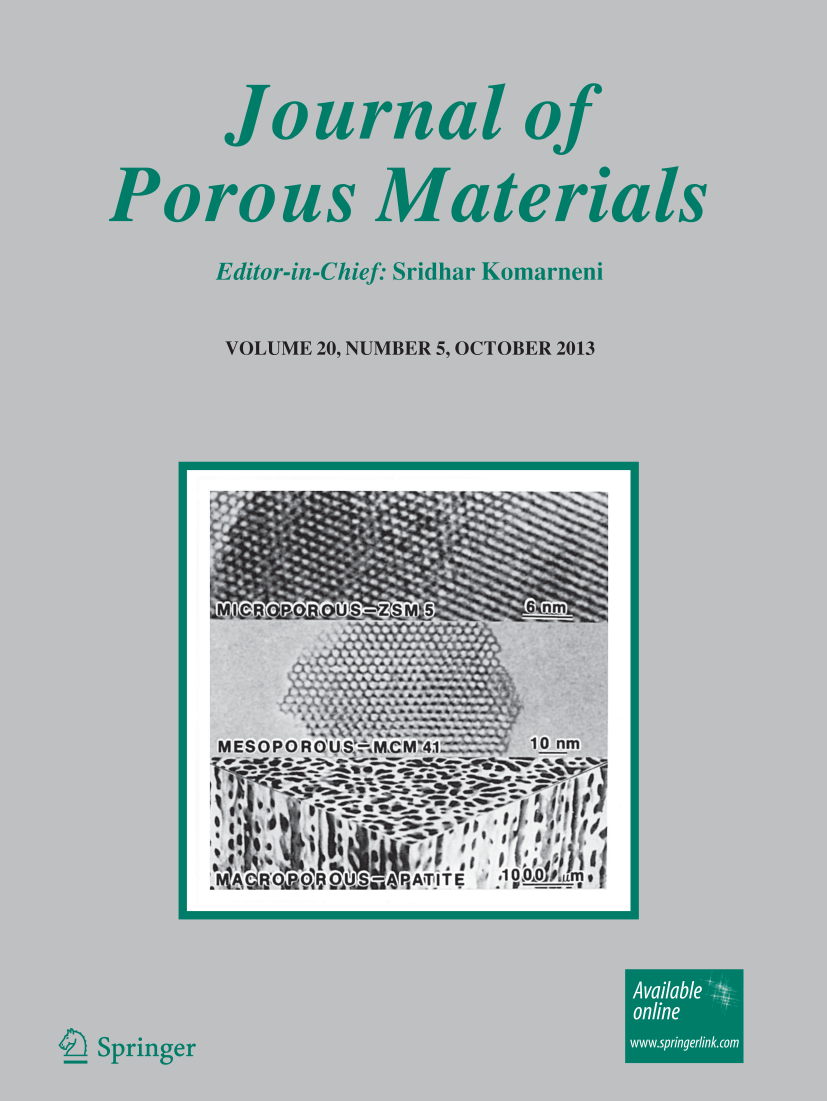
Porous materials include microporous materials with 50 nm pores.
Examples of microporous materials are natural and synthetic molecular sieves, cationic and anionic clays, pillared clays, tobermorites, pillared Zr and Ti
phosphates, spherosilicates, carbons, porous polymers, xerogels, etc. Mesoporous materials include synthetic molecular sieves, xerogels, aerogels, glasses, glass
ceramics, porous polymers, etc.; while macroporous materials include ceramics, glass ceramics, porous polymers, aerogels, cement, etc. The porous materials
can be crystalline, semicrystalline or noncrystalline, or combinations thereof. They can also be either organic, inorganic, or their composites. The overall
objective of the journal is the establishment of one main forum covering the basic and applied aspects of all porous materials.



 京公网安备 11010802042870号
京ICP备2023020795号-1
京公网安备 11010802042870号
京ICP备2023020795号-1

 分享
分享
 求助内容:
求助内容: 应助结果提醒方式:
 扫码关注我们
