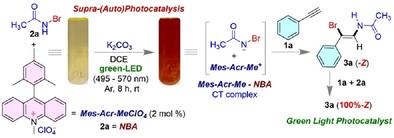
{"title":"A Self-Sustaining Supramolecular (Auto)Photocatalysis via the Synthesis of N-Vinylacetamides","authors":"Tarun Kumar Dinda, Prasenjit Mal","doi":"10.1002/chem.202404624","DOIUrl":null,"url":null,"abstract":"<p>Efforts to enhance photocatalysts prioritize improving their accessibility and practicality in photocatalytic applications. Supramolecular (auto)photocatalysis, which exploits transient self-assembled complexes, facilitates visible light-driven reactions, with autocatalytic systems promoting sustainable and atom-economical processes. In this study, the photocatalyst Mes-Acr-MeClO<sub>4</sub>, typically active under blue light, formed a dark red charge-transfer (CT) complex with <i>N</i>-bromoacetamide (NBA) in the presence of K<sub>2</sub>CO<sub>3</sub> in DCE, enabling green-light photocatalysis. This self-assembled CT complex initiated an auto-photocatalytic process via two-photon absorption, generating an <i>N</i>-centered radical that drove <i>anti</i>-Markovnikov, <i>syn</i>-periplanar addition to phenylacetylene, achieving exclusive <i>Z</i>-selective formation of (<i>Z</i>)-<i>N</i>-(2-bromo-2-phenylvinyl)acetamide. Interestingly, the product itself functioned as a potent green-LED photocatalyst (λ<sub>em</sub> = 518 nm, τ = 10 ns), driving its own synthesis with added terminal alkynes. With 100% atom economy, this work highlights a system chemistry approach, showcasing a highly efficient, self-sustaining catalytic process that advances green and sustainable synthetic strategies. This protocol emphasizes sustainability with an outstanding E-factor of 11.15, reflecting minimal waste production (11.15 kg per 1 kg of product) and demonstrating a strong commitment to green chemistry principles.</p>","PeriodicalId":144,"journal":{"name":"Chemistry - A European Journal","volume":"31 29","pages":""},"PeriodicalIF":3.7000,"publicationDate":"2025-04-07","publicationTypes":"Journal Article","fieldsOfStudy":null,"isOpenAccess":false,"openAccessPdf":"","citationCount":"0","resultStr":null,"platform":"Semanticscholar","paperid":null,"PeriodicalName":"Chemistry - A European Journal","FirstCategoryId":"92","ListUrlMain":"https://chemistry-europe.onlinelibrary.wiley.com/doi/10.1002/chem.202404624","RegionNum":2,"RegionCategory":"化学","ArticlePicture":[],"TitleCN":null,"AbstractTextCN":null,"PMCID":null,"EPubDate":"","PubModel":"","JCR":"Q2","JCRName":"CHEMISTRY, MULTIDISCIPLINARY","Score":null,"Total":0}
引用次数: 0
Abstract
Efforts to enhance photocatalysts prioritize improving their accessibility and practicality in photocatalytic applications. Supramolecular (auto)photocatalysis, which exploits transient self-assembled complexes, facilitates visible light-driven reactions, with autocatalytic systems promoting sustainable and atom-economical processes. In this study, the photocatalyst Mes-Acr-MeClO4, typically active under blue light, formed a dark red charge-transfer (CT) complex with N-bromoacetamide (NBA) in the presence of K2CO3 in DCE, enabling green-light photocatalysis. This self-assembled CT complex initiated an auto-photocatalytic process via two-photon absorption, generating an N-centered radical that drove anti-Markovnikov, syn-periplanar addition to phenylacetylene, achieving exclusive Z-selective formation of (Z)-N-(2-bromo-2-phenylvinyl)acetamide. Interestingly, the product itself functioned as a potent green-LED photocatalyst (λem = 518 nm, τ = 10 ns), driving its own synthesis with added terminal alkynes. With 100% atom economy, this work highlights a system chemistry approach, showcasing a highly efficient, self-sustaining catalytic process that advances green and sustainable synthetic strategies. This protocol emphasizes sustainability with an outstanding E-factor of 11.15, reflecting minimal waste production (11.15 kg per 1 kg of product) and demonstrating a strong commitment to green chemistry principles.
期刊介绍:
Chemistry—A European Journal is a truly international journal with top quality contributions (2018 ISI Impact Factor: 5.16). It publishes a wide range of outstanding Reviews, Minireviews, Concepts, Full Papers, and Communications from all areas of chemistry and related fields.
Based in Europe Chemistry—A European Journal provides an excellent platform for increasing the visibility of European chemistry as well as for featuring the best research from authors from around the world.
All manuscripts are peer-reviewed, and electronic processing ensures accurate reproduction of text and data, plus short publication times.
The Concepts section provides nonspecialist readers with a useful conceptual guide to unfamiliar areas and experts with new angles on familiar problems.
Chemistry—A European Journal is published on behalf of ChemPubSoc Europe, a group of 16 national chemical societies from within Europe, and supported by the Asian Chemical Editorial Societies. The ChemPubSoc Europe family comprises: Angewandte Chemie, Chemistry—A European Journal, European Journal of Organic Chemistry, European Journal of Inorganic Chemistry, ChemPhysChem, ChemBioChem, ChemMedChem, ChemCatChem, ChemSusChem, ChemPlusChem, ChemElectroChem, and ChemistryOpen.





 京公网安备 11010802042870号
京ICP备2023020795号-1
京公网安备 11010802042870号
京ICP备2023020795号-1

 分享
分享
 求助内容:
求助内容: 应助结果提醒方式:
 扫码关注我们
