{"title":"Bis(Dipyrrinate) Based Bis(Germylenes): Synthesis, Reactivity, and UV-Vis Spectroscopic Analysis","authors":"Prakash Chandra Joshi, Pratima Shukla, Vishal Singh, Vivek Kumar Singh, Aditi Garg, Harshita Gaur, Pritam Mahawar, Hemant Kumar, Selvarajan Nagendran","doi":"10.1002/chem.202500214","DOIUrl":null,"url":null,"abstract":"<p>The first examples of air and water stable bis(germylenes) <b>5</b>–<b>9</b> and bis(germacarbonyl) compounds <b>10</b>–<b>12</b> are reported. Bis(germylene monochloride) <b>5</b> is isolated by starting from bis(dipyrromethene) <b>4</b>, which in turn has been synthesized by oxidizing bis(dipyrromethane) <b>3</b> using DDQ. Terephthaldehyde <b>1</b> and mesityl pyrrole <b>2</b> were the precursors for compound <b>3</b>. Bis(germylene monochloride) <b>5</b> reacts with alcohols and phenol in the presence of a mild base (Cs₂CO₃) to afford bis(germylene alkoxides) <b>6</b>–<b>7</b> and bis(germylene phenoxide) <b>8</b>, respectively. Compound <b>5′</b>s reaction with sodium pyrrolide has resulted in bis(germylene pyrrolide) <b>9</b>. Further, compounds <b>7</b> and <b>9</b> react with elemental sulfur and selenium under ambient conditions, resulting in bis(germacarbonyl) compounds <b>10</b>–<b>12</b>. The UV-Vis spectroscopic investigations on compounds <b>4</b>–<b>12</b> are done experimentally and computationally.</p>","PeriodicalId":144,"journal":{"name":"Chemistry - A European Journal","volume":"31 28","pages":""},"PeriodicalIF":3.7000,"publicationDate":"2025-04-07","publicationTypes":"Journal Article","fieldsOfStudy":null,"isOpenAccess":false,"openAccessPdf":"","citationCount":"0","resultStr":null,"platform":"Semanticscholar","paperid":null,"PeriodicalName":"Chemistry - A European Journal","FirstCategoryId":"92","ListUrlMain":"https://chemistry-europe.onlinelibrary.wiley.com/doi/10.1002/chem.202500214","RegionNum":2,"RegionCategory":"化学","ArticlePicture":[],"TitleCN":null,"AbstractTextCN":null,"PMCID":null,"EPubDate":"","PubModel":"","JCR":"Q2","JCRName":"CHEMISTRY, MULTIDISCIPLINARY","Score":null,"Total":0}
引用次数: 0
Abstract
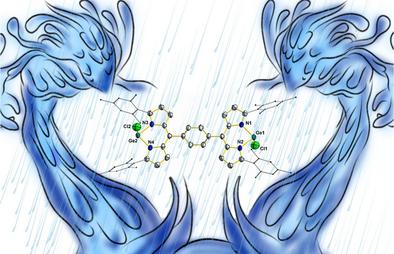
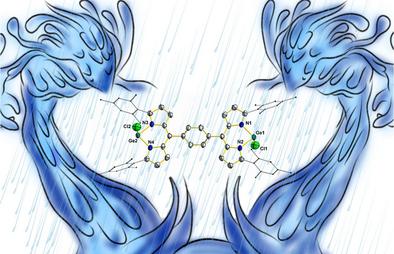
The first examples of air and water stable bis(germylenes) 5–9 and bis(germacarbonyl) compounds 10–12 are reported. Bis(germylene monochloride) 5 is isolated by starting from bis(dipyrromethene) 4, which in turn has been synthesized by oxidizing bis(dipyrromethane) 3 using DDQ. Terephthaldehyde 1 and mesityl pyrrole 2 were the precursors for compound 3. Bis(germylene monochloride) 5 reacts with alcohols and phenol in the presence of a mild base (Cs₂CO₃) to afford bis(germylene alkoxides) 6–7 and bis(germylene phenoxide) 8, respectively. Compound 5′s reaction with sodium pyrrolide has resulted in bis(germylene pyrrolide) 9. Further, compounds 7 and 9 react with elemental sulfur and selenium under ambient conditions, resulting in bis(germacarbonyl) compounds 10–12. The UV-Vis spectroscopic investigations on compounds 4–12 are done experimentally and computationally.
期刊介绍:
Chemistry—A European Journal is a truly international journal with top quality contributions (2018 ISI Impact Factor: 5.16). It publishes a wide range of outstanding Reviews, Minireviews, Concepts, Full Papers, and Communications from all areas of chemistry and related fields.
Based in Europe Chemistry—A European Journal provides an excellent platform for increasing the visibility of European chemistry as well as for featuring the best research from authors from around the world.
All manuscripts are peer-reviewed, and electronic processing ensures accurate reproduction of text and data, plus short publication times.
The Concepts section provides nonspecialist readers with a useful conceptual guide to unfamiliar areas and experts with new angles on familiar problems.
Chemistry—A European Journal is published on behalf of ChemPubSoc Europe, a group of 16 national chemical societies from within Europe, and supported by the Asian Chemical Editorial Societies. The ChemPubSoc Europe family comprises: Angewandte Chemie, Chemistry—A European Journal, European Journal of Organic Chemistry, European Journal of Inorganic Chemistry, ChemPhysChem, ChemBioChem, ChemMedChem, ChemCatChem, ChemSusChem, ChemPlusChem, ChemElectroChem, and ChemistryOpen.





 京公网安备 11010802042870号
京ICP备2023020795号-1
京公网安备 11010802042870号
京ICP备2023020795号-1

 分享
分享
 求助内容:
求助内容: 应助结果提醒方式:
 扫码关注我们
