Yalan Xu, Yiwei Liu, Liping Feng, Xiaoli Sun, Muhua Wang, Yueyi Xia, Luoxing Yang and Junjie Yuwang
{"title":"Raspberry-derived carbon dots for specific detection of intracellular copper ions†","authors":"Yalan Xu, Yiwei Liu, Liping Feng, Xiaoli Sun, Muhua Wang, Yueyi Xia, Luoxing Yang and Junjie Yuwang","doi":"10.1039/D5AY00225G","DOIUrl":null,"url":null,"abstract":"<p >The detection of intracellular copper ions is crucial for advancing biomedical research and enhancing disease diagnosis. In this study, blue emissive carbon dots (B-CDs) were successfully synthesized using raspberry as the carbon source through a simple hydrothermal method. Characterization techniques combined with theoretical calculations confirmed that the fundamental structural unit of B-CDs is a twelve-membered aromatic ring rich in oxygen and nitrogen functional groups. The B-CDs exhibited high selectivity for Cu<small><sup>2+</sup></small>, showing a strong linear response in the concentration range of 0 to 150 μM, with a detection limit of 0.39 μM. Zeta potential and hydrodynamic size measurements indicated that the B-CDs interact with Cu<small><sup>2+</sup></small><em>via</em> electrostatic forces. Further studies revealed that the fluorescence quenching of B-CDs in the presence of Cu<small><sup>2+</sup></small> is primarily due to a dynamic quenching process. Moreover, B-CDs were successfully applied to detect intracellular Cu<small><sup>2+</sup></small>. These findings not only show significant potential of B-CDs in fluorescence sensing but also provide valuable insights for the design of efficient carbon-based sensors.</p>","PeriodicalId":64,"journal":{"name":"Analytical Methods","volume":" 16","pages":" 3239-3248"},"PeriodicalIF":2.6000,"publicationDate":"2025-04-07","publicationTypes":"Journal Article","fieldsOfStudy":null,"isOpenAccess":false,"openAccessPdf":"","citationCount":"0","resultStr":null,"platform":"Semanticscholar","paperid":null,"PeriodicalName":"Analytical Methods","FirstCategoryId":"92","ListUrlMain":"https://pubs.rsc.org/en/content/articlelanding/2025/ay/d5ay00225g","RegionNum":3,"RegionCategory":"化学","ArticlePicture":[],"TitleCN":null,"AbstractTextCN":null,"PMCID":null,"EPubDate":"","PubModel":"","JCR":"Q2","JCRName":"CHEMISTRY, ANALYTICAL","Score":null,"Total":0}
引用次数: 0
Abstract
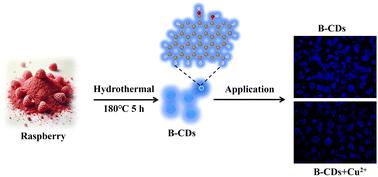
The detection of intracellular copper ions is crucial for advancing biomedical research and enhancing disease diagnosis. In this study, blue emissive carbon dots (B-CDs) were successfully synthesized using raspberry as the carbon source through a simple hydrothermal method. Characterization techniques combined with theoretical calculations confirmed that the fundamental structural unit of B-CDs is a twelve-membered aromatic ring rich in oxygen and nitrogen functional groups. The B-CDs exhibited high selectivity for Cu2+, showing a strong linear response in the concentration range of 0 to 150 μM, with a detection limit of 0.39 μM. Zeta potential and hydrodynamic size measurements indicated that the B-CDs interact with Cu2+via electrostatic forces. Further studies revealed that the fluorescence quenching of B-CDs in the presence of Cu2+ is primarily due to a dynamic quenching process. Moreover, B-CDs were successfully applied to detect intracellular Cu2+. These findings not only show significant potential of B-CDs in fluorescence sensing but also provide valuable insights for the design of efficient carbon-based sensors.



 京公网安备 11010802042870号
京ICP备2023020795号-1
京公网安备 11010802042870号
京ICP备2023020795号-1

 分享
分享
 求助内容:
求助内容: 应助结果提醒方式:
 扫码关注我们
