{"title":"The Molecular Toolbox for Linkage Type-Specific Analysis of Ubiquitin Signaling","authors":"Julian Koch, Camilla Reiter Elbæk, Dominik Priesmann, Rune Busk Damgaard","doi":"10.1002/cbic.202500114","DOIUrl":null,"url":null,"abstract":"<p>Modification of proteins and other biomolecules with ubiquitin regulates virtually all aspects of eukaryotic cell biology. Ubiquitin can be attached to substrates as a monomer or as an array of polyubiquitin chains with defined linkages between the ubiquitin moieties. Each ubiquitin linkage type adopts a distinct structure, enabling the individual linkage types to mediate specific functions or outcomes in the cell. The dynamics, heterogeneity, and in some cases low abundance, make analysis of linkage type-specific ubiquitin signaling a challenging and complex task. Herein, the strategies and molecular tools available for enrichment, detection, and characterization of linkage type-specific ubiquitin signaling, are reviewed. The molecular “toolbox” consists of a range of molecularly different affinity reagents, including antibodies and antibody-like molecules, affimers, engineered ubiquitin-binding domains, catalytically inactive deubiquitinases, and macrocyclic peptides, each with their unique characteristics and binding modes. The molecular engineering of these ubiquitin-binding molecules makes them useful tools and reagents that can be coupled to a range of analytical methods, such as immunoblotting, fluorescence microscopy, mass spectrometry-based proteomics, or enzymatic analyses to aid in deciphering the ever-expanding complexity of ubiquitin modifications.</p>","PeriodicalId":140,"journal":{"name":"ChemBioChem","volume":"26 10","pages":""},"PeriodicalIF":2.8000,"publicationDate":"2025-04-07","publicationTypes":"Journal Article","fieldsOfStudy":null,"isOpenAccess":false,"openAccessPdf":"https://onlinelibrary.wiley.com/doi/epdf/10.1002/cbic.202500114","citationCount":"0","resultStr":null,"platform":"Semanticscholar","paperid":null,"PeriodicalName":"ChemBioChem","FirstCategoryId":"99","ListUrlMain":"https://chemistry-europe.onlinelibrary.wiley.com/doi/10.1002/cbic.202500114","RegionNum":4,"RegionCategory":"生物学","ArticlePicture":[],"TitleCN":null,"AbstractTextCN":null,"PMCID":null,"EPubDate":"","PubModel":"","JCR":"Q3","JCRName":"BIOCHEMISTRY & MOLECULAR BIOLOGY","Score":null,"Total":0}
引用次数: 0
Abstract
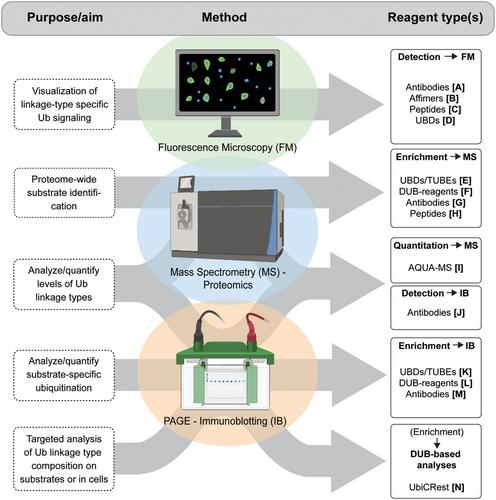
Modification of proteins and other biomolecules with ubiquitin regulates virtually all aspects of eukaryotic cell biology. Ubiquitin can be attached to substrates as a monomer or as an array of polyubiquitin chains with defined linkages between the ubiquitin moieties. Each ubiquitin linkage type adopts a distinct structure, enabling the individual linkage types to mediate specific functions or outcomes in the cell. The dynamics, heterogeneity, and in some cases low abundance, make analysis of linkage type-specific ubiquitin signaling a challenging and complex task. Herein, the strategies and molecular tools available for enrichment, detection, and characterization of linkage type-specific ubiquitin signaling, are reviewed. The molecular “toolbox” consists of a range of molecularly different affinity reagents, including antibodies and antibody-like molecules, affimers, engineered ubiquitin-binding domains, catalytically inactive deubiquitinases, and macrocyclic peptides, each with their unique characteristics and binding modes. The molecular engineering of these ubiquitin-binding molecules makes them useful tools and reagents that can be coupled to a range of analytical methods, such as immunoblotting, fluorescence microscopy, mass spectrometry-based proteomics, or enzymatic analyses to aid in deciphering the ever-expanding complexity of ubiquitin modifications.
期刊介绍:
ChemBioChem (Impact Factor 2018: 2.641) publishes important breakthroughs across all areas at the interface of chemistry and biology, including the fields of chemical biology, bioorganic chemistry, bioinorganic chemistry, synthetic biology, biocatalysis, bionanotechnology, and biomaterials. It is published on behalf of Chemistry Europe, an association of 16 European chemical societies, and supported by the Asian Chemical Editorial Society (ACES).





 京公网安备 11010802042870号
京ICP备2023020795号-1
京公网安备 11010802042870号
京ICP备2023020795号-1

 分享
分享
 求助内容:
求助内容: 应助结果提醒方式:
 扫码关注我们
