{"title":"Catechol-Functionalized Covalent Organic Framework: Synthesis, Characterization and Metal-Free Organocatalyst for CO2 Fixation Under Mild Conditions","authors":"Minghao Liu, Guoxin Cui, Xue Cai, Guan Yun, Weiqi Zeng, Jing Li, Jinghan Zhang, Rongxin Tan, Zhenlu Wang, Jian Jiang","doi":"10.1002/chem.202500654","DOIUrl":null,"url":null,"abstract":"<p>Covalent organic frameworks (COFs) incorporating hydrogen bond donor (HBD) moieties show great promise for heterogeneous catalyst for CO<sub>2</sub> cycloaddition. In this work, a catechol-functionalized COF (<b>BL-TF-COF</b>) was constructed via Schiff-base condensation under solvothermal conditions, which was characterized using powder X-ray diffraction (PXRD), Fourier transform infrared spectroscopy (FT-IR), solid-state <sup>13</sup>C nuclear magnetic resonance (NMR), scanning electron microscope (SEM), high resolution transmission electron microscope (HR-TEM), diffuse reflection spectroscopy (DRS) and cyclic voltammetry (CV). <b>BL-TF-COF</b> presents high crystallinity, large surface area (523 m<sup>2</sup> g<sup>−1</sup>) and remarkable chemical stability, along with abundant hydroxyl functional groups distributed on the pore wall. This framework shows a CO<sub>2</sub> adsorption capacity up to 88 mg g<sup>−1</sup> at 273 K and 1 bar. The binding locations of the adsorption of CO<sub>2</sub> over <b>BL-TF-COF</b> was studied by grand canonical Monte Carlo (GCMC) simulations. <b>BL-TF-COF</b> displays remarkable catalytic performance for the cycloaddition of CO<sub>2</sub> with epoxides under mild conditions. Under the condition of the epichlorohydrin/tetrabutylammonium bromide/<b>BL-TF-COF</b> molar ratio of 10210:630:4, the system achieved 62.5% substrate conversion at 25 °C under atmospheric CO<sub>2</sub> pressure (1 bar) within 48 h. Mechanistic insights into epoxide adsorption and activation processes were investigated through density functional theory (DFT) calculations.</p>","PeriodicalId":144,"journal":{"name":"Chemistry - A European Journal","volume":"31 27","pages":""},"PeriodicalIF":3.7000,"publicationDate":"2025-04-07","publicationTypes":"Journal Article","fieldsOfStudy":null,"isOpenAccess":false,"openAccessPdf":"","citationCount":"0","resultStr":null,"platform":"Semanticscholar","paperid":null,"PeriodicalName":"Chemistry - A European Journal","FirstCategoryId":"92","ListUrlMain":"https://chemistry-europe.onlinelibrary.wiley.com/doi/10.1002/chem.202500654","RegionNum":2,"RegionCategory":"化学","ArticlePicture":[],"TitleCN":null,"AbstractTextCN":null,"PMCID":null,"EPubDate":"","PubModel":"","JCR":"Q2","JCRName":"CHEMISTRY, MULTIDISCIPLINARY","Score":null,"Total":0}
引用次数: 0
Abstract
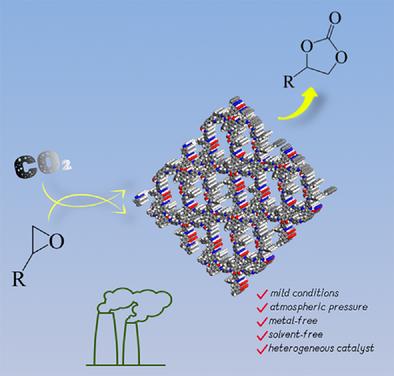
Covalent organic frameworks (COFs) incorporating hydrogen bond donor (HBD) moieties show great promise for heterogeneous catalyst for CO2 cycloaddition. In this work, a catechol-functionalized COF (BL-TF-COF) was constructed via Schiff-base condensation under solvothermal conditions, which was characterized using powder X-ray diffraction (PXRD), Fourier transform infrared spectroscopy (FT-IR), solid-state 13C nuclear magnetic resonance (NMR), scanning electron microscope (SEM), high resolution transmission electron microscope (HR-TEM), diffuse reflection spectroscopy (DRS) and cyclic voltammetry (CV). BL-TF-COF presents high crystallinity, large surface area (523 m2 g−1) and remarkable chemical stability, along with abundant hydroxyl functional groups distributed on the pore wall. This framework shows a CO2 adsorption capacity up to 88 mg g−1 at 273 K and 1 bar. The binding locations of the adsorption of CO2 over BL-TF-COF was studied by grand canonical Monte Carlo (GCMC) simulations. BL-TF-COF displays remarkable catalytic performance for the cycloaddition of CO2 with epoxides under mild conditions. Under the condition of the epichlorohydrin/tetrabutylammonium bromide/BL-TF-COF molar ratio of 10210:630:4, the system achieved 62.5% substrate conversion at 25 °C under atmospheric CO2 pressure (1 bar) within 48 h. Mechanistic insights into epoxide adsorption and activation processes were investigated through density functional theory (DFT) calculations.
期刊介绍:
Chemistry—A European Journal is a truly international journal with top quality contributions (2018 ISI Impact Factor: 5.16). It publishes a wide range of outstanding Reviews, Minireviews, Concepts, Full Papers, and Communications from all areas of chemistry and related fields.
Based in Europe Chemistry—A European Journal provides an excellent platform for increasing the visibility of European chemistry as well as for featuring the best research from authors from around the world.
All manuscripts are peer-reviewed, and electronic processing ensures accurate reproduction of text and data, plus short publication times.
The Concepts section provides nonspecialist readers with a useful conceptual guide to unfamiliar areas and experts with new angles on familiar problems.
Chemistry—A European Journal is published on behalf of ChemPubSoc Europe, a group of 16 national chemical societies from within Europe, and supported by the Asian Chemical Editorial Societies. The ChemPubSoc Europe family comprises: Angewandte Chemie, Chemistry—A European Journal, European Journal of Organic Chemistry, European Journal of Inorganic Chemistry, ChemPhysChem, ChemBioChem, ChemMedChem, ChemCatChem, ChemSusChem, ChemPlusChem, ChemElectroChem, and ChemistryOpen.





 京公网安备 11010802042870号
京ICP备2023020795号-1
京公网安备 11010802042870号
京ICP备2023020795号-1

 分享
分享
 求助内容:
求助内容: 应助结果提醒方式:
 扫码关注我们
