{"title":"Designed Metal-Free Quasi-1D Crystals with Giant Birefringence","authors":"Yang Li, Jihyun Lee, Kang Min Ok","doi":"10.1002/chem.202500849","DOIUrl":null,"url":null,"abstract":"<p>Birefringence, a vital property of anisotropic crystals, is indispensable for advanced optical technologies. Quasi-1D structures, with their inherent structural anisotropy, offer fertile ground for discovering materials with exceptional optical anisotropy. In this work, we report four metal-free quasi-1D crystals—(C<sub>5</sub>H<sub>6</sub>NO)<sup>+</sup>(NO<sub>3</sub>)<sup>-</sup>(<b>4HPN</b>), (C<sub>5</sub>H<sub>6</sub>NO)<sup>+</sup>(HC<sub>2</sub>O<sub>4</sub>)<sup>-</sup>(<b>4HPO</b>), (C<sub>4</sub>N<sub>3</sub>H<sub>6</sub>)<sup>+</sup>(NO<sub>3</sub>)<sup>-</sup>(<b>2APMN</b>), and (C<sub>4</sub>N<sub>3</sub>H<sub>6</sub>)<sup>+</sup>(HC<sub>2</sub>O<sub>4</sub>)<sup>-</sup>·H<sub>2</sub>O (<b>2APMO</b>)—designed to feature pseudo-chain structures and grown as centimeter-scale crystals via a facile aqueous-solution method. These crystals display wide bandgaps (3.40–4.48 eV) and exceptional birefringence, with calculated values up to 0.555@546 nm and an experimental maximum of 0.597@546 nm for <b>4HPN</b>. The giant birefringence stems from their quasi-1D architectures, high-spatial density, and optimal arrangement of the birefringence-active groups (BAGs). This study highlights the promise of metal-free quasi-1D materials for next-generation miniaturized polarization optics and laser-driven applications.</p>","PeriodicalId":144,"journal":{"name":"Chemistry - A European Journal","volume":"31 28","pages":""},"PeriodicalIF":3.7000,"publicationDate":"2025-04-07","publicationTypes":"Journal Article","fieldsOfStudy":null,"isOpenAccess":false,"openAccessPdf":"https://onlinelibrary.wiley.com/doi/epdf/10.1002/chem.202500849","citationCount":"0","resultStr":null,"platform":"Semanticscholar","paperid":null,"PeriodicalName":"Chemistry - A European Journal","FirstCategoryId":"92","ListUrlMain":"https://chemistry-europe.onlinelibrary.wiley.com/doi/10.1002/chem.202500849","RegionNum":2,"RegionCategory":"化学","ArticlePicture":[],"TitleCN":null,"AbstractTextCN":null,"PMCID":null,"EPubDate":"","PubModel":"","JCR":"Q2","JCRName":"CHEMISTRY, MULTIDISCIPLINARY","Score":null,"Total":0}
引用次数: 0
Abstract
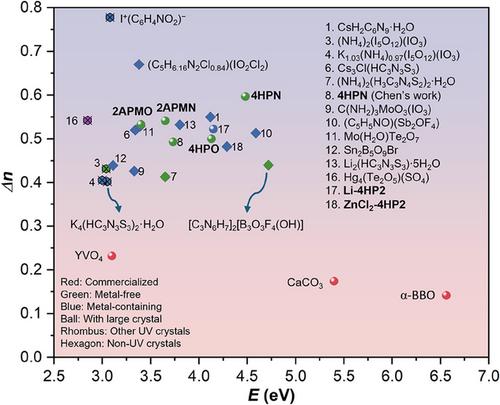
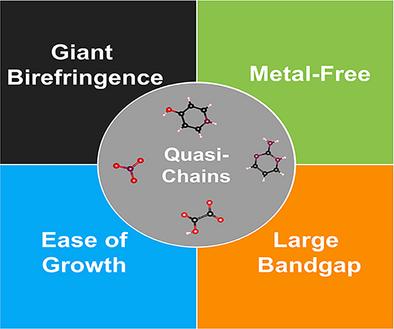
Birefringence, a vital property of anisotropic crystals, is indispensable for advanced optical technologies. Quasi-1D structures, with their inherent structural anisotropy, offer fertile ground for discovering materials with exceptional optical anisotropy. In this work, we report four metal-free quasi-1D crystals—(C5H6NO)+(NO3)-(4HPN), (C5H6NO)+(HC2O4)-(4HPO), (C4N3H6)+(NO3)-(2APMN), and (C4N3H6)+(HC2O4)-·H2O (2APMO)—designed to feature pseudo-chain structures and grown as centimeter-scale crystals via a facile aqueous-solution method. These crystals display wide bandgaps (3.40–4.48 eV) and exceptional birefringence, with calculated values up to 0.555@546 nm and an experimental maximum of 0.597@546 nm for 4HPN. The giant birefringence stems from their quasi-1D architectures, high-spatial density, and optimal arrangement of the birefringence-active groups (BAGs). This study highlights the promise of metal-free quasi-1D materials for next-generation miniaturized polarization optics and laser-driven applications.
期刊介绍:
Chemistry—A European Journal is a truly international journal with top quality contributions (2018 ISI Impact Factor: 5.16). It publishes a wide range of outstanding Reviews, Minireviews, Concepts, Full Papers, and Communications from all areas of chemistry and related fields.
Based in Europe Chemistry—A European Journal provides an excellent platform for increasing the visibility of European chemistry as well as for featuring the best research from authors from around the world.
All manuscripts are peer-reviewed, and electronic processing ensures accurate reproduction of text and data, plus short publication times.
The Concepts section provides nonspecialist readers with a useful conceptual guide to unfamiliar areas and experts with new angles on familiar problems.
Chemistry—A European Journal is published on behalf of ChemPubSoc Europe, a group of 16 national chemical societies from within Europe, and supported by the Asian Chemical Editorial Societies. The ChemPubSoc Europe family comprises: Angewandte Chemie, Chemistry—A European Journal, European Journal of Organic Chemistry, European Journal of Inorganic Chemistry, ChemPhysChem, ChemBioChem, ChemMedChem, ChemCatChem, ChemSusChem, ChemPlusChem, ChemElectroChem, and ChemistryOpen.





 京公网安备 11010802042870号
京ICP备2023020795号-1
京公网安备 11010802042870号
京ICP备2023020795号-1

 分享
分享
 求助内容:
求助内容: 应助结果提醒方式:
 扫码关注我们
