{"title":"Geometry-Dependent Energy-Gap Modulation of π-Conjugated Systems Based on Hypervalent Silicon(IV)-Fused Azomethine Compounds","authors":"Masayuki Gon, Shun Dekura, Tomoyuki Akutagawa, Kazuo Tanaka","doi":"10.1002/chem.202500506","DOIUrl":null,"url":null,"abstract":"<p>The colors of substances and emissions are determined by the width of the energy gap between frontier molecular orbitals. In general, significant structural transformation or chemical modification is essential to tune the energy gap. Herein, we reveal a hypervalent silicon compound that can form both square pyramidal (SPY) and trigonal bipyramidal (TBPY) geometries and demonstrate a novel technique to modulate the energy gap of the π-conjugated system. The energy gap in the TBPY geometry is narrower than that in the SPY geometry owing to the stronger contribution of a polarized three-center four-electron (3c-4e) bond and a nitrogen–silicon (N−Si) coordination, and the geometries are changeable by external stimuli such as photoirradiation and temperature variations. Correspondingly, the emission bands in the orange (<i>λ</i><sub>PL</sub> = 640 nm) and yellow (<i>λ</i><sub>PL</sub> = 579 nm) regions were observed from the TBPY geometry at room temperature and the SPY geometry at −196 °C, respectively. Furthermore, the geometry can be fixed to the TBPY geometry by introducing bulky substituents at silicon. These mechanisms are experimentally and theoretically clarified in detail. Our findings described here are expected to be a novel molecular design for creating stimuli-responsive materials.</p>","PeriodicalId":144,"journal":{"name":"Chemistry - A European Journal","volume":"31 29","pages":""},"PeriodicalIF":3.7000,"publicationDate":"2025-04-07","publicationTypes":"Journal Article","fieldsOfStudy":null,"isOpenAccess":false,"openAccessPdf":"","citationCount":"0","resultStr":null,"platform":"Semanticscholar","paperid":null,"PeriodicalName":"Chemistry - A European Journal","FirstCategoryId":"92","ListUrlMain":"https://chemistry-europe.onlinelibrary.wiley.com/doi/10.1002/chem.202500506","RegionNum":2,"RegionCategory":"化学","ArticlePicture":[],"TitleCN":null,"AbstractTextCN":null,"PMCID":null,"EPubDate":"","PubModel":"","JCR":"Q2","JCRName":"CHEMISTRY, MULTIDISCIPLINARY","Score":null,"Total":0}
引用次数: 0
Abstract
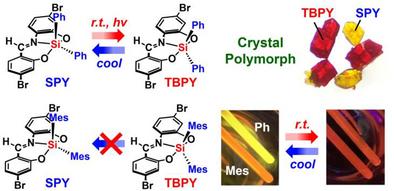
The colors of substances and emissions are determined by the width of the energy gap between frontier molecular orbitals. In general, significant structural transformation or chemical modification is essential to tune the energy gap. Herein, we reveal a hypervalent silicon compound that can form both square pyramidal (SPY) and trigonal bipyramidal (TBPY) geometries and demonstrate a novel technique to modulate the energy gap of the π-conjugated system. The energy gap in the TBPY geometry is narrower than that in the SPY geometry owing to the stronger contribution of a polarized three-center four-electron (3c-4e) bond and a nitrogen–silicon (N−Si) coordination, and the geometries are changeable by external stimuli such as photoirradiation and temperature variations. Correspondingly, the emission bands in the orange (λPL = 640 nm) and yellow (λPL = 579 nm) regions were observed from the TBPY geometry at room temperature and the SPY geometry at −196 °C, respectively. Furthermore, the geometry can be fixed to the TBPY geometry by introducing bulky substituents at silicon. These mechanisms are experimentally and theoretically clarified in detail. Our findings described here are expected to be a novel molecular design for creating stimuli-responsive materials.
期刊介绍:
Chemistry—A European Journal is a truly international journal with top quality contributions (2018 ISI Impact Factor: 5.16). It publishes a wide range of outstanding Reviews, Minireviews, Concepts, Full Papers, and Communications from all areas of chemistry and related fields.
Based in Europe Chemistry—A European Journal provides an excellent platform for increasing the visibility of European chemistry as well as for featuring the best research from authors from around the world.
All manuscripts are peer-reviewed, and electronic processing ensures accurate reproduction of text and data, plus short publication times.
The Concepts section provides nonspecialist readers with a useful conceptual guide to unfamiliar areas and experts with new angles on familiar problems.
Chemistry—A European Journal is published on behalf of ChemPubSoc Europe, a group of 16 national chemical societies from within Europe, and supported by the Asian Chemical Editorial Societies. The ChemPubSoc Europe family comprises: Angewandte Chemie, Chemistry—A European Journal, European Journal of Organic Chemistry, European Journal of Inorganic Chemistry, ChemPhysChem, ChemBioChem, ChemMedChem, ChemCatChem, ChemSusChem, ChemPlusChem, ChemElectroChem, and ChemistryOpen.





 京公网安备 11010802042870号
京ICP备2023020795号-1
京公网安备 11010802042870号
京ICP备2023020795号-1

 分享
分享
 求助内容:
求助内容: 应助结果提醒方式:
 扫码关注我们
