Matthew W. Segar MD, MS , Kaleb Lambeth MD , Anna Rosenblatt MD , Robert D. Paisley MD , Abdi Rasekh MD , Joanna Molina-Razavi MD , Mehdi Razavi MD , Ambarish Pandey MD, MSCS , Mohammad Saeed MD
{"title":"Electrocardiographic P-wave parameters and lifetime atrial fibrillation risk: A multicohort study","authors":"Matthew W. Segar MD, MS , Kaleb Lambeth MD , Anna Rosenblatt MD , Robert D. Paisley MD , Abdi Rasekh MD , Joanna Molina-Razavi MD , Mehdi Razavi MD , Ambarish Pandey MD, MSCS , Mohammad Saeed MD","doi":"10.1016/j.hrthm.2025.03.2004","DOIUrl":null,"url":null,"abstract":"<div><h3>Background</h3><div>The P wave<span> on the surface electrocardiogram (ECG) undergoes characteristic changes before development of atrial fibrillation (AF). However, the relationship between P-wave parameters and lifetime risk of AF remains poorly characterized.</span></div></div><div><h3>Objective</h3><div>We sought to determine the association between baseline ECG P-wave parameters and lifetime risk of AF.</div></div><div><h3>Methods</h3><div><span>We conducted a pooled analysis of 25,508 participants from 4 prospective cohort studies<span>. P-wave parameters were analyzed on the basis of contemporary consensus criteria, including advanced interatrial block, P-terminal force in V</span></span><sub>1</sub>, P-wave axis, P-wave voltage in lead I, P-wave area in lead II, and P-wave dispersion. Using a modified Kaplan-Meier analysis accounting for competing risks, we calculated lifetime risk of AF stratified by individual and cumulative ECG abnormalities.</div></div><div><h3>Results</h3><div>During follow-up, AF developed in 2877 participants (11.3%). At index age 45 years, interatrial block showed the strongest association with lifetime AF risk (35.4% vs 23.9%), followed by lead II area (30.0% vs 24.6%) and P-wave dispersion >70 ms (28.8% vs 23.6%). A dose-response relationship was observed with cumulative abnormalities: participants with 0–1 abnormalities had a lifetime risk of 22.9%, increasing to 27.0%, 30.7%, and 35.7% for 2, 3, and 4+ abnormalities, respectively. Participants with 4+ ECG abnormalities lived an average of 17.1 years free of AF compared with 21.7 years for those with none.</div></div><div><h3>Conclusion</h3><div>Multiple P-wave parameters are associated with increased lifetime risk of AF, with a strong dose-response relationship for cumulative abnormalities. These findings suggest that comprehensive ECG analysis may enhance long-term AF risk assessment.</div></div>","PeriodicalId":12886,"journal":{"name":"Heart rhythm","volume":"23 2","pages":"Pages 332-339"},"PeriodicalIF":5.7000,"publicationDate":"2026-02-01","publicationTypes":"Journal Article","fieldsOfStudy":null,"isOpenAccess":false,"openAccessPdf":"","citationCount":"0","resultStr":null,"platform":"Semanticscholar","paperid":null,"PeriodicalName":"Heart rhythm","FirstCategoryId":"3","ListUrlMain":"https://www.sciencedirect.com/science/article/pii/S1547527125023082","RegionNum":2,"RegionCategory":"医学","ArticlePicture":[],"TitleCN":null,"AbstractTextCN":null,"PMCID":null,"EPubDate":"2025/4/4 0:00:00","PubModel":"Epub","JCR":"Q1","JCRName":"CARDIAC & CARDIOVASCULAR SYSTEMS","Score":null,"Total":0}
引用次数: 0
Abstract
Background
The P wave on the surface electrocardiogram (ECG) undergoes characteristic changes before development of atrial fibrillation (AF). However, the relationship between P-wave parameters and lifetime risk of AF remains poorly characterized.
Objective
We sought to determine the association between baseline ECG P-wave parameters and lifetime risk of AF.
Methods
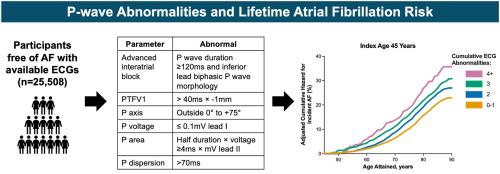
We conducted a pooled analysis of 25,508 participants from 4 prospective cohort studies. P-wave parameters were analyzed on the basis of contemporary consensus criteria, including advanced interatrial block, P-terminal force in V1, P-wave axis, P-wave voltage in lead I, P-wave area in lead II, and P-wave dispersion. Using a modified Kaplan-Meier analysis accounting for competing risks, we calculated lifetime risk of AF stratified by individual and cumulative ECG abnormalities.
Results
During follow-up, AF developed in 2877 participants (11.3%). At index age 45 years, interatrial block showed the strongest association with lifetime AF risk (35.4% vs 23.9%), followed by lead II area (30.0% vs 24.6%) and P-wave dispersion >70 ms (28.8% vs 23.6%). A dose-response relationship was observed with cumulative abnormalities: participants with 0–1 abnormalities had a lifetime risk of 22.9%, increasing to 27.0%, 30.7%, and 35.7% for 2, 3, and 4+ abnormalities, respectively. Participants with 4+ ECG abnormalities lived an average of 17.1 years free of AF compared with 21.7 years for those with none.
Conclusion
Multiple P-wave parameters are associated with increased lifetime risk of AF, with a strong dose-response relationship for cumulative abnormalities. These findings suggest that comprehensive ECG analysis may enhance long-term AF risk assessment.
期刊介绍:
HeartRhythm, the official Journal of the Heart Rhythm Society and the Cardiac Electrophysiology Society, is a unique journal for fundamental discovery and clinical applicability.
HeartRhythm integrates the entire cardiac electrophysiology (EP) community from basic and clinical academic researchers, private practitioners, engineers, allied professionals, industry, and trainees, all of whom are vital and interdependent members of our EP community.
The Heart Rhythm Society is the international leader in science, education, and advocacy for cardiac arrhythmia professionals and patients, and the primary information resource on heart rhythm disorders. Its mission is to improve the care of patients by promoting research, education, and optimal health care policies and standards.



 京公网安备 11010802042870号
京ICP备2023020795号-1
京公网安备 11010802042870号
京ICP备2023020795号-1

 分享
分享
 求助内容:
求助内容: 应助结果提醒方式:
 扫码关注我们
