Junwei Xiang, Hu Zheng, Yuhang Cai, Siyuan Chen, Yuanyin Wang, Ran Chen
{"title":"Cumulative social disadvantage and its impact on long COVID: insights from a U.S. national survey.","authors":"Junwei Xiang, Hu Zheng, Yuhang Cai, Siyuan Chen, Yuanyin Wang, Ran Chen","doi":"10.1186/s12916-025-04039-5","DOIUrl":null,"url":null,"abstract":"<p><strong>Background: </strong>The COVID-19 pandemic has exacerbated health disparities, with long COVID emerging as a major global public health challenge. Although clinical risk factors for long COVID are well-documented, the cumulative burden of adverse social determinants of health (SDoH) remains underexplored. This study aims to investigate the association between cumulative social disadvantage and long COVID.</p><p><strong>Methods: </strong>Using data from the 2022 and 2023 National Health Interview Survey cycles (n = 16,446 U.S.adults), cumulative social disadvantage was quantified through 18 SDoH indicators and categorized into quartiles. The highest quartile represents the most disadvantaged individuals. Long COVID was defined as self-reported symptoms persisting for three months or longer. Weighted logistic regression models were used to examine the association, adjusting for demographic and clinical variables.</p><p><strong>Results: </strong>Adults in the highest quartile of cumulative social disadvantage exhibited an increased odds of experiencing long COVID compared to those in the lowest quartile (AOR = 2.52, 95% Cl: 2.13, 2.98). This association persisted across demographic subgroups, with particularly pronounced effects among women and non-Hispanic Blacks. Hispanics and non-Hispanic Whites showed weaker, but still statistically significant. Key contributors included mental health difficulties, economic instability, and healthcare access barriers. Furthermore, cumulative social disadvantage was linked to fair or poor general health status among individuals with long COVID.</p><p><strong>Conclusions: </strong>This study highlights the positive association between cumulative social disadvantage and long COVID. Addressing systemic inequities through integrated public health strategies is essential to mitigate the burden of long COVID and reduce social disparities in health.</p>","PeriodicalId":9188,"journal":{"name":"BMC Medicine","volume":"23 1","pages":"207"},"PeriodicalIF":8.3000,"publicationDate":"2025-04-07","publicationTypes":"Journal Article","fieldsOfStudy":null,"isOpenAccess":false,"openAccessPdf":"https://www.ncbi.nlm.nih.gov/pmc/articles/PMC11974196/pdf/","citationCount":"0","resultStr":null,"platform":"Semanticscholar","paperid":null,"PeriodicalName":"BMC Medicine","FirstCategoryId":"3","ListUrlMain":"https://doi.org/10.1186/s12916-025-04039-5","RegionNum":1,"RegionCategory":"医学","ArticlePicture":[],"TitleCN":null,"AbstractTextCN":null,"PMCID":null,"EPubDate":"","PubModel":"","JCR":"Q1","JCRName":"MEDICINE, GENERAL & INTERNAL","Score":null,"Total":0}
引用次数: 0
Abstract
Background: The COVID-19 pandemic has exacerbated health disparities, with long COVID emerging as a major global public health challenge. Although clinical risk factors for long COVID are well-documented, the cumulative burden of adverse social determinants of health (SDoH) remains underexplored. This study aims to investigate the association between cumulative social disadvantage and long COVID.
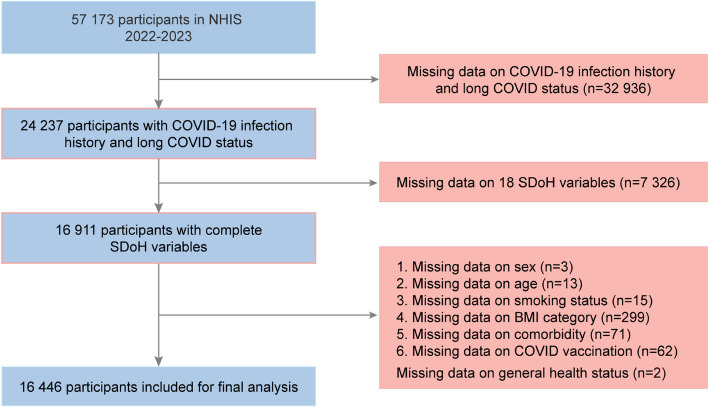
Methods: Using data from the 2022 and 2023 National Health Interview Survey cycles (n = 16,446 U.S.adults), cumulative social disadvantage was quantified through 18 SDoH indicators and categorized into quartiles. The highest quartile represents the most disadvantaged individuals. Long COVID was defined as self-reported symptoms persisting for three months or longer. Weighted logistic regression models were used to examine the association, adjusting for demographic and clinical variables.
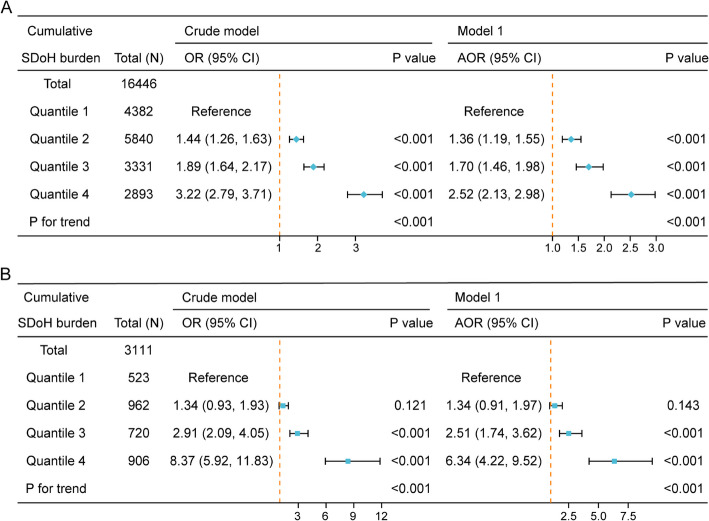
Results: Adults in the highest quartile of cumulative social disadvantage exhibited an increased odds of experiencing long COVID compared to those in the lowest quartile (AOR = 2.52, 95% Cl: 2.13, 2.98). This association persisted across demographic subgroups, with particularly pronounced effects among women and non-Hispanic Blacks. Hispanics and non-Hispanic Whites showed weaker, but still statistically significant. Key contributors included mental health difficulties, economic instability, and healthcare access barriers. Furthermore, cumulative social disadvantage was linked to fair or poor general health status among individuals with long COVID.
Conclusions: This study highlights the positive association between cumulative social disadvantage and long COVID. Addressing systemic inequities through integrated public health strategies is essential to mitigate the burden of long COVID and reduce social disparities in health.
期刊介绍:
BMC Medicine is an open access, transparent peer-reviewed general medical journal. It is the flagship journal of the BMC series and publishes outstanding and influential research in various areas including clinical practice, translational medicine, medical and health advances, public health, global health, policy, and general topics of interest to the biomedical and sociomedical professional communities. In addition to research articles, the journal also publishes stimulating debates, reviews, unique forum articles, and concise tutorials. All articles published in BMC Medicine are included in various databases such as Biological Abstracts, BIOSIS, CAS, Citebase, Current contents, DOAJ, Embase, MEDLINE, PubMed, Science Citation Index Expanded, OAIster, SCImago, Scopus, SOCOLAR, and Zetoc.



 京公网安备 11010802042870号
京ICP备2023020795号-1
京公网安备 11010802042870号
京ICP备2023020795号-1

 分享
分享
 求助内容:
求助内容: 应助结果提醒方式:
 扫码关注我们
