{"title":"Embracing the future: Neonatal screening for epileptic syndromes","authors":"Rima Nabbout, Mathieu Kuchenbuch","doi":"10.1111/epi.18285","DOIUrl":null,"url":null,"abstract":"<p>Since Guthrie's pioneering work in 1963 on phenylketonuria, the spectrum of diseases addressed in neonatal screening programs has broadened. Ethical considerations regarding the conditions qualifying for neonatal screening were raised as early as the 1960s.<span><sup>1, 2</sup></span> In 1968, the World Health Organization established recommendations for identifying disease candidates that could benefit from such an approach.<span><sup>3</sup></span> The main criteria outlined in this report include the importance of the impact of the disease on health, the understanding of its natural history, and the availability of suitable diagnostic tests and of acceptable treatment. In many high-income countries, national committees have been established to determine the diseases candidate to be included in neonatal screening programs.<span><sup>4</sup></span> The number of conditions in newborn screening currently spans from 2 (Bosnia and Herzegovina) to 40 (Italy) in Europe,<span><sup>5</sup></span> and from 33 (Montana and Louisiana) to 74 (Connecticut) in the United States.<span><sup>6</sup></span></p><p>The Advisory Committee on Heritable Disorders in Newborns and Children (ACHDNC) founded in the United States to advise the Secretary of Health and Human Services on this topic developed, in 2006, an instrument to assess the suitability of disorders for inclusion in newborn screening programs (Figure 1).<span><sup>7</sup></span> This score enabled the distinction between high-scoring conditions (e.g., congenital hypothyroidism and galactosemia, scoring at or above 1200), low-scoring conditions (e.g., X-linked adrenoleukodystrophy and fragile X syndrome, scoring below 1000), and a middle group scoring between 1000 and 1199 (e.g., congenital toxoplasmosis and malonic acidemia). Using this score, 29 conditions with high scores were identified for inclusion in the recommended uniform screening panel (RUSP), whereas an additional 25 were selected from the middle group due to their relevance in the differential diagnosis of the core panel conditions.<span><sup>7</sup></span> Progressively, this number increased to include 37 conditions in the core panel and 26 conditions in the secondary panel, that is, “conditions that are part of the differential diagnosis of a core panel condition.”<span><sup>8</sup></span> The inclusion of spinal muscular atrophy (SMA) in this core panel in 2018, mainly due to the revolution of its treatment landscape with the implementation of gene and antisense oligonucleotide (ASO) therapies, marked a significant milestone as it represents one of the first instances of genetic screening being integrated into routine newborn screening programs.</p><p>Recently, patients' advocacy groups and physicians highlighted to the committee that the nomination process for the RUSC is arduous and overlooks major factors valued by the families.<span><sup>9</sup></span> Consequently, the committee has chosen to suspend nominations of new conditions for a period of 6 months (from December 2023 to May 2024) to ensure a consistent and standardized pathway, thereby preventing inconsistencies in the nomination processes. The updated process, introduced in May 2024, simplifies the nominations by implementing a two-step approach, starting with a lighter preliminary form to assess appropriateness before requiring a full nomination package. In addition to reducing the initial burden, the updated process allows an improved review involving different stakeholders and necessitating multidisciplinary consensus validation.<span><sup>10</sup></span> The patients' advocacy groups underscored the extension of the role of neonatal screening, beyond disorders with available cure, to the reduction of diagnostic odyssey, early access to innovative therapies as soon as they become available, and the ability to plan for the child's future needs. However, it is worth noting that, to date, no monogenic epilepsies, mainly no developmental and epileptic encephalopathy (DEE), is included in these various official screening panels.</p><p>We are witnessing a significant shift in the field of epilepsy classification, adding to well-defined electroclinical syndromes a precision classification based on etiologies, particularly for monogenic and metabolic diseases. This shift is supported by the rise of precision medicine and disease-modifying therapies, along with a deeper understanding of the substantial social, societal, and economic impacts of early-onset epilepsies.</p><p>This urges the need to evaluate epilepsies and epileptic syndromes that are strong candidates for neonatal screening or may be close to meeting the inclusion criteria of these screening panels.</p><p>We have chosen to categorize epilepsy and epilepsy syndromes based on the potential impact that neonatal screening may have on the outcomes trajectories of affected individuals. This classification allows for tailoring the screening and treatment strategies according to the specific characteristics of each group, thereby optimizing early intervention.</p><p>The advances in genetics, making genomic sequencing faster (from months to few days) and more affordable (from $1000 to $500 for a genome between 2014 and 2024), have paved the way for genetic newborn screening.<span><sup>58</sup></span> These developments have spurred the initiation of several international genomic newborn screening studies. To date, eight studies<span><sup>59-66</sup></span> have proposed newborn screening gene panels, ranging from 14 to 954 genes (Table 1). The common goal of these studies is to implement and evaluate the utility of genomic sequencing for screening of “actionable” genes in newborn. They also aim to examine the ethical implications and value of utilizing genomic data generated at birth as a lifelong health care asset.</p><p>However, the fact that none of the genes associated with epileptic syndromes appear in all eight panels of neonatal screening highlights the difficulty in constructing these panels. For instance, GLUT1DS, present in 7 out of 8 panels, and pyridox(am)ine 5′-phosphate deficiency (P5PD)-DEE, identified in 6 out of 8, were the most represented syndromes, consistent with our proposition and our estimated score. Despite the market authorization of a precision therapy, cerliponase alpha, for type 2 neuronal ceroid lipofuscinosis (NCL2) giving, is a significant positive impact in presymptomatic individuals,<span><sup>20</sup></span> the search for pathogenic variants in tripeptidyl peptidase 1 gene (<i>TPP1</i>) was only included in half of the neonatal screening panel. Similarly, PD-DEE and <i>TSC</i> genes were excluded from over 50% of the panels. The rationale behind this decision warrants further investigation, acknowledging that this exclusion may also reflect the existence of a separate screening panel for metabolic diseases, including PD-DEE, established in these institutions or regions.</p><p>Finally, the rationale behind the selection of certain genes in the list of neonatal screening panels may be debated. For instance, the inclusion of some progressive myoclonic epilepsies as ceroid lipofuscinosis neuronal 3 gene (<i>CLN3</i>), <i>CLN5</i>, and <i>CLN6</i>, a group of neurodegenerative epilepsy syndromes, characterized by drug-resistant epilepsy, myoclonia with severe neurological prognosis, and early death, may be puzzling because of the lack of available therapies. Lafora-causing genes are also present in the large 928-gene panel, although the trials for this progressive myoclonus epilepsy are only initiating in humans.<span><sup>67</sup></span> Finally, calcium voltage-gated channel subunit alpha1 A gene (<i>CACNA1A</i>), a gene causing a wide range of phenotypes—such as type 2 episodic ataxia, DEEs, including Lennox–Gastaut syndrome (LGS) and EIMFS, as well as familial hemiplegic—presents a significant challenge because of the known high variability of the phenotypes, even within the same family.<span><sup>68-70</sup></span> Furthermore, acetazolamide, a targeted therapy for <i>CACNA1A</i>-related disorders, has shown benefits in some limited cases, but further research is needed.<span><sup>71</sup></span></p><p>In addition to the technical and ethical considerations,<span><sup>58, 72, 73</sup></span> the implementation of a neonatal screening program for epilepsy requires the establishment of a robust infrastructure to ensure timely diagnosis confirmation and intervention. The establishment of dedicated tertiary centers for rare epilepsies with a network of laboratories with expertise in epilepsy genetic testing would be pivotal in providing an effective framework for neonatal screening for epilepsy in France. These centers would facilitate the rapid validation of pathogenic variants, thereby ensuring that newborns receive appropriate therapies through a streamlined care pathway. The readiness of a multidisciplinary team, including pediatric epileptologists, geneticists, psychologists, rehabilitation specialists, and care coordinators and nurses, with the option of national consensus meetings for complex cases, should be established and supported. The work achieved by neuromuscular pediatricians and their existing networks for the care of newborns screened with the survival motor neuron 1(<i>SMN1</i>) pathogenic variant may serve as a valuable model.</p><p>The development of therapies for rare diseases is frequently expensive due to various factors, including the intricate nature of the treatments and the clinical trials, which are often lengthy and costly. This is exemplified by the development of therapies for SMA. It is anticipated that the costs of these therapies will decline over time, with advances in therapy modalities and production pipelines and the development of methodologies in clinical trials adapted for rare diseases with smaller numbers of patients. Therefore, it is imperative that individuals with rare epilepsies who are eligible for targeted therapies (Group 1) do not face delays in access to precision therapies beyond what is currently actionable. Furthermore, delayed treatment exposes patients to the higher costs of managing disease complications frequently affecting neurodevelopment in these disorders. The identification of additional accurate biomarkers will facilitate optimal patient selection, particularly in individuals with epilepsy syndromes that are amenable to emerging precision medicine approaches (Group 2). Once the potential for significant improvements in both quality of life and survival is demonstrated by these therapies, the cost–benefit ratio will favor neonatal screening and early treatment and neonatal screening.</p><p>The severity of several epileptic syndromes and the potential for significant improvement with early therapeutic intervention justify the inclusion of biotinidase deficiency (<i>BTD</i>), folinic acid–responsive seizures related to <i>FOLR1</i> pathogenic variants and holocarboxylase synthetase deficiency (<i>HLCS</i>), PD-DEE (<i>ALDH7A1, PLPBP</i>), P5PD-DEE (<i>PNPO</i>), <i>GLUT1</i>DS (<i>SLC2A1</i>), and PME related to <i>CLN2</i> and TSC (<i>TSC1</i> and <i>TSC2</i>) in neonatal panel screening. In addition, a second group, including some channelopathies (<i>SCN2A</i>, <i>SCN8A</i>, <i>SCN1A</i>, <i>KCNQ2</i>) and PME (NCL 3, NCL 5, NCL 6, Lafora), might warrant inclusion in the neonatal screening panel due to emerging therapies and the potential for early intervention in the presymptomatic period, such as for <i>SCN1A</i>. In this last group, some challenges on the pathogenicity predictioner of the variants detected at birth remain to be resolved.</p><p>Despite the changes proposed by the ACHDNC, the previous scoring system may be a good first step in initiating a consensus proposal within the epilepsy community supported by the International League Against Epilepsy (ILAE) and other partners such as the European Reference Centre for Rare Epilepsies (EpiCARE)<span><sup>74</sup></span> involved in rare and complex epilepsies, emphasizing the roles of the medical and scientific experts, patient advocacy groups, and pharmaceutical industries. This will allow us to propose and update the list of epilepsy syndrome candidates for neonatal screening and their implementation in regional and national initiatives. However, we recognize that access issues for children born in low- and middle-income countries (LMICs) remain unresolved. In this setting, epilepsy diagnosis is often delayed or sometimes missed, and genetic testing is generally not available. However, such recommendations with a consensus list could support increased investments in diagnostic infrastructures to facilitate the diagnosis of rare epilepsy syndromes with actionable genetic etiologies in vulnerable populations. We hope that, with the identification of additional accurate biomarkers, a better understanding of underlying mechanisms, and the development of targeted therapies, other syndromes will be included as candidates for neonatal screening in the future.</p><p>R.N. is supported by the Agence Nationale de la Recherche under “Investissements d'avenir” program (ANR-10-IAHU-01) and Chair Geen-DS funded by FAMA fund hosted by Swiss Philanthropy Foundation. M.K. and R.N. are recipients of a grant managed by the Agence Nationale de la Recherche under the 4th PIA, integrated into France2030, with the reference ANR-23-RHUS-0002 (innov4-epiK).</p><p>The authors declare that the research was conducted in the absence of any commercial or financial relationships that could be construed as a potential conflict of interest. We confirm that we have read the Journal's position on issues involved in ethical publication and affirm that this report is consistent with those guidelines.</p>","PeriodicalId":11768,"journal":{"name":"Epilepsia","volume":"66 6","pages":"1843-1853"},"PeriodicalIF":6.6000,"publicationDate":"2025-04-07","publicationTypes":"Journal Article","fieldsOfStudy":null,"isOpenAccess":false,"openAccessPdf":"https://onlinelibrary.wiley.com/doi/epdf/10.1111/epi.18285","citationCount":"0","resultStr":null,"platform":"Semanticscholar","paperid":null,"PeriodicalName":"Epilepsia","FirstCategoryId":"3","ListUrlMain":"https://onlinelibrary.wiley.com/doi/10.1111/epi.18285","RegionNum":1,"RegionCategory":"医学","ArticlePicture":[],"TitleCN":null,"AbstractTextCN":null,"PMCID":null,"EPubDate":"","PubModel":"","JCR":"Q1","JCRName":"CLINICAL NEUROLOGY","Score":null,"Total":0}
引用次数: 0
Abstract
Since Guthrie's pioneering work in 1963 on phenylketonuria, the spectrum of diseases addressed in neonatal screening programs has broadened. Ethical considerations regarding the conditions qualifying for neonatal screening were raised as early as the 1960s.1, 2 In 1968, the World Health Organization established recommendations for identifying disease candidates that could benefit from such an approach.3 The main criteria outlined in this report include the importance of the impact of the disease on health, the understanding of its natural history, and the availability of suitable diagnostic tests and of acceptable treatment. In many high-income countries, national committees have been established to determine the diseases candidate to be included in neonatal screening programs.4 The number of conditions in newborn screening currently spans from 2 (Bosnia and Herzegovina) to 40 (Italy) in Europe,5 and from 33 (Montana and Louisiana) to 74 (Connecticut) in the United States.6
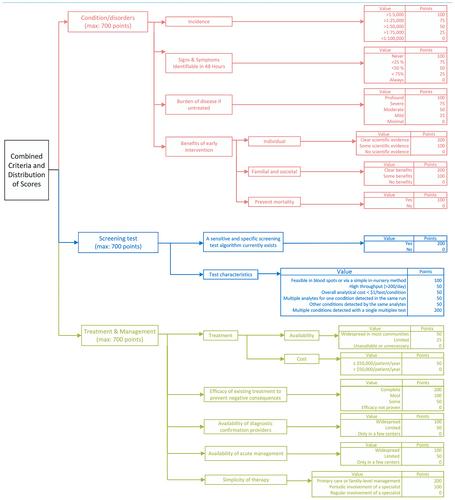
The Advisory Committee on Heritable Disorders in Newborns and Children (ACHDNC) founded in the United States to advise the Secretary of Health and Human Services on this topic developed, in 2006, an instrument to assess the suitability of disorders for inclusion in newborn screening programs (Figure 1).7 This score enabled the distinction between high-scoring conditions (e.g., congenital hypothyroidism and galactosemia, scoring at or above 1200), low-scoring conditions (e.g., X-linked adrenoleukodystrophy and fragile X syndrome, scoring below 1000), and a middle group scoring between 1000 and 1199 (e.g., congenital toxoplasmosis and malonic acidemia). Using this score, 29 conditions with high scores were identified for inclusion in the recommended uniform screening panel (RUSP), whereas an additional 25 were selected from the middle group due to their relevance in the differential diagnosis of the core panel conditions.7 Progressively, this number increased to include 37 conditions in the core panel and 26 conditions in the secondary panel, that is, “conditions that are part of the differential diagnosis of a core panel condition.”8 The inclusion of spinal muscular atrophy (SMA) in this core panel in 2018, mainly due to the revolution of its treatment landscape with the implementation of gene and antisense oligonucleotide (ASO) therapies, marked a significant milestone as it represents one of the first instances of genetic screening being integrated into routine newborn screening programs.
Recently, patients' advocacy groups and physicians highlighted to the committee that the nomination process for the RUSC is arduous and overlooks major factors valued by the families.9 Consequently, the committee has chosen to suspend nominations of new conditions for a period of 6 months (from December 2023 to May 2024) to ensure a consistent and standardized pathway, thereby preventing inconsistencies in the nomination processes. The updated process, introduced in May 2024, simplifies the nominations by implementing a two-step approach, starting with a lighter preliminary form to assess appropriateness before requiring a full nomination package. In addition to reducing the initial burden, the updated process allows an improved review involving different stakeholders and necessitating multidisciplinary consensus validation.10 The patients' advocacy groups underscored the extension of the role of neonatal screening, beyond disorders with available cure, to the reduction of diagnostic odyssey, early access to innovative therapies as soon as they become available, and the ability to plan for the child's future needs. However, it is worth noting that, to date, no monogenic epilepsies, mainly no developmental and epileptic encephalopathy (DEE), is included in these various official screening panels.
We are witnessing a significant shift in the field of epilepsy classification, adding to well-defined electroclinical syndromes a precision classification based on etiologies, particularly for monogenic and metabolic diseases. This shift is supported by the rise of precision medicine and disease-modifying therapies, along with a deeper understanding of the substantial social, societal, and economic impacts of early-onset epilepsies.
This urges the need to evaluate epilepsies and epileptic syndromes that are strong candidates for neonatal screening or may be close to meeting the inclusion criteria of these screening panels.
We have chosen to categorize epilepsy and epilepsy syndromes based on the potential impact that neonatal screening may have on the outcomes trajectories of affected individuals. This classification allows for tailoring the screening and treatment strategies according to the specific characteristics of each group, thereby optimizing early intervention.
The advances in genetics, making genomic sequencing faster (from months to few days) and more affordable (from $1000 to $500 for a genome between 2014 and 2024), have paved the way for genetic newborn screening.58 These developments have spurred the initiation of several international genomic newborn screening studies. To date, eight studies59-66 have proposed newborn screening gene panels, ranging from 14 to 954 genes (Table 1). The common goal of these studies is to implement and evaluate the utility of genomic sequencing for screening of “actionable” genes in newborn. They also aim to examine the ethical implications and value of utilizing genomic data generated at birth as a lifelong health care asset.
However, the fact that none of the genes associated with epileptic syndromes appear in all eight panels of neonatal screening highlights the difficulty in constructing these panels. For instance, GLUT1DS, present in 7 out of 8 panels, and pyridox(am)ine 5′-phosphate deficiency (P5PD)-DEE, identified in 6 out of 8, were the most represented syndromes, consistent with our proposition and our estimated score. Despite the market authorization of a precision therapy, cerliponase alpha, for type 2 neuronal ceroid lipofuscinosis (NCL2) giving, is a significant positive impact in presymptomatic individuals,20 the search for pathogenic variants in tripeptidyl peptidase 1 gene (TPP1) was only included in half of the neonatal screening panel. Similarly, PD-DEE and TSC genes were excluded from over 50% of the panels. The rationale behind this decision warrants further investigation, acknowledging that this exclusion may also reflect the existence of a separate screening panel for metabolic diseases, including PD-DEE, established in these institutions or regions.
Finally, the rationale behind the selection of certain genes in the list of neonatal screening panels may be debated. For instance, the inclusion of some progressive myoclonic epilepsies as ceroid lipofuscinosis neuronal 3 gene (CLN3), CLN5, and CLN6, a group of neurodegenerative epilepsy syndromes, characterized by drug-resistant epilepsy, myoclonia with severe neurological prognosis, and early death, may be puzzling because of the lack of available therapies. Lafora-causing genes are also present in the large 928-gene panel, although the trials for this progressive myoclonus epilepsy are only initiating in humans.67 Finally, calcium voltage-gated channel subunit alpha1 A gene (CACNA1A), a gene causing a wide range of phenotypes—such as type 2 episodic ataxia, DEEs, including Lennox–Gastaut syndrome (LGS) and EIMFS, as well as familial hemiplegic—presents a significant challenge because of the known high variability of the phenotypes, even within the same family.68-70 Furthermore, acetazolamide, a targeted therapy for CACNA1A-related disorders, has shown benefits in some limited cases, but further research is needed.71
In addition to the technical and ethical considerations,58, 72, 73 the implementation of a neonatal screening program for epilepsy requires the establishment of a robust infrastructure to ensure timely diagnosis confirmation and intervention. The establishment of dedicated tertiary centers for rare epilepsies with a network of laboratories with expertise in epilepsy genetic testing would be pivotal in providing an effective framework for neonatal screening for epilepsy in France. These centers would facilitate the rapid validation of pathogenic variants, thereby ensuring that newborns receive appropriate therapies through a streamlined care pathway. The readiness of a multidisciplinary team, including pediatric epileptologists, geneticists, psychologists, rehabilitation specialists, and care coordinators and nurses, with the option of national consensus meetings for complex cases, should be established and supported. The work achieved by neuromuscular pediatricians and their existing networks for the care of newborns screened with the survival motor neuron 1(SMN1) pathogenic variant may serve as a valuable model.
The development of therapies for rare diseases is frequently expensive due to various factors, including the intricate nature of the treatments and the clinical trials, which are often lengthy and costly. This is exemplified by the development of therapies for SMA. It is anticipated that the costs of these therapies will decline over time, with advances in therapy modalities and production pipelines and the development of methodologies in clinical trials adapted for rare diseases with smaller numbers of patients. Therefore, it is imperative that individuals with rare epilepsies who are eligible for targeted therapies (Group 1) do not face delays in access to precision therapies beyond what is currently actionable. Furthermore, delayed treatment exposes patients to the higher costs of managing disease complications frequently affecting neurodevelopment in these disorders. The identification of additional accurate biomarkers will facilitate optimal patient selection, particularly in individuals with epilepsy syndromes that are amenable to emerging precision medicine approaches (Group 2). Once the potential for significant improvements in both quality of life and survival is demonstrated by these therapies, the cost–benefit ratio will favor neonatal screening and early treatment and neonatal screening.
The severity of several epileptic syndromes and the potential for significant improvement with early therapeutic intervention justify the inclusion of biotinidase deficiency (BTD), folinic acid–responsive seizures related to FOLR1 pathogenic variants and holocarboxylase synthetase deficiency (HLCS), PD-DEE (ALDH7A1, PLPBP), P5PD-DEE (PNPO), GLUT1DS (SLC2A1), and PME related to CLN2 and TSC (TSC1 and TSC2) in neonatal panel screening. In addition, a second group, including some channelopathies (SCN2A, SCN8A, SCN1A, KCNQ2) and PME (NCL 3, NCL 5, NCL 6, Lafora), might warrant inclusion in the neonatal screening panel due to emerging therapies and the potential for early intervention in the presymptomatic period, such as for SCN1A. In this last group, some challenges on the pathogenicity predictioner of the variants detected at birth remain to be resolved.
Despite the changes proposed by the ACHDNC, the previous scoring system may be a good first step in initiating a consensus proposal within the epilepsy community supported by the International League Against Epilepsy (ILAE) and other partners such as the European Reference Centre for Rare Epilepsies (EpiCARE)74 involved in rare and complex epilepsies, emphasizing the roles of the medical and scientific experts, patient advocacy groups, and pharmaceutical industries. This will allow us to propose and update the list of epilepsy syndrome candidates for neonatal screening and their implementation in regional and national initiatives. However, we recognize that access issues for children born in low- and middle-income countries (LMICs) remain unresolved. In this setting, epilepsy diagnosis is often delayed or sometimes missed, and genetic testing is generally not available. However, such recommendations with a consensus list could support increased investments in diagnostic infrastructures to facilitate the diagnosis of rare epilepsy syndromes with actionable genetic etiologies in vulnerable populations. We hope that, with the identification of additional accurate biomarkers, a better understanding of underlying mechanisms, and the development of targeted therapies, other syndromes will be included as candidates for neonatal screening in the future.
R.N. is supported by the Agence Nationale de la Recherche under “Investissements d'avenir” program (ANR-10-IAHU-01) and Chair Geen-DS funded by FAMA fund hosted by Swiss Philanthropy Foundation. M.K. and R.N. are recipients of a grant managed by the Agence Nationale de la Recherche under the 4th PIA, integrated into France2030, with the reference ANR-23-RHUS-0002 (innov4-epiK).
The authors declare that the research was conducted in the absence of any commercial or financial relationships that could be construed as a potential conflict of interest. We confirm that we have read the Journal's position on issues involved in ethical publication and affirm that this report is consistent with those guidelines.
期刊介绍:
Epilepsia is the leading, authoritative source for innovative clinical and basic science research for all aspects of epilepsy and seizures. In addition, Epilepsia publishes critical reviews, opinion pieces, and guidelines that foster understanding and aim to improve the diagnosis and treatment of people with seizures and epilepsy.



 京公网安备 11010802042870号
京ICP备2023020795号-1
京公网安备 11010802042870号
京ICP备2023020795号-1

 分享
分享
 求助内容:
求助内容: 应助结果提醒方式:
 扫码关注我们
