Xiaoxiao Liu, Yushuang Luo, Yiyu Huang, Mengfei Li, Ming Guo, Zheyi Dong, Jie Wu, Guangyan Cai, Hanyu Zhu, Kaifa Wang, Xiangmei Chen, Ping Li, Qinggang Li
{"title":"Novel Biomarkers as Non-Invasive Diagnostic Tools in IgA Nephropathy: A Comparative Study with Lupus Nephritis and Membranous Nephropathy.","authors":"Xiaoxiao Liu, Yushuang Luo, Yiyu Huang, Mengfei Li, Ming Guo, Zheyi Dong, Jie Wu, Guangyan Cai, Hanyu Zhu, Kaifa Wang, Xiangmei Chen, Ping Li, Qinggang Li","doi":"10.2147/JIR.S512916","DOIUrl":null,"url":null,"abstract":"<p><strong>Rationale: </strong>The diagnostic value of endothelial-associated biomarkers in IgAN and their ability to differentiate it from other kidney diseases have not yet been clarified.</p><p><strong>Objective: </strong>This study aimed to investigate the diagnostic value of endothelial-associated biomarkers in IgAN patients.</p><p><strong>Methods and results: </strong>This is a cross-sectional study involving 96 participants, with IgAN, LN, MN, and healthy subjects recruited in a 1:1:1:1 ratio. Seventy-five percent of the sample was used for developing a classification model, and the remaining 25% was used for constructing a validation cohort. Plasma levels of 12 endothelial-associated biomarkers were detected using multiplex immunoassay technology. Among all the biomarkers evaluated, VLA-4 and VEGFD were prioritized for distinguishing IgAN from other groups (p<0.001), with 85% classification accuracy. These two biomarkers also showed significant correlation with eGFR (VLA-4: <i>r</i> = - 0.291, <i>P</i> = 0.021; VEGFD: <i>r</i> = - 0.271, <i>P</i> = 0.031) and Gd-IgA1 (VLA-4: <i>r</i> = 0.403, <i>P</i> = 0.003; VEGFD: <i>r</i> = 0.412, <i>P</i> = 0.002). These two biomarkers also showed superior diagnostic efficacy (AUC=0.952 and 0.945) compared to Gd-IgA1 (AUC=0.736). Subgroup analysis of IgAN patients revealed clinically relevant effect sizes for the IgA and IgA/C3 ratios between high- and low-VLA-4 and VEGFD groups, with Hedges' g values of 0.962 and 0.819, respectively. The diagnostic efficacy of VLA-4 and VEGFD levels in IgAN was further validated in an independent cohort comprising 24 participants.</p><p><strong>Conclusion: </strong>VLA-4 and VEGFD emerge as robust, non-invasive biomarkers for IgAN diagnosis and may play significant roles in the pathogenesis of IgAN.</p>","PeriodicalId":16107,"journal":{"name":"Journal of Inflammation Research","volume":"18 ","pages":"4627-4639"},"PeriodicalIF":4.1000,"publicationDate":"2025-04-02","publicationTypes":"Journal Article","fieldsOfStudy":null,"isOpenAccess":false,"openAccessPdf":"https://www.ncbi.nlm.nih.gov/pmc/articles/PMC11972577/pdf/","citationCount":"0","resultStr":null,"platform":"Semanticscholar","paperid":null,"PeriodicalName":"Journal of Inflammation Research","FirstCategoryId":"3","ListUrlMain":"https://doi.org/10.2147/JIR.S512916","RegionNum":2,"RegionCategory":"医学","ArticlePicture":[],"TitleCN":null,"AbstractTextCN":null,"PMCID":null,"EPubDate":"2025/1/1 0:00:00","PubModel":"eCollection","JCR":"Q2","JCRName":"IMMUNOLOGY","Score":null,"Total":0}
引用次数: 0
Abstract
Rationale: The diagnostic value of endothelial-associated biomarkers in IgAN and their ability to differentiate it from other kidney diseases have not yet been clarified.
Objective: This study aimed to investigate the diagnostic value of endothelial-associated biomarkers in IgAN patients.
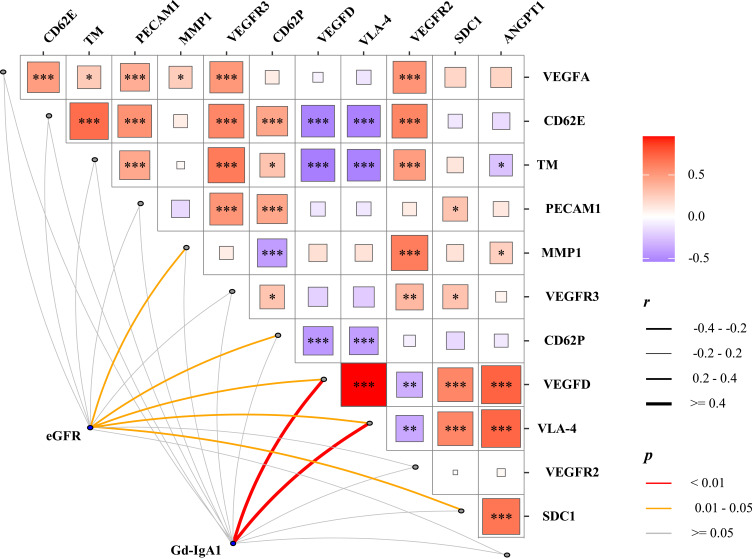
Methods and results: This is a cross-sectional study involving 96 participants, with IgAN, LN, MN, and healthy subjects recruited in a 1:1:1:1 ratio. Seventy-five percent of the sample was used for developing a classification model, and the remaining 25% was used for constructing a validation cohort. Plasma levels of 12 endothelial-associated biomarkers were detected using multiplex immunoassay technology. Among all the biomarkers evaluated, VLA-4 and VEGFD were prioritized for distinguishing IgAN from other groups (p<0.001), with 85% classification accuracy. These two biomarkers also showed significant correlation with eGFR (VLA-4: r = - 0.291, P = 0.021; VEGFD: r = - 0.271, P = 0.031) and Gd-IgA1 (VLA-4: r = 0.403, P = 0.003; VEGFD: r = 0.412, P = 0.002). These two biomarkers also showed superior diagnostic efficacy (AUC=0.952 and 0.945) compared to Gd-IgA1 (AUC=0.736). Subgroup analysis of IgAN patients revealed clinically relevant effect sizes for the IgA and IgA/C3 ratios between high- and low-VLA-4 and VEGFD groups, with Hedges' g values of 0.962 and 0.819, respectively. The diagnostic efficacy of VLA-4 and VEGFD levels in IgAN was further validated in an independent cohort comprising 24 participants.
Conclusion: VLA-4 and VEGFD emerge as robust, non-invasive biomarkers for IgAN diagnosis and may play significant roles in the pathogenesis of IgAN.
理由:内皮相关生物标志物在IgAN中的诊断价值及其与其他肾脏疾病的区分能力尚未明确。目的:探讨内皮相关生物标志物在IgAN患者中的诊断价值。方法和结果:这是一项涉及96名参与者的横断面研究,IgAN、LN、MN和健康受试者按1:1:1:1的比例招募。75%的样本用于开发分类模型,其余25%用于构建验证队列。使用多重免疫分析技术检测12种内皮相关生物标志物的血浆水平。在所有评估的生物标志物中,VLA-4和VEGFD是区分IgAN与其他组的优先选择(pr = - 0.291, P = 0.021;VEGFD: r = - 0.271, P = 0.031)、Gd-IgA1 (vra -4: r = 0.403, P = 0.003;VEGFD: r = 0.412, P = 0.002)。与Gd-IgA1 (AUC=0.736)相比,这两种生物标志物的诊断效果也更佳(AUC=0.952和0.945)。IgAN患者的亚组分析显示,高、低vas -4和VEGFD组之间IgA和IgA/C3比值的临床相关效应量,Hedges' g值分别为0.962和0.819。在一个包括24名参与者的独立队列中,进一步验证了IgAN中vla4和VEGFD水平的诊断功效。结论:vas -4和vegf是诊断IgAN的有力的、无创的生物标志物,可能在IgAN的发病机制中发挥重要作用。
期刊介绍:
An international, peer-reviewed, open access, online journal that welcomes laboratory and clinical findings on the molecular basis, cell biology and pharmacology of inflammation.






 京公网安备 11010802042870号
京ICP备2023020795号-1
京公网安备 11010802042870号
京ICP备2023020795号-1

 分享
分享
 求助内容:
求助内容: 应助结果提醒方式:
 扫码关注我们
